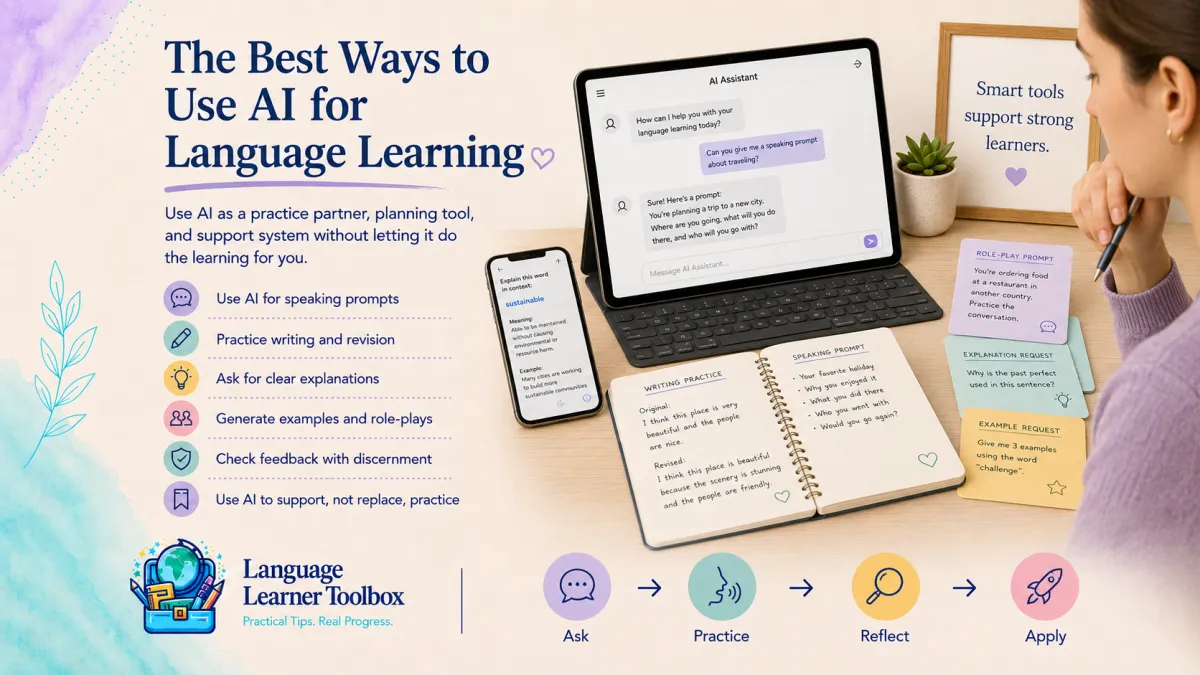
The Best Ways to Use AI for Language Learning
Use AI to personalize practice, prepare for real conversations, and get helpful feedback without letting it do the learning for you.
Many language learners open an AI tool and type something like:
Help me learn Spanish.
Or:
Teach me French.
The response may be helpful.
But it is usually broad.
A vocabulary list.
A grammar explanation.
A study plan that could belong to almost anyone.
Other learners use AI to translate everything, rewrite their work, or give them the answer before they have a chance to think.
They get a polished result.
But not always much practice.
The problem is not the tool.
It is knowing what role to give it.
AI works best when it helps you:
Practice.
Prepare.
Understand.
Notice patterns.
Reflect.
It is less helpful when it replaces the listening, reading, speaking, writing, and thinking that help you learn.
The goal is not to make AI do more.
The goal is to use it in ways that help you do more with the language.
1. Tell AI What Kind of Learner You Are
A better response usually begins with a better request.
Before asking for an activity, give AI a little context.
Include:
the language you are learning
your approximate level
your current goal
the type of practice you want
how you want feedback
Instead of:
Help me practice Italian.
Try:
I am an intermediate Italian learner. My goal is to feel more comfortable in everyday conversations. Ask me one question at a time, keep your responses short, and correct only mistakes that affect meaning.
Those details help AI adjust the difficulty and focus.
You can also ask:
Use more common vocabulary.
Make the questions easier.
Give me time to answer before correcting me.
Explain corrections in simple English.
You do not need to write a complicated prompt.
You need to make the goal clear.
2. Practice Conversations With Less Pressure
AI can give you a place to practice before speaking with another person.
You might talk about:
your weekend
family
work
travel
hobbies
food
current goals
Try:
Have a friendly conversation with me in Spanish about weekend plans. Ask one question at a time. Use language appropriate for an advanced beginner.
Then answer in the target language.
Do not worry about creating perfect responses.
Practice finding words.
Adding details.
Asking a question back.
Continuing after a mistake.
You can also ask AI to help you improve one response:
Show me one way to make my answer clearer, but keep the language close to my level.
This kind of practice can help you prepare for real conversations without replacing them.
AI can give you repetition.
A tutor, teacher, or conversation partner gives you the experience of communicating with another person.
Both can be useful.
3. Prepare for Conversations You May Actually Have
Language practice becomes more meaningful when it connects to real life.
Think about situations where you may need the language.
Maybe you are preparing to:
order at a restaurant
check into a hotel
meet a new coworker
speak with a child’s teacher
make an appointment
ask for directions
visit family
make small talk
Try:
Help me practice checking into a hotel in French. You are the hotel employee. Keep the conversation realistic and use language appropriate for an advanced beginner.
Afterward, ask:
What are three useful phrases from this conversation that I should practice again?
You can also prepare before meeting a tutor or conversation partner.
For example:
I am going to talk about childhood memories. Give me five questions I may be asked and eight useful words that could help me answer.
Preparation gives you a place to begin.
It does not remove every pause or mistake.
It makes the conversation more familiar before it happens.
4. Turn Vocabulary Into Language You Can Use
AI can create vocabulary lists quickly.
But collecting more words is not always what learners need.
Words become more useful when you see them in context and practice using them.
Instead of:
Give me twenty travel words.
Try:
Give me eight useful Spanish words for talking about weekend travel. Include one simple example sentence for each.
Then continue:
Ask me to use each word in a sentence. Give me one word at a time.
Or:
Create a short conversation using these words.
The goal is not only to recognize vocabulary.
It is to retrieve it when you want to communicate.
You can use AI to help you move through several steps:
Learn the word.
See it in a sentence.
Use it yourself.
Review it later.
Use it in conversation.
That turns a vocabulary list into practice.
And it is another reminder that more things count as language practice than you may think.
5. Get Feedback Without Losing Your Own Voice
AI can be useful for writing feedback.
But there is a difference between receiving help and having the work replaced.
If you ask:
Make this better.
AI may rewrite the entire paragraph.
The new version may sound polished.
But you may not understand what changed.
Try:
Read this paragraph in German. First, tell me what I communicated clearly. Then explain the three most important corrections. Do not rewrite the entire paragraph.
You can also say:
Keep my original voice.
Correct only mistakes that make the meaning unclear.
Help me improve one sentence at a time.
Explain why the correction is needed.
This keeps you involved in the learning.
You see your patterns.
You make decisions.
You revise your own work.
The goal is not to sound like AI.
The goal is to become more able to express your own ideas.
6. Make Difficult Material Easier to Work With
Sometimes a reading passage, grammar explanation, or listening activity feels too difficult.
AI can help create a bridge.
For reading, try:
Rewrite this article for an intermediate English learner. Keep the important ideas, but use shorter sentences and more common vocabulary.
Then compare the easier version with the original.
Ask:
Which useful phrases from the original should I learn?
For grammar, try:
Explain the difference between the Spanish preterite and imperfect using everyday examples. Avoid technical grammar terms when possible.
Then:
Give me five short examples and ask me to choose which tense fits.
AI can explain the same idea in several ways.
That can be helpful when a textbook explanation does not make sense.
But remember that AI can make mistakes.
If an explanation seems unusual or conflicts with a trusted teacher, dictionary, textbook, or reference source, check it.
Use AI as a helpful coach.
Not as the final authority on every language question.
7. Create Practice Around Your Real Life
One of AI’s biggest strengths is personalization.
You can create practice connected to your:
Work.
Interests.
Travel.
Family.
Daily routines.
For example:
I work in a school office and I am learning Spanish. Give me ten useful phrases I might use with parents and students.
Or:
I enjoy gardening. Write a short intermediate French reading about planting vegetables, followed by five comprehension questions.
Or:
I am traveling to Japan. Help me practice asking for help at a train station.
Personal practice is often easier to remember because the language has a reason to matter.
You are not learning random sentences.
You are preparing to talk about your life.
8. Use AI to Choose a Clear Next Step
AI can help you organize practice.
But be careful.
A detailed thirty-day study plan may look impressive and still be difficult to follow.
Ask for something realistic.
For example:
I am an intermediate Italian learner. Conversation is my main goal. I have fifteen minutes on weekdays and thirty minutes on Saturday. Create a simple one-week plan using listening, vocabulary, and speaking practice.
Then add:
Give me a five-minute backup option for busy days.
A useful plan should help you begin.
It should not give you another long list to manage.
You can also use AI for reflection.
Try:
Ask me five questions about my language practice this week. Help me notice one improvement, identify one challenge, and choose one realistic focus for next week.
This can support a simple weekly language-learning reflection and help you decide what to practice each day.
Let AI Support the Learning
AI can create activities in seconds.
That does not mean you need more activities.
Most learners already have plenty of things they could study.
What they need is practice that fits their goals.
Use AI to:
Prepare for a conversation.
Practice finding words.
Understand a difficult idea.
Get useful feedback.
Connect learning to real life.
Notice what to work on next.
But keep doing the parts that build ability.
Listen.
Read.
Think.
Write.
Speak.
Try again.
AI should make meaningful practice easier to access.
It should not remove the practice.
Try This
Choose one real language goal you have this week.
Ask AI for one activity connected to that goal and your current level.
Tell it how you want feedback before you begin.
Remember This
AI is most useful when it helps you practice, prepare, understand, and reflect.
It becomes less useful when it does the thinking, writing, or speaking for you.
Use AI to create better practice, not to avoid the practice that builds real skill.
Ready for Your Next Step?
The Learning Tools & Resources page brings together practical guides for choosing and using language-learning support with more purpose.
If you want to use AI more effectively, focus on one clear goal at a time: prepare for a conversation, review vocabulary in context, get focused feedback, simplify difficult material, or reflect on what to practice next.
If consistency is the bigger challenge, the 21-Day Language Habit Bootcamp offers one practical step each day to help you build a routine and keep using the tools you choose.

