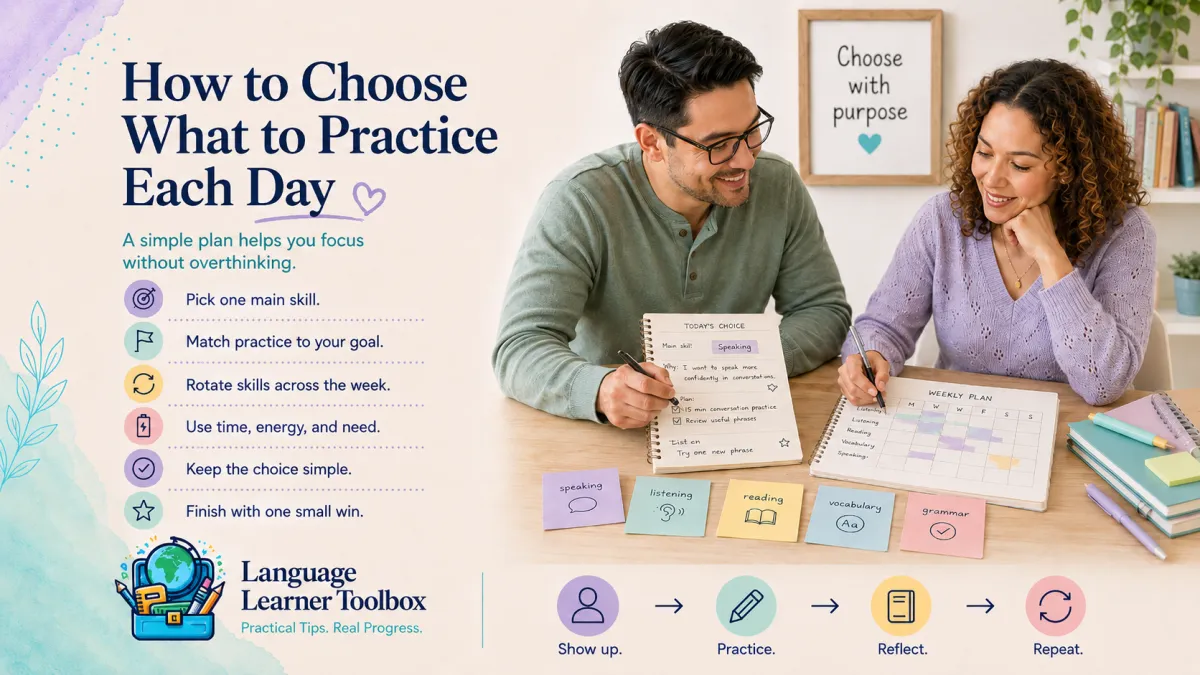
How to Choose What to Practice Each Day
Create a simple plan so you can spend less time deciding and more time learning.
Many language learners sit down to practice and immediately face a problem.
What should I work on today?
Vocabulary?
Listening?
Grammar?
Speaking?
Reading?
There are so many possibilities that choosing can become its own project.
Sometimes learners spend more time looking for the right activity than actually practicing.
Other times, they choose whatever feels easiest and wonder why they are not making progress in the areas that matter most.
The goal is not to practice everything every day.
The goal is to choose one useful focus and begin.
A simple plan can help you make that decision without overthinking it.
1. Start With Your Current Goal
Before choosing an activity, ask:
What do I want to become more comfortable doing?
Maybe you want to:
understand everyday conversations
speak with less hesitation
remember more useful vocabulary
read more confidently
improve pronunciation
prepare for a conversation, class, or trip
Your goal gives direction to your practice.
If you want to understand spoken language more easily, listening may need more attention.
If you want to speak with confidence, you need opportunities to produce language, not only study it.
If you want to remember vocabulary, review and use may be more helpful than adding another long list of new words.
The activity should support the goal.
You do not need the perfect choice.
You need a choice that moves you in the right direction.
2. Choose One Main Skill
Trying to practice every skill in one short session can make learning feel scattered.
Instead, choose one main focus.
Today might be:
Listening day.
Speaking day.
Vocabulary day.
Reading day.
Grammar review day.
You may naturally use more than one skill during the activity.
Listening to a short story may also help you notice vocabulary.
Writing a response may help you prepare for speaking.
Reading aloud may support pronunciation.
That is fine.
Choose one main purpose, then let the other skills support it.
If you are still deciding whether a short activity is worthwhile, remember that more things count as language practice than you may think.
3. Match the Activity to the Time You Have
Not every day gives you the same amount of time.
Your practice can change without disappearing.
If you have five minutes:
review five useful phrases
describe something you see
listen to one short clip
read one paragraph
answer one conversation question
If you have fifteen minutes:
listen to a short recording twice
review vocabulary and use it in sentences
practice speaking about one familiar topic
read a short article and summarize the main idea
If you have more time:
complete a lesson
have a conversation
combine listening with speaking or writing
review what you learned during the week
A shorter session is not a lesser session.
Choose an activity that fits the time you actually have.
This makes it easier to stay consistent even on busy days instead of waiting for a large block of time.
4. Consider Your Energy
Time is not the only thing that changes.
Energy changes too.
Some days, you are ready for a challenging conversation or a new grammar concept.
Other days, you may be tired.
That does not mean you have to skip practice.
Choose a lighter activity.
Listen to something familiar.
Review old vocabulary.
Read a short passage.
Repeat useful phrases.
Watch a short video with subtitles.
Low-energy practice can still keep you connected to the language.
The important question is not:
What would the ideal learner do today?
Ask:
What can I do well with the time and energy I have?
A realistic choice makes it easier to build a language routine that fits your life.
5. Rotate Skills Across the Week
You do not need to include every skill every day.
A simple weekly rhythm can create balance.
For example:
Monday: vocabulary
Tuesday: listening
Wednesday: speaking
Thursday: reading
Friday: review
Your schedule does not need to look like this.
You might practice speaking several times a week because that is your main goal.
You may combine reading and vocabulary.
You may spend more time listening because that skill feels difficult.
The purpose of a weekly plan is not to create more rules.
It is to help you remember what matters.
A simple rotation also reduces daily decision-making.
You already know what kind of practice comes next.
6. Let Reflection Guide the Next Choice
Sometimes the best practice idea comes from what happened yesterday.
Ask:
What felt difficult?
What word did I need but could not remember?
What did I understand more easily?
What would I like to try again?
If you had trouble following a conversation, choose a short listening activity.
If you could not explain an idea, practice the vocabulary you needed.
If a phrase felt useful, review it and use it again.
Reflection helps practice become more intentional.
It also keeps you from changing plans every time you find a new app, resource, or study idea.
Your own learning can show you what to do next.
A simple weekly language-learning reflection can help you notice patterns and make better choices over time.
You Do Not Have to Practice Everything Today
Language learning includes many skills.
That does not mean every practice session needs to include all of them.
Choose one useful focus.
Match it to your goal.
Fit it into the time and energy you have.
Then begin.
A clear next step is often more valuable than a perfect plan.
Try This
Choose one language goal that matters to you right now.
Pick one activity that supports that goal.
Decide what a five-minute version of that activity would look like.
Remember This
You do not need to practice every skill every day.
Choose one main focus and let the activity support your current goal.
Match practice to the time and energy you actually have.
A simple weekly rhythm can reduce decision fatigue.
Reflection can help you choose what to practice next.
Continue Reading
What Counts as Language Practice? More Than You Think
How to Build a Language Routine That Fits Your Life
A Simple Weekly Language-Learning Reflection
Ready for Your Next Step?
Join the 21-Day Language Habit Bootcamp for simple daily guidance.
When speaking is one of your goals,The Language Learner’s Workbook: A Guide for Conversation Practice gives you structured topics, questions, vocabulary, and activities so you always have a clear place to begin.

