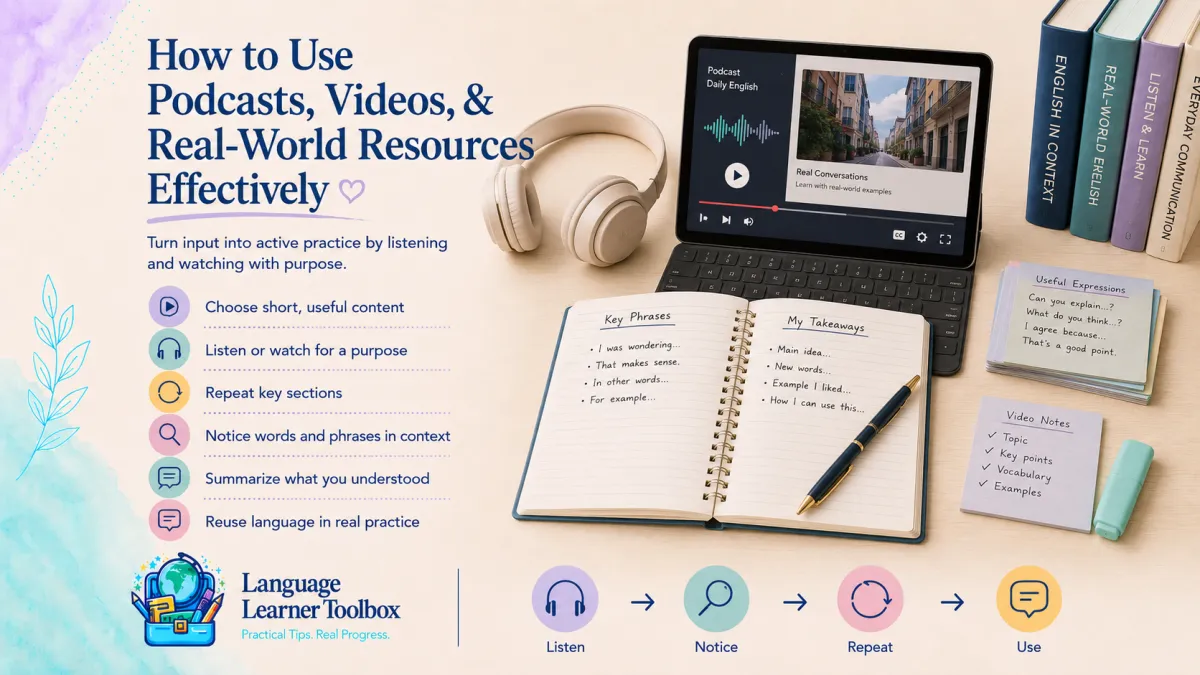
How to Use Podcasts, Videos, and Real-World Resources Effectly
Podcasts, videos, interviews, television programs, music, news clips, social media, and other real-world resources can make language learning more interesting and practical.
They expose you to natural voices, everyday vocabulary, cultural references, different accents, and the way people actually communicate.
They can also become passive background noise.
You may listen for twenty minutes, understand a few words, and finish without knowing what you practiced. You may pause every sentence to look something up, become frustrated, and give up. Or you may choose material that is so difficult that the experience feels more like guessing than learning.
The resource is not enough by itself.
What matters is how you use it.
Effective real-world practice usually includes four steps:
Prepare before you begin.
Listen or watch with a clear purpose.
Notice a small amount of useful language.
Use or review what you learned afterward.
The goal is not to understand every word.
The goal is to understand more, notice useful language, and become better prepared for real communication.
Begin With a Clear Purpose
Before pressing play, decide what you want to practice.
Your purpose might be:
understand the main idea
listen for specific details
become more comfortable with natural speed
notice pronunciation and rhythm
learn vocabulary connected to one topic
identify useful conversational phrases
practice summarizing
hear different accents
prepare for a real-life situation
improve your ability to follow longer speech
A clear purpose changes the activity.
Without one, you may simply watch or listen.
With one, you know what to pay attention to.
For example:
I will listen for the speaker’s three main recommendations.
Or:
I will notice how the speakers ask follow-up questions.
Or:
I will choose five phrases I could use when talking about travel.
One focused goal is enough.
Choose Material That Matches Your Level
Real-world language can be challenging because speakers may:
talk quickly
connect words
use slang
change topics
interrupt each other
refer to cultural knowledge
use unfamiliar accents
leave sentences unfinished
The resource should stretch your ability without making understanding nearly impossible.
A resource may be too difficult if:
you cannot identify the topic
nearly every sentence contains unfamiliar language
you depend completely on translation
you cannot follow the speaker even after several attempts
the activity creates more frustration than useful effort
A resource may be too easy if:
you understand everything immediately
you rarely notice anything new
you do not need to concentrate
it does not support your current goal
Look for material where you can understand the general direction while still encountering some challenge.
You do not need to understand a specific percentage. You need enough understanding to stay oriented and enough difficulty to learn something.
Start With Short Sections
Long videos and podcast episodes can be useful, but they are difficult to study closely.
Begin with:
one short clip
two or three minutes of audio
one scene
one interview question
one short news segment
one section of a podcast
one social media video
one song verse or chorus
A short section allows you to listen more than once without becoming overwhelmed.
You can always continue later.
Ten focused minutes with a short clip may create more learning than an hour of distracted listening.
Choose Topics You Already Understand
Background knowledge makes real-world language easier to follow.
If you already know something about:
cooking
sports
gardening
health
education
travel
technology
history
parenting
business
entertainment
you can use that knowledge to predict meaning.
You may recognize the situation even when you miss individual words.
This does not mean you should avoid unfamiliar topics forever.
It means familiar subjects can help you build listening confidence before adding more difficulty.
Decide Whether You Are Practicing or Relaxing
Watching a program for enjoyment is valuable exposure.
It does not need to become a lesson every time.
However, it helps to know which mode you are in.
Relaxed exposure
You watch or listen for enjoyment and general familiarity.
You may:
follow the main idea
notice a few familiar words
keep the resource playing
avoid frequent pauses
accept partial understanding
Focused practice
You use a short section intentionally.
You may:
preview the topic
listen more than once
take notes
use captions or a transcript
look up selected phrases
summarize afterward
repeat useful language
Both modes have value.
The problem comes when you expect the results of focused practice while giving the activity only background attention.
Prepare Before Listening or Watching
A small amount of preparation can improve comprehension.
Before beginning, look at:
the title
the description
the thumbnail
the speaker
the topic
key images
section headings
available transcript
a short summary
Then predict:
What will this be about?
What words might appear?
What questions might be answered?
What do I already know about the topic?
You might write down five likely words or phrases.
For a video about airport travel, you might predict:
boarding pass
luggage
security
departure gate
delayed flight
Prediction prepares your brain to recognize language more quickly.
Listen Once for the Main Idea
On the first listen, avoid stopping for every unfamiliar word.
Focus on the larger message.
Ask:
Who is speaking?
What is the topic?
What is happening?
What is the speaker trying to explain?
Is the tone serious, humorous, frustrated, or excited?
What are the main points?
You may understand the message even when some vocabulary is missing.
This first listen builds the habit of staying with real communication instead of abandoning it when one word is unclear.
Listen Again for Details
On the second listen, choose something more specific.
You might listen for:
names
times
places
reasons
examples
opinions
steps
problems and solutions
repeated words
transitions between ideas
Write only brief notes.
Do not try to copy every sentence.
Your notes might include:
three key ideas
five useful words
one surprising detail
one question
one phrase to review
The goal is to support understanding, not create a complete transcript.
Use Captions and Transcripts Strategically
Captions can make difficult material more accessible.
They can also cause you to read instead of listen.
Try using them in stages.
First attempt
Listen without captions and identify the main idea.
Second attempt
Turn on captions in the language you are learning.
Check what you missed and connect the written and spoken forms.
Third attempt
Listen again without captions.
Notice whether the speech is easier to follow.
Captions in your first language can help when the material is far above your level, but they often shift attention away from the language you are learning.
Use them when necessary, then return to the original language.
Do Not Pause for Every Unknown Word
Constantly pausing can break the flow of listening.
Not every unfamiliar word needs immediate attention.
Continue when:
you understand the general idea
the word appears only once
the visual context provides enough meaning
the word is not important to your goal
stopping would interrupt useful practice
Pause or look something up when:
the word is central to the message
it appears repeatedly
it prevents understanding
it seems useful for your life
you want to use it yourself
it is part of a repeated phrase
Choose a small number of useful items.
Three well-practiced phrases are more valuable than twenty words copied quickly.
Notice Phrases, Not Only Words
Real communication is built from useful groups of words.
Instead of recording only:
recommend
notice:
I would recommend...
I highly recommend...
What would you recommend?
It comes highly recommended.
Instead of recording:
opinion
notice:
In my opinion...
What is your opinion on...?
I have a different opinion.
I am still forming an opinion.
Phrases help you speak more naturally because they provide ready-made patterns.
Pay Attention to How Speakers Organize Ideas
Real-world resources can teach you more than vocabulary.
Notice how speakers:
begin an explanation
introduce an example
change topics
disagree politely
clarify meaning
add details
tell stories
summarize
ask follow-up questions
repair misunderstandings
Useful phrases might include:
The main reason is...
For example...
What I mean is...
On the other hand...
That reminds me of...
Let me explain...
The point is...
In other words...
These phrases help you organize your own speaking and writing.
Notice Pronunciation in Context
Words often sound different in natural speech than they do when pronounced alone.
Listen for:
connected words
reduced sounds
stressed words
rhythm
pauses
rising and falling intonation
repeated pronunciation patterns
Choose one short sentence and listen several times.
Then:
Read it.
Listen again.
Repeat with the speaker.
Record yourself.
Compare the rhythm and stress.
You do not need to imitate every feature perfectly.
The goal is to improve recognition and clarity.
Try Shadowing Short Sections
Shadowing means speaking along with or immediately after the speaker.
Use a very short section.
You might:
Listen once.
Read the transcript.
Mark stressed words.
Play one sentence.
Repeat it.
Play it again and speak along.
Record yourself.
Shadowing can help with:
rhythm
connected speech
pronunciation
fluency
confidence
listening speed
Do not use a long section at first.
One or two sentences are enough.
Use Videos for Visual Support
Video gives you information that audio alone does not provide.
You can use:
facial expressions
gestures
objects
setting
actions
diagrams
text on the screen
changes in tone
These clues support comprehension.
Before using captions, try watching once with the sound and visuals together.
Then ask:
What did the visuals help me understand?
What emotion or attitude did I notice?
Which words matched the actions?
What could I explain even without every sentence?
Visual support is especially helpful for beginners and for unfamiliar topics.
Use Podcasts to Build Listening Stamina
Podcasts require you to follow meaning without visual help.
That can make them more challenging and valuable.
Begin with:
short episodes
familiar topics
one or two speakers
clear sound quality
available transcripts
predictable formats
You do not have to study the entire episode closely.
You might:
listen to the first five minutes
choose one section to repeat
summarize one main idea
collect three useful phrases
listen again later while walking or driving
Over time, gradually increase the length.
Use Interviews to Practice Questions and Answers
Interviews are especially useful for conversation practice.
Notice:
how the interviewer introduces the topic
how questions are formed
how the speaker begins an answer
how follow-up questions develop the topic
how the speaker gives examples
how opinions are softened or strengthened
After listening, answer the same questions yourself.
For example:
What motivated you to begin?
What was the most difficult part?
What advice would you give someone else?
This turns listening into speaking practice.
Use News Carefully
News can provide current topics and clear structure.
It may also include:
specialized vocabulary
fast delivery
assumed background knowledge
names and places
formal language
emotionally difficult content
Choose short segments and topics you already understand.
Focus on:
the main event
who was involved
where it happened
why it matters
what may happen next
Then summarize the story in simple language.
Do not try to copy the broadcaster’s level of detail.
Use Social Media Selectively
Short-form videos can offer:
conversational language
everyday pronunciation
cultural references
humor
practical demonstrations
repeated phrases
They can also contain:
incorrect captions
exaggerated claims
highly informal language
slang
regional expressions
poor explanations
distracting content
Use short videos as examples, not as your only source of instruction.
When a phrase seems useful, confirm its meaning and tone before using it in an important situation.
Use Movies and Television in Manageable Ways
A full episode may be too long for focused practice.
Choose:
one scene
one conversation
one recurring character
one type of situation
one short exchange
You might study a scene by:
Watching without captions.
Describing what happened.
Watching with captions.
Choosing useful phrases.
Repeating one short exchange.
Retelling the scene.
Imagining a similar conversation from your life.
This keeps entertainment enjoyable while creating practical learning.
Use Music for Sound and Memory
Songs can support:
pronunciation
rhythm
repeated phrases
vocabulary
cultural familiarity
memory
However, lyrics may include:
unusual word order
poetic language
incomplete sentences
slang
stretched pronunciation
metaphors
outdated expressions
Enjoy the music, but do not assume every lyric is a model for everyday speech.
Choose a few understandable phrases and check how they are used outside the song.
Summarize What You Understood
After listening or watching, explain the content in your own words.
You can summarize:
aloud
in writing
to a tutor
to a conversation partner
in a voice recording
with AI feedback
Use simple language.
A summary might include:
the main topic
two important points
one example
your opinion
one question
Summarizing reveals what you understood and gives you active speaking or writing practice.
Retell Instead of Repeating Exactly
You do not need to reproduce the speaker’s words.
Retelling helps you organize meaning using the language available to you.
For example:
The speaker explained three ways to save time. First, she said to plan the night before. Then she suggested grouping similar tasks. Finally, she recommended turning off notifications.
Your version may be simpler than the original.
That is fine.
The goal is to communicate the message clearly.
Ask and Answer Questions
Create questions from the resource.
You might ask:
What was the main idea?
Why did the speaker do that?
What happened next?
Do I agree?
Have I experienced something similar?
What would I do in that situation?
What advice would I give?
What information was missing?
Then answer aloud.
This moves the activity beyond comprehension into conversation.
Connect the Topic to Your Life
Personal connection strengthens memory.
After watching or listening, ask:
How does this relate to my experience?
Do I agree with the speaker?
What would be different in my community?
Have I faced a similar problem?
What would I recommend?
What story could I tell about this topic?
The resource becomes a starting point for meaningful language rather than an isolated exercise.
Reuse the Vocabulary Quickly
Choose two or three phrases and use them the same day.
You might:
write a short paragraph
answer a question
record a voice message
use them with a tutor
add them to a vocabulary notebook
include them in a conversation
create a new example
New language becomes more memorable when it is used soon after you notice it.
Build a Simple Practice Sequence
A useful sequence might look like this:
Prepare
Preview the title and predict vocabulary.
Listen or Watch
Focus on the main idea.
Repeat
Listen again for details.
Notice
Choose a few useful phrases.
Use
Summarize, answer questions, or speak about the topic.
Review
Return to the phrases later.
This process can take ten minutes or thirty minutes.
Adjust it to your schedule.
Create a Five-Minute Version
On a busy day:
Choose a one-minute clip.
Listen once.
Write the main idea.
Choose one phrase.
Say one original sentence with it.
That still counts as purposeful practice.
Create a Fifteen-Minute Version
Preview the topic.
Listen or watch once.
Listen again with captions or a transcript.
Choose three phrases.
Summarize aloud.
Save one next step.
Create a Longer Practice Session
For a deeper session:
Preview the topic.
Predict vocabulary.
Listen without support.
Take brief notes.
Listen with captions or transcript.
Check important phrases.
practice pronunciation.
Summarize.
Answer personal questions.
Review later.
You do not need the longer version every time.
Repeat the Same Resource
Many learners constantly search for new material.
Repeating a useful resource can be more valuable.
On the first listen, you may understand the topic.
On the second, you notice details.
On the third, you hear phrases and pronunciation.
On the fourth, you can summarize more easily.
Repetition makes natural speech feel less overwhelming.
Track Improvement
Use the same short clip more than once over several days.
Notice whether you can:
understand more without captions
identify more details
follow the speaker’s speed
recognize phrases
summarize more clearly
repeat sentences more naturally
use the vocabulary yourself
This gives you visible evidence of progress.
Avoid Turning Every Resource Into Homework
Real-world language should remain interesting.
You do not need to analyze everything you enjoy.
Choose a small portion for focused practice and allow the rest to be exposure.
For example:
study five minutes closely
enjoy the remaining episode normally
This balance supports both learning and motivation.
Use One Main Source for a While
Constantly changing sources can make practice scattered.
Try using one podcast, channel, series, or speaker for several weeks.
Familiarity helps because you begin to recognize:
recurring topics
speaking style
common vocabulary
format
pronunciation
repeated phrases
Once that source becomes easier, add variety.
Build Variety Gradually
Eventually, use different:
speakers
accents
ages
regions
topics
formats
levels of formality
Real communication does not sound the same every time.
Variety prepares you to understand more people.
Add one kind of difficulty at a time.
For example, keep the topic familiar while trying a new accent.
Know When a Resource Is Not Helping
A resource may not be a good fit if:
you rarely understand the topic
it consistently feels frustrating
the language is not relevant to your goals
the sound quality is poor
the captions are unreliable
you spend more time searching than practicing
you never return to it
it contains language you would not use
the format does not fit your schedule
Try a shorter section or more support first.
If it still does not work, choose something else.
Use Real-World Resources With a Tutor or Partner
Bring a short clip to a session.
You can:
summarize it
discuss the topic
ask about unclear phrases
compare opinions
practice pronunciation
answer interview questions
role-play a similar situation
receive feedback
This turns independent listening into interactive communication.
Keep a Listening and Media Record
A simple record can include:
title or source
date
topic
main idea
useful phrases
one question
one personal response
whether you want to return to it
Do not create so much record keeping that it replaces listening.
A few lines are enough.
Try This With One Short Clip
Choose a clip that lasts between one and three minutes.
Then:
Read the title and predict the topic.
Listen once without stopping.
Write the main idea.
Listen again for three details.
Use captions or a transcript to check.
Choose two useful phrases.
Summarize the clip aloud.
Connect the topic to your own life.
Listen once more without captions.
Then ask:
What became easier after I listened more than once?
That is the kind of progress real-world resources can create.
Remember This
Real-world resources become learning tools when you use them with a purpose.
You do not need to understand every word to understand more than you did before.
Prepare, listen, notice a small amount of useful language, and use it again. Focused repetition will help natural speech become more familiar over time.
Ready for Your Next Step?
The Learning Tools & Resources page brings together practical guides, workbooks, and downloadable support to help you choose and use language-learning resources more effectively.
If you want to turn listening and viewing into a regular learning habit, the 21-Day Language Habit Bootcamp offers one practical step each day to help you build consistency and keep showing up.
If real-world content gives you ideas but you still need help using them in conversation, The Language Learner’s Workbook: A Guide for Conversation Practice provides structured topics, questions, vocabulary preparation, and reflection for meaningful speaking practice.

