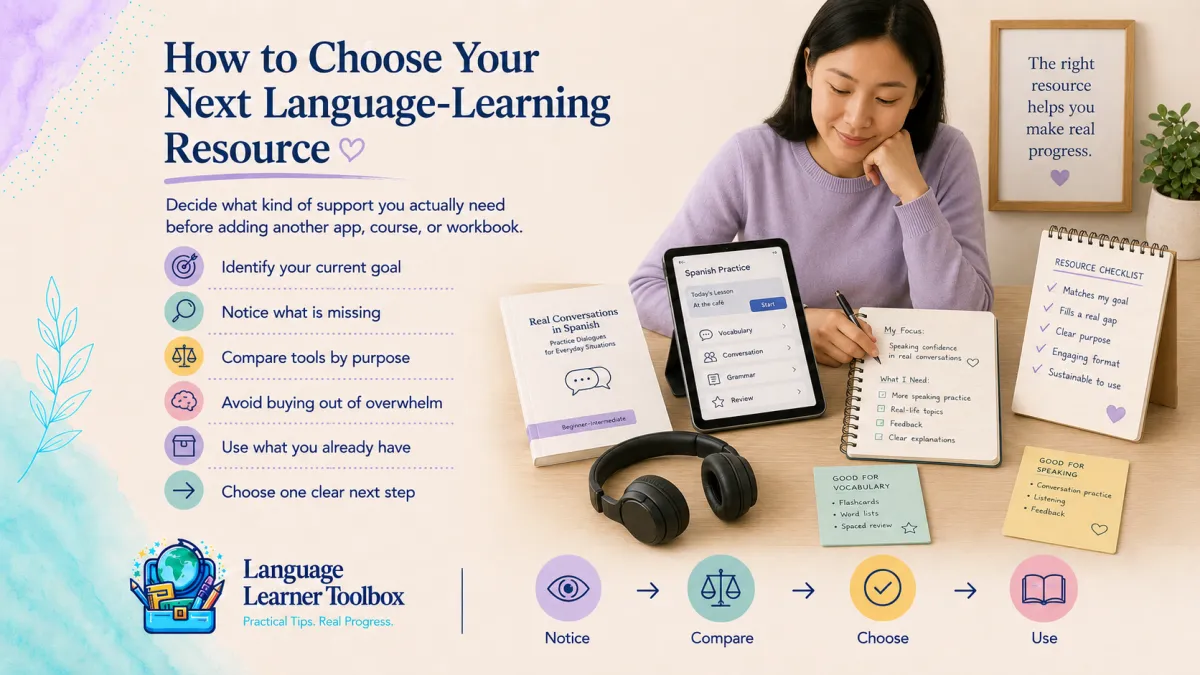
How to Choose Your Next Language-Learning Resource
Language learners often assume that progress requires another resource.
A new app may look more motivating. A different workbook may seem more complete. A course, tutor, podcast, membership, or AI tool may promise to solve the problem your current routine has not solved.
Sometimes a new resource really can help.
Sometimes the resource you already have is good enough, but you have not used it consistently or purposefully enough to see what it can do.
The challenge is knowing the difference.
Before adding another tool, ask:
What support am I actually missing?
Your next resource should fill a clear gap. It should not simply add more material to an already crowded learning system.
Begin With Your Current Goal
A useful resource should support something specific you want to improve.
Before browsing options, write down your most important goal right now.
For example:
I want to understand everyday conversations more easily.
I want to speak without freezing.
I want to remember vocabulary I can actually use.
I want clearer grammar explanations.
I want to build a consistent routine.
I want feedback on my writing.
I want structured practice with a conversation partner.
I want to prepare for travel, work, or an exam.
Try to choose one primary goal.
If you are working on everything at once, almost every resource will appear useful.
A clear goal helps you eliminate tools that may be good but are not right for your current need.
Ask:
What would I most like to do better one month from now?
That answer should guide your decision.
Identify the Real Problem
Your goal tells you what you want.
You also need to understand what is preventing you from getting there.
Suppose your goal is to speak more confidently.
The problem may be:
you do not practice speaking often enough
you lack useful conversation topics
you know words but cannot retrieve them quickly
you feel anxious when someone asks a question
you need feedback
your current activities are mostly silent
you do not have anyone to practice with
Each problem suggests a different kind of support.
A vocabulary app may not solve a lack of real conversation.
A conversation partner may not solve confusion about basic sentence structure.
A new course may not solve inconsistency.
Do not choose a resource until you can describe the problem it needs to address.
Notice What Is Already Working
Before focusing on what is missing, review what is working.
You may already have:
a useful workbook
a reliable podcast
a tutor
a conversation partner
a vocabulary system
a study schedule
an app you use consistently
a helpful dictionary
a collection of speaking prompts
a course you have not finished
Ask:
Which resource do I use most often?
What has helped me make visible progress?
Which activities do I return to willingly?
What feels clear and manageable?
What already supports my current goal?
You do not need to replace something that is working.
Your next resource should support your existing system, not disrupt it without a good reason.
Use What You Already Have Before Adding More
A new resource can feel productive because choosing and buying it creates a sense of action.
But owning a tool is not the same as using it.
Before adding something new, ask:
Have I used my current resource long enough to evaluate it fairly?
Have I followed the instructions?
Have I practiced consistently?
Have I completed more than the first few lessons?
Have I reviewed what I learned?
Have I applied the material outside the resource?
Have I adjusted the way I use it?
A workbook cannot help if it remains closed.
A tutor cannot provide useful direction if you arrive without a goal.
An app cannot build speaking confidence if you avoid the speaking activities.
A podcast cannot improve listening if it plays in the background without your attention.
Sometimes the missing resource is not another product.
It is a better plan for using the one you already have.
Decide Whether You Need More Practice or Different Support
This is one of the most important questions you can ask.
You may need more practice when:
you understand the material but cannot use it quickly yet
you make small mistakes that improve with repetition
the resource still challenges you appropriately
you have used it inconsistently
you know what to do but have not done it often enough
you are seeing slow but real progress
you have not applied the skill in real communication
You may need a different resource when:
the instructions are consistently confusing
the level is far too easy or difficult
the resource does not address your goal
the activities do not require the skill you want to build
there is no useful feedback
the format does not fit your schedule
the material is outdated or unreliable
you have used it faithfully and reached its limits
Do not mistake the normal difficulty of learning for evidence that the tool is failing.
Progress often feels slow before it becomes visible.
Look for a Gap, Not a Novelty
A new resource should add something meaningful.
It might provide:
a clearer sequence
live feedback
speaking practice
better listening material
useful review
accountability
real-life examples
level-appropriate reading
specialized vocabulary
a more practical format
support for a specific situation
Try to complete this sentence:
My current system helps me with ________, but it does not give me enough ________.
For example:
My current course teaches grammar clearly, but it does not give me enough speaking practice.
Or:
My conversation partner helps me speak, but I need more organized vocabulary review.
Or:
I have plenty of listening material, but I do not know how to turn it into active practice.
The second blank reveals the gap your next resource should fill.
Choose the Type of Support You Need
Different resources solve different problems.
If You Need Structure
Look for:
a workbook
a guided course
a clear study plan
a step-by-step program
a short challenge
a sequenced lesson series
Structure is helpful when you frequently ask:
What should I do next?
A structured resource should reduce decisions, not create more of them.
If You Need Feedback
Look for:
a tutor
a teacher
a correction service
a writing review tool
a pronunciation coach
guided AI feedback
a knowledgeable conversation partner
Feedback is valuable when you cannot tell what is wrong or which mistake matters most.
If You Need Speaking Practice
Look for:
conversation prompts
a language partner
tutoring
speaking challenges
role-play activities
AI conversation practice
guided conversation lessons
Choose something that requires original responses, not only repeating or selecting answers.
If You Need Listening Practice
Look for:
short podcasts
videos with transcripts
graded listening activities
interviews
audiobooks
natural conversations
lessons with replay and comprehension support
The resource should match your level and help you listen with a purpose.
If You Need Vocabulary Support
Look for:
a vocabulary notebook system
spaced review
phrase-based flashcards
topic-based vocabulary
sentence-building activities
retrieval practice
tools that show words in context
Avoid resources that only encourage collecting long lists.
If You Need Accountability
Look for:
scheduled tutoring
a class
a guided challenge
a study partner
a progress tracker
regular check-ins
a simple weekly commitment
Accountability is most useful when it helps you act consistently, not when it creates guilt.
If You Need Better Organization
Look for:
a study planner
a language-learning roadmap
an organization checklist
a resource comparison worksheet
a simple file or notebook system
a personal learning toolbox plan
Sometimes the problem is not the quality of your materials.
It is that they are scattered and difficult to use.
Match the Resource to Your Current Level
The right resource should be usable now.
Do not choose something only because you hope to grow into it eventually.
A resource is probably too difficult if:
you cannot understand the instructions
every activity requires translation
you cannot complete basic tasks without constant help
the examples assume knowledge you do not have
you feel lost more often than challenged
A resource may be too easy if:
you can complete it without much attention
it repeats skills you already control
you rarely encounter anything new
it does not require original language
you finish activities quickly but cannot identify what you learned
Look for a level that allows successful effort.
You should understand enough to participate and encounter enough challenge to grow.
Match the Resource to Your Real Schedule
A resource can be excellent and still be wrong for your life.
Ask:
How much time does it require?
Can I use it in short sessions?
Does it require a fixed schedule?
Can I pause and return easily?
Will I need extra preparation?
Can I use it on busy days?
Does it fit the devices or materials I prefer?
Can I realistically continue for several weeks?
Do not choose based on the schedule you wish you had.
Choose based on the time you can actually protect.
A small resource used regularly is more valuable than a comprehensive one you avoid.
Match the Format to the Practice
Consider how the resource asks you to learn.
Does it use:
videos
audio
reading
writing
live interaction
worksheets
games
flashcards
open-ended prompts
printed materials
mobile practice
longer lessons
Your preferences matter, but the format must also support your goal.
If you want to improve listening, the resource needs meaningful audio.
If you want to speak, it needs to make you respond aloud.
If you want to write, it needs to include original writing and useful feedback.
If you want consistency, it should be easy to begin.
Do not choose an attractive format that avoids the skill you need to practice.
Look for Active Use
A resource should ask you to do more than watch, read, or recognize.
Active practice may include:
recalling vocabulary without looking
answering questions aloud
creating original sentences
summarizing a text
responding to a conversation prompt
explaining an idea
correcting your own work
applying a grammar pattern
reviewing mistakes
repeating a task with improvement
Ask:
What will I actually do with this resource?
A clear answer is a good sign.
If the answer is mostly “consume more information,” the resource may not create the progress you expect.
Check Whether It Complements Your Current Tools
Your resources should have different jobs.
For example:
a workbook provides structure
a podcast provides listening
a tutor provides feedback
a vocabulary notebook supports review
a conversation partner provides real interaction
Problems arise when several tools all do the same thing.
You may not need:
three beginner apps
four grammar books
several unused courses
multiple vocabulary systems
overlapping subscriptions
Before choosing something new, ask:
What role will this play that my current resources do not?
If you cannot answer, it may be a duplicate.
Avoid Buying From Overwhelm
Overwhelm can make any new system look like the answer.
You may think:
This app will finally keep me motivated.
This course will tell me everything.
This workbook will help me start over correctly.
This subscription will organize my learning.
This tool will make practice easier.
Pause before purchasing.
Ask:
Am I choosing this because I have a clear need?
Am I avoiding a difficult type of practice?
Am I tired of my current resource or truly limited by it?
Am I buying hope instead of a plan?
What will change in my routine after I get this?
A new resource should lead to a specific action.
It should not simply create a new pile of possibilities.
Compare Resources by Purpose
When evaluating options, compare them using the same criteria.
Consider:
Goal Match
Does this support my current priority?
Level
Can I use it successfully now?
Practice Type
Does it require the skill I want to improve?
Feedback
Will I know what to adjust?
Schedule
Can I fit it into my real week?
Organization
Does it provide a clear path?
Real-Life Use
Can I apply the learning outside the resource?
Cost
Is the support worth the price?
Fit
Am I likely to return to it?
A popular resource may score poorly for your particular need.
A simpler option may fit much better.
Test a Small Part First
When possible, try the resource before fully committing.
Use:
a sample chapter
a free trial
one tutor session
a demonstration lesson
a library copy
a preview
a short introductory activity
Do not spend the entire trial looking at features.
Complete a real lesson or practice task.
Then ask:
Did I understand what to do?
Did I actively use the language?
Did it match my goal?
Was the level appropriate?
Did the format work for me?
Could I fit it into my routine?
Did it provide something new?
Did I want to continue?
A practical test reveals more than a long list of features.
Decide What You Will Stop or Reduce
Every new resource requires time.
Adding something without removing or reducing anything else can make your system too complicated.
Before adding a resource, decide:
What will it replace?
What will I use less often?
Where will it fit in my week?
How many times will I use it?
What result will I look for?
For example:
I will use this listening guide twice a week instead of searching for random videos.
Or:
I will use this workbook as my main resource and keep the app only for short vocabulary review.
This gives the resource a defined place.
Choose One Clear Next Step
You do not need to redesign your entire learning system.
Choose one useful change.
Your next step might be:
continue your current resource for two more weeks
schedule a tutor session
add one listening source
create a vocabulary notebook
find a conversation partner
begin a guided workbook
cancel an unused subscription
organize the resources you already own
test one new app
return to a course you paused
One clear step is easier to evaluate than several changes at once.
Give the Resource a Job
Once you choose a resource, define its role.
Complete this sentence:
I will use this resource to help me ________.
For example:
practice speaking twice a week
review vocabulary in context
prepare for tutor sessions
improve listening comprehension
follow a structured learning sequence
receive feedback on writing
organize weekly practice
Then decide:
when you will use it
how often
for how long
what action you will take
how you will measure whether it helps
A resource without a job often becomes clutter.
Review the Decision After a Set Period
Choose a review date before you begin.
That may be:
one week
two weeks
one month
four tutoring sessions
one completed workbook unit
ten practice sessions
At the review, ask:
Did I use it as planned?
Did it support my goal?
Did it create active practice?
Did I learn something useful?
Did it fit my schedule?
Did I notice progress?
Should I continue, adjust, or stop?
Do not keep using a resource only because you paid for it.
Do not abandon it after one difficult session either.
Give it a fair test, then make a thoughtful decision.
A Simple Resource Decision Check
Before choosing your next language-learning resource, answer these questions.
What is my most important goal right now?
What is preventing me from reaching it?
What do my current resources already do well?
What kind of support is missing?
Do I need a new resource or more practice?
What exact job will the new resource have?
Can I fit it into my real schedule?
What will I reduce or replace?
How long will I test it?
How will I know whether it helped?
If your answers are clear, you are ready to choose.
If they are vague, wait.
Clarity before commitment can save you time, money, and frustration.
Your Next Resource Should Simplify Learning
A useful resource should make your next step clearer.
It should help you:
practice a specific skill
reduce confusion
use your time more purposefully
receive support you cannot easily create alone
build on what is already working
make progress you can recognize
It should not make your learning system harder to manage.
You do not need the newest resource.
You do not need the resource everyone else recommends.
You need the support that fits the gap in front of you.
Pause.
Evaluate.
Choose one clear next step.
Then use it long enough to discover what it can help you do.
Remember This
The next resource should solve a clear problem.
It should not simply give you more material to manage.
Sometimes you need a new tool. Sometimes you need a better plan for using what you already have. Clarity helps you tell the difference.
Ready for Your Next Step?
The Learning Tools & Resources page brings together practical guides, workbooks, and downloadable support to help you choose tools that fit your goals, level, schedule, and preferred way of practicing.
If consistency is the real challenge, the 21-Day Language Habit Bootcamp offers one practical step each day to help you build a routine and make better use of the resources you already have.
For more structured support, explore the The Language Learner’s Workbook: A Guide for Conversation Practice and other tools choose the one that best matches your current goal.

