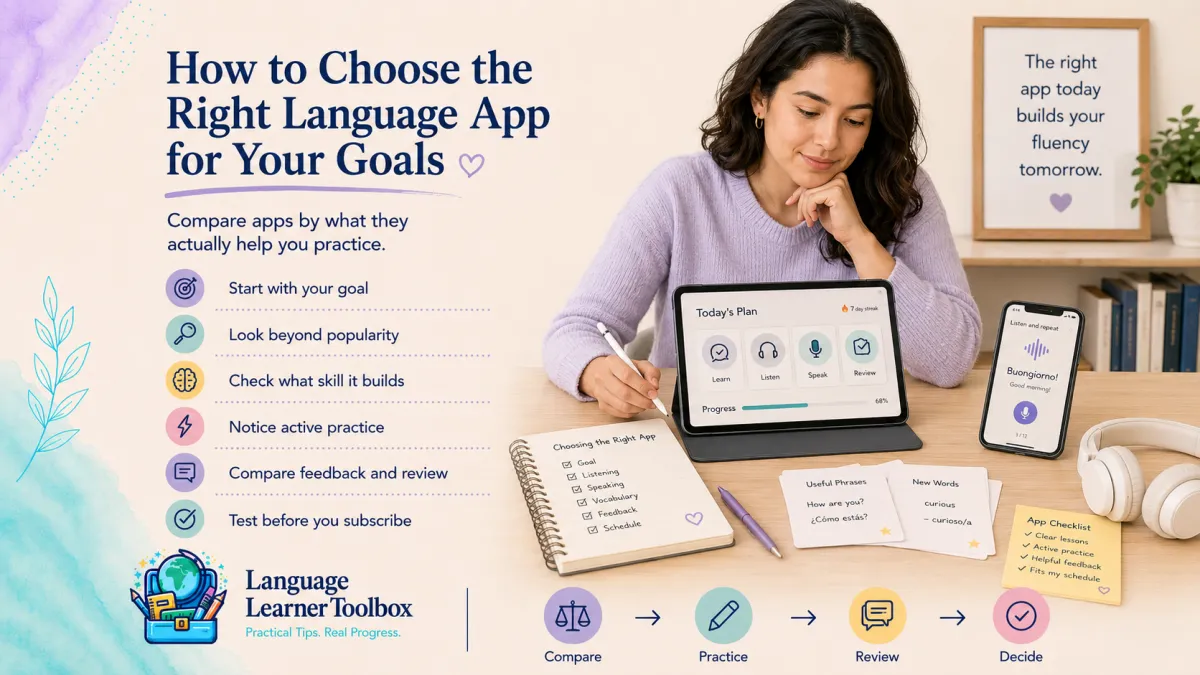
How to Choose the Right Language App for Your Goals
Language apps can be useful, convenient, and motivating.
They can also create the feeling of progress without always helping you practice the skill you care about most.
One app may be excellent for vocabulary review. Another may provide strong listening practice. A third may help with pronunciation, grammar, reading, or conversation.
The challenge is that many apps are marketed as complete language-learning solutions, even when they are strongest in only one or two areas.
The right question is not:
Which language app is the most popular?
A better question is:
What does this app actually help me practice?
The best app for you depends on your goal, current level, schedule, and the kind of learning support you need.
Begin With the Skill You Want to Improve
Before comparing apps, decide what you want to do better.
Your goal might be:
remember useful vocabulary
understand spoken language
improve pronunciation
speak more confidently
read more easily
write more accurately
understand grammar
prepare for travel
build a consistent study routine
practice for a test
communicate in a specific work or family setting
A broad goal such as “learn Italian” does not give you enough information to choose well.
A more specific goal makes the decision easier.
For example:
I want to understand everyday conversations at a more natural speed.
That goal points toward an app with strong listening practice, useful transcripts, adjustable playback, and activities that check meaning.
Another learner may say:
I want to speak more easily without translating every sentence.
That goal requires more than tapping correct answers. It calls for sentence creation, speaking aloud, retrieval practice, and opportunities to respond in original language.
The app should match the skill.
Look Beyond the App’s Main Promise
Many language apps use broad phrases such as:
become fluent
learn faster
speak confidently
master a language
learn in minutes a day
practice all four skills
Those promises may sound appealing, but they do not tell you what the learner actually does inside the app.
Look at the activities.
Does the app ask you to:
choose from multiple answers?
match words and pictures?
repeat sentences?
type original responses?
answer open-ended questions?
listen to natural speech?
record your voice?
recall vocabulary without clues?
read longer passages?
speak in realistic situations?
review mistakes?
create your own sentences?
The activity matters more than the slogan.
An app may say it develops speaking confidence, but if most activities involve silent recognition, speaking may not be its strongest feature.
Understand Recognition and Production
Language apps often rely heavily on recognition.
Recognition means identifying an answer when you see or hear it.
Examples include:
choosing the correct translation
matching words
selecting a missing word
recognizing the correct sentence
identifying the meaning of a phrase
Recognition is useful. It can strengthen familiarity and help you notice patterns.
But speaking and writing require production.
Production means retrieving and creating language without being shown the full answer first.
Examples include:
answering a question aloud
writing an original sentence
describing a picture
responding to a prompt
summarizing what you heard
explaining an idea in your own words
recalling vocabulary without a visible list
If your main goal is communication, look for an app that requires production, not only recognition.
Ask:
Does this app help me create language, or mostly identify it?
You may need both, but the balance should fit your goal.
Choose an App for Vocabulary Carefully
Vocabulary apps can be useful when they help you remember words and use them in context.
A strong vocabulary app may include:
spaced review
example sentences
audio pronunciation
useful phrases
topic-based vocabulary
retrieval practice
personalized review
opportunities to create sentences
practice using words in conversation
Be cautious if the app mainly presents isolated words without context.
Knowing that one word matches another does not always mean you can use it naturally.
Look for vocabulary practice that helps you answer:
What does this word mean here?
What words commonly appear with it?
How is it pronounced?
When would I use it?
Can I recall it without looking?
Can I use it in a sentence?
Can I recognize it in real speech?
The goal is not to collect words.
It is to make useful language easier to retrieve.
Choose an App for Listening Based on the Audio
If listening is your goal, pay attention to the quality and variety of the audio.
Ask:
Are the speakers natural and clear?
Is the speech too slow or unnaturally careful?
Are there different voices and accents?
Can I adjust the speed?
Are transcripts available?
Can I replay short sections?
Does the app check understanding?
Does it teach useful phrases from the audio?
Does the difficulty increase gradually?
Beginning learners may benefit from slower, supported audio.
Intermediate and advanced learners need increasing exposure to natural speed, connected speech, and different voices.
Listening practice should not only ask whether you recognized one word.
It should help you understand meaning.
Useful activities may include:
identifying the main idea
noticing key details
arranging events in order
completing a short summary
answering comprehension questions
repeating useful phrases
explaining what you understood
An app with excellent vocabulary activities may still provide weak listening practice.
Evaluate the skill separately.
Choose an App for Speaking by Examining the Response
Many apps include a microphone button and call the activity speaking practice.
That does not necessarily mean the app develops conversation.
Repeating a sentence can help pronunciation and rhythm.
It is not the same as forming your own response.
For stronger speaking practice, look for activities that ask you to:
answer open-ended questions
describe familiar situations
respond without reading a full script
practice common conversations
tell short stories
give opinions
ask follow-up questions
repeat an answer and improve it
receive understandable feedback
use new vocabulary in your own response
Ask what happens after you speak.
Does the app:
check only whether the sound was close enough?
give pronunciation feedback?
identify one useful correction?
let you try again?
ask a follow-up question?
help you make the answer clearer?
encourage longer responses?
The strongest speaking practice requires more than repeating.
It requires thinking, retrieving, and responding.
Choose an App for Pronunciation With Realistic Expectations
Pronunciation tools can help you notice sounds, stress, rhythm, and recurring patterns.
Look for features such as:
clear audio models
slow and natural-speed examples
individual sound practice
word and sentence stress
recording and playback
visual feedback
comparison with a model
repeated attempts
explanations of common difficulties
Pronunciation scoring can be useful, but it is not perfect.
A score should be treated as feedback, not a final judgment of whether your speech is acceptable.
The goal is clear communication, not removing every sign of an accent.
A useful app should help you understand what to adjust and give you another opportunity to practice.
Choose an App for Grammar Based on Application
Grammar apps can explain patterns and provide focused exercises.
The strongest ones help you connect the rule to communication.
Look for:
simple explanations
clear examples
comparison of similar forms
practice in meaningful sentences
feedback on incorrect answers
review of recurring errors
opportunities to create original language
activities that connect grammar to speaking or writing
Grammar practice may be too limited if you only select the correct form from a list.
That can help you recognize the pattern, but you may still struggle to use it in conversation.
A strong grammar app should eventually help you answer:
Can I use this pattern to communicate something I actually want to say?
Choose an App for Reading Based on the Texts
Reading apps vary widely.
Some use short translated sentences. Others offer stories, articles, dialogues, or graded texts.
Consider:
Are the texts interesting enough to continue?
Is the level appropriate?
Are definitions easy to access?
Can you hear the text read aloud?
Are useful phrases highlighted?
Does the app ask comprehension questions?
Does it help you notice language in context?
Can you save words without interrupting the reading too much?
Are the texts long enough to build reading stamina?
A useful reading app should help you understand more than individual sentences.
It should gradually support longer attention, vocabulary in context, and comprehension of complete ideas.
Consider Your Current Level
An app that works well for a beginner may become too limited later.
A beginner may need:
translations
clear instructions
short lessons
slow audio
visual support
frequent review
simple sentence patterns
An intermediate learner may need:
more open-ended activities
longer listening
fewer translations
real-world topics
original speaking and writing
more natural language
An advanced learner may need:
authentic material
nuance
specialized vocabulary
longer responses
detailed feedback
natural speed
complex ideas
support for precision and style
Before committing, look at several lessons beyond the first level.
Some apps have strong beginner content but offer limited support after the basics.
Match the App to Your Available Time
Many apps promote short daily lessons.
That can be helpful when consistency is your main goal.
However, short lessons are not automatically enough for every skill.
A five-minute review may help you maintain vocabulary.
It may not provide enough time for deeper listening, extended speaking, or writing feedback.
Ask:
Can I complete a useful activity in the time I have?
Can I continue longer when I have more time?
Does the app remember where I stopped?
Can I choose a specific skill?
Is there a shorter backup activity for busy days?
Does the app encourage meaningful practice or only daily completion?
The daily streak can be motivating, but it should support learning rather than become the goal itself.
Notice What the App Rewards
Apps often use:
points
streaks
badges
leagues
levels
reminders
daily goals
progress bars
These features can encourage consistency.
They can also shift attention toward completing tasks rather than improving communication.
Ask yourself:
Am I focused on learning or collecting points?
Do I rush through activities to protect a streak?
Do I repeat easy work because it earns rewards?
Am I avoiding difficult speaking or writing activities?
Does the progress display reflect a skill I care about?
A streak shows that you opened the app.
It does not always show what you learned.
Use motivational features as support, not as your main measure of progress.
Check the Quality of Feedback
Feedback matters, especially when you make a mistake.
A weak app may simply show that an answer was wrong.
A stronger app helps you understand why.
Look for feedback that:
explains important errors
shows a correct example
compares similar choices
lets you try again
returns mistakes to later review
identifies recurring patterns
avoids overwhelming correction
connects the correction to meaning
For speaking and writing, feedback should be especially clear.
Ask whether the app helps you improve the response or only marks it.
Consider Whether the App Fits Your Learning Style
Some learners enjoy fast, game-like activities.
Others prefer calm, structured lessons.
Some want audio. Others like reading and writing.
Some need detailed explanations. Others want to begin practicing immediately.
Consider whether you prefer:
guided lessons or independent choice
short activities or longer sessions
repetition or variety
visual support or audio instruction
gamified practice or a straightforward format
frequent correction or delayed feedback
translation or learning through context
printed notes alongside digital practice
The app should not need to match every preference.
It should be usable enough that you will continue.
At the same time, do not choose only what feels easy.
If speaking is your goal, a comfortable vocabulary game cannot replace speaking practice.
Check Whether It Connects to Real Life
A good app should help language move beyond the app.
Ask:
Does it teach phrases I could actually use?
Can I practice situations from my life?
Does it encourage speaking aloud?
Can I apply the lesson in a conversation?
Does it help me notice language outside the app?
Can I use the vocabulary in writing or speaking?
Does it prepare me for travel, work, family, or community situations?
An app becomes more valuable when it helps you do something beyond earning the next level.
Look at the Review System
Language learning requires returning to material.
A strong app should help you review at useful intervals.
Look for:
spaced review
personalized practice
error-based review
saved vocabulary
skill refreshers
progress summaries
review of weak areas
opportunities to retrieve answers without hints
Be careful when review means only repeating the same easy activity.
Good review should strengthen recall and increase independence.
Check the Cost and Subscription Terms
Before paying, understand what is included.
Ask:
Is the app free, paid, or partly free?
Is payment monthly or annual?
Does the price increase after a trial?
Can you cancel easily?
Which features require payment?
Do you lose access when you cancel?
Is there a family or group option?
Is the premium version meaningfully better?
Would a one-time resource meet the same need?
Do not subscribe only because the annual plan appears cheaper.
It is only a good value if you use it.
Set a date to review whether the app is still helping.
Test the App With a Real Goal
Do not spend your entire free trial exploring menus and settings.
Choose one goal and complete real practice.
For example:
For the next seven days, I will use this app to practice listening for fifteen minutes.
Or:
I will complete four speaking activities and record whether I am creating original responses.
Then evaluate the experience.
Ask:
Did the activities match my goal?
Was the difficulty appropriate?
Did I actively use the language?
Was the feedback useful?
Could I fit it into my schedule?
Did I want to return?
Did I notice improvement?
Did the app provide something my current resources do not?
A fair test should include enough use to move beyond the excitement of trying something new.
Avoid Using Too Many Apps at Once
Using several apps can create variety.
It can also scatter your attention.
You may end up:
repeating beginner material
tracking multiple streaks
reviewing the same vocabulary
switching methods constantly
spending more time choosing than practicing
avoiding deeper work
Try assigning each app a clear job.
For example:
one app for structured lessons
one tool for vocabulary review
one source for listening
one place for speaking or feedback
You may not need all four.
Choose a small set that supports your current goals.
Know What an App Cannot Replace
An app can provide useful support.
It may not replace:
real conversation
personal feedback
extended listening
meaningful writing
cultural understanding
interaction with different speakers
practice responding under pressure
a thoughtful learning plan
reflection on your progress
Do not expect one tool to do everything.
A language app is most useful when it has a clear role within a broader learning system.
Use a Simple App Comparison
When comparing apps, rate each one in these areas.
Goal Match
Does it support the skill I want to improve?
Active Practice
Does it require me to retrieve, create, speak, write, or respond?
Level Fit
Is the content appropriate for my current ability?
Feedback
Does it help me understand and improve mistakes?
Real-Life Use
Can I apply the language outside the app?
Schedule Fit
Can I use it consistently within the time I have?
Review
Does it help me remember and revisit important material?
Cost
Is the value worth the price for the role it will play?
The most popular app may not receive the highest score for your goal.
That is the point.
Choose Based on Purpose, Not Popularity
An app may have millions of users and still be a poor fit for you.
Another app may be less well known but provide exactly the practice you need.
Popularity can tell you that many people find a tool appealing.
It cannot tell you whether the tool matches:
your goal
your level
your schedule
your preferred format
your current learning gap
Choose the app based on the job you need it to do.
The Right App Has a Clear Role
A useful app should have a simple answer to this question:
Why am I using this?
Your answer might be:
I use this to review vocabulary.
I use this to practice listening.
I use this to prepare for conversations.
I use this to receive pronunciation feedback.
I use this to follow a structured beginner course.
I use this to build a daily study habit.
If you cannot explain the app’s role, it may not have one.
You do not need the app that promises everything.
You need one that helps you practice something important.
Try This Before You Subscribe
Choose one language app you are currently using or considering.
Complete these sentences:
My current language goal is:
The main skill this app helps me practice is:
Most of the activities require me to:
The app gives feedback by:
I can realistically use it:
I will test it for:
I will know it is helping when:
Then ask one final question:
Does this app help me do the kind of practice my goal requires?
If the answer is yes, give it a fair test.
If the answer is unclear, keep looking.
The best language app is not the one everyone is talking about.
It is the one that helps you practice with purpose and make progress you can use.
Remember This
The most popular app is not always the right app.
The best app is the one that helps you practice the skill you actually want to improve.
Choose based on purpose, level, schedule, and active practice, not streaks, points, or broad promises.
Ready for Your Next Step?
The Learning Tools & Resources page brings together practical guides for choosing apps, workbooks, AI tools, tutors, and other language-learning support more thoughtfully.
If you are still deciding whether another tool is necessary, read How to Choose Your Next Language-Learning Resource.
If consistency is the bigger challenge, the 21-Day Language Habit Bootcamp offers one practical step each day to help you build a routine and use your learning tools more consistently.

