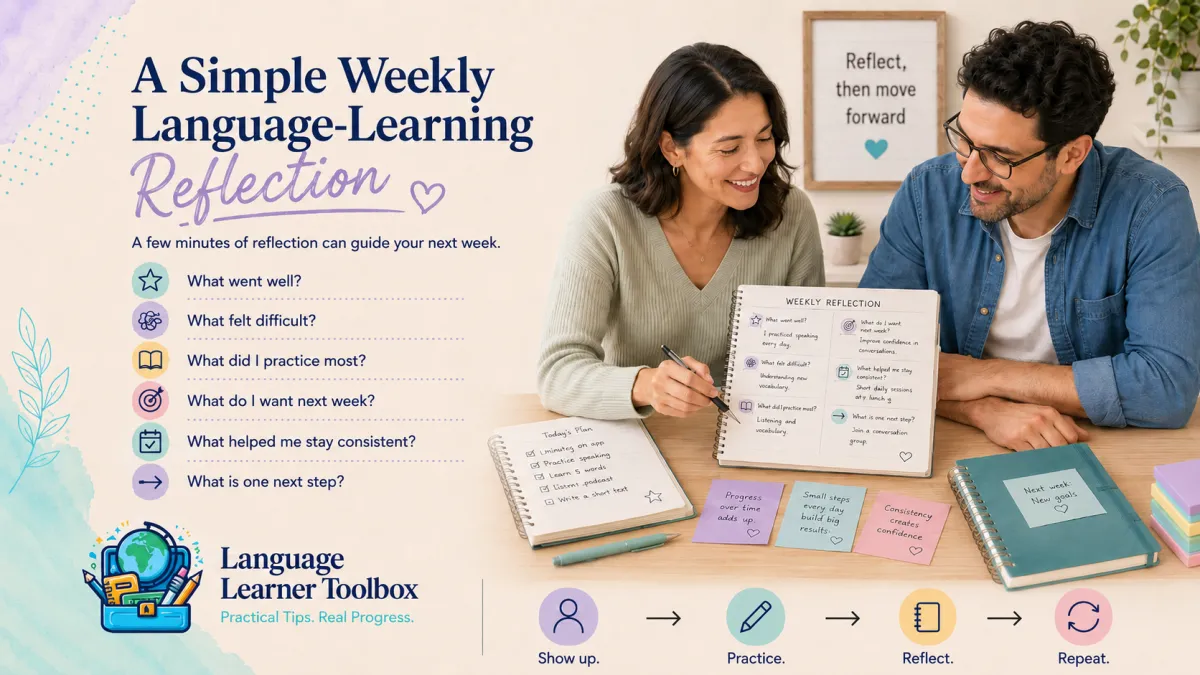
A Simple Weekly Language-Learning Reflection
A few minutes of reflection can help you notice progress and plan a better week.
Many language learners move quickly from one week to the next.
They finish a lesson.
Practice a few times.
Miss a day.
Learn some new words.
Then begin again on Monday without looking back.
The problem is not that they are doing nothing.
The problem is that they may not notice what their practice is teaching them.
What worked?
What felt difficult?
What helped them continue?
What should they focus on next?
A short weekly reflection can answer those questions.
You do not need a long journal entry.
You do not need to analyze every study session.
A few honest answers can help you see progress, make better choices, and begin the next week with a clearer plan.
1. Begin With What Went Well
Many learners begin reflection by looking for mistakes.
What did I forget?
What did I skip?
What am I still unable to do?
Those questions may be useful later.
Start with what worked.
Ask:
What went well this week?
Maybe you:
practiced more often
understood part of a conversation
remembered useful vocabulary
finished a reading
spoke even though you felt nervous
returned after missing a day
Do not dismiss a success because it seems small.
Small wins often show that a habit is becoming stronger.
They can also help you recognize progress before you feel fluent.
Write down at least one thing that went well.
It reminds you that the week contained more than unfinished goals.
2. Notice What Felt Difficult
Reflection is not only celebration.
It is also a chance to notice where you need support.
Ask:
What felt difficult?
Maybe listening felt too fast.
You could not remember the words you wanted.
Your study time kept getting interrupted.
You avoided speaking.
The activity was too long for the time you had.
Try to describe the difficulty without turning it into a judgment.
Instead of:
I am terrible at listening.
Write:
I had trouble understanding the main idea when people spoke quickly.
Instead of:
I was not disciplined.
Write:
Evening practice was difficult because I was tired.
Specific observations are more useful than criticism.
They help you decide what to change.
3. Look at What You Actually Practiced
Sometimes our plans and our actions are different.
You may have planned to practice speaking but spent most of the week reviewing vocabulary.
You may have intended to study grammar but listened to podcasts instead.
That information is useful.
Ask:
What did I practice most?
Then consider:
Did that practice support my current goal?
Did I enjoy it?
Did I avoid another skill?
Do I want to continue the same focus next week?
You are not looking for a perfect balance.
You are trying to understand your learning.
A simple reflection can help you track language progress without losing motivation because it shows what you are actually doing, not only what you hoped to do.
4. Notice What Helped You Stay Consistent
Some weeks are easier than others.
Look for the conditions that helped you practice.
Maybe:
your materials were already prepared
you practiced at the same time each day
the activity was short
you used a checklist
you studied with another person
you connected practice to an existing routine
Ask:
What made practice easier this week?
That answer can help you protect what is working.
Perhaps five-minute sessions were easier to continue than thirty-minute sessions.
Maybe listening during your walk felt natural.
Maybe leaving your notebook on the table helped you remember.
You do not always need a new system.
Sometimes you need to keep using the part of your routine that already works.
5. Choose One Focus for Next Week
Reflection becomes most useful when it leads to a clear next step.
Ask:
What do I want to focus on next week?
Keep the answer simple.
You might choose:
listen three times
practice one conversation topic
review useful travel phrases
read one short article
speak for five minutes twice
return to a routine that worked before
You do not need a long list.
One clear focus can make it easier to know what to practice each day.
Then ask:
What is one small step I can take first?
Choose something specific.
Not:
Improve my speaking.
Try:
Answer one conversation question aloud on Monday.
Not:
Study more vocabulary.
Try:
Review five useful words after breakfast.
A clear next step makes beginning easier.
Reflection Helps You Learn From Your Own Experience
Your week already contains useful information.
The activities you enjoyed.
The practice you avoided.
The moments that felt easier.
The routines that helped.
The difficulties that kept returning.
Reflection helps you notice those patterns.
It gives you a chance to celebrate progress without ignoring challenges.
It also helps you adjust without starting over.
You are not trying to create a perfect week.
You are learning how to build a better one.
Try This
Take five minutes at the end of the week and answer:
What went well?
What felt difficult?
What is one focus for next week?
Remember This
Reflection helps make progress visible.
Begin with what worked before focusing on what was difficult.
Notice what you practiced and what helped you stay consistent.
Choose one clear focus instead of creating a long new plan.
A small adjustment can make the next week easier.
Continue Reading
How to Track Language Progress Without Losing Motivation
How to Recognize Progress Before You Feel Fluent
How to Choose What to Practice Each Day
Ready for Your Next Step?
Join the 21-Day Language Habit Bootcamp for simple daily guidance, or use the Language Learning Habit Stack Workbook to plan, track, and reflect on a routine that fits real life.

