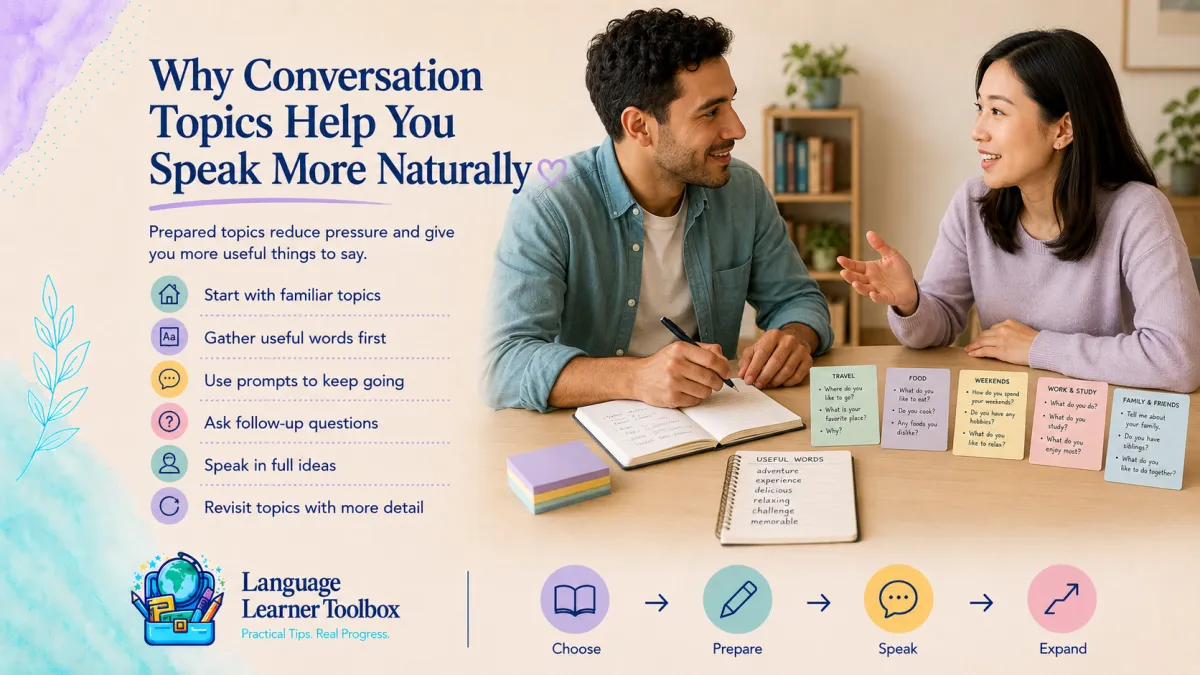
Why Conversation Topics Help You Speak More Naturally
Conversation practice sounds simple.
You meet with someone, begin talking, and use the language as much as you can.
But many learners quickly run into the same problem:
What should we talk about?
Without a clear topic, conversations often stay at the surface. You may repeat the same questions about work, family, weather, or weekend plans. The stronger speaker may carry most of the exchange. Long pauses may appear because neither person knows what to ask next.
A prepared conversation topic changes that.
It gives you something meaningful to think about, vocabulary to prepare, questions to ask, and ideas to develop. Instead of trying to invent both the language and the subject at the same time, you can focus more fully on communicating.
Conversation topics do not make speaking artificial.
Used well, they make it easier for real conversation to begin.
Topics Reduce the Pressure of Starting
The first few minutes of a conversation can feel difficult.
You may be trying to decide:
what to say
how to begin
which vocabulary you know
whether the other person is interested
how to keep the exchange moving
A clear topic removes one of those decisions.
Instead of beginning with:
What do you want to talk about?
you can begin with:
Today, I thought we could talk about travel experiences.
Or:
I prepared a few questions about daily routines.
That simple structure creates direction.
You are no longer searching for a subject while also searching for words.
Topics Help You Prepare Useful Language
Preparation does not mean memorizing a script.
It means giving yourself a few tools before the conversation begins.
For one topic, you might prepare:
five useful words
three phrases
four questions
one personal example
one opinion
one follow-up question
For a conversation about food, you might prepare:
comfort food
family recipe
homemade
try something new
remind me of
You may also prepare questions such as:
What food reminds you of your childhood?
Is there a dish your family makes for special occasions?
What is something you enjoy cooking?
Have your eating habits changed over time?
This preparation makes vocabulary easier to retrieve because it is connected to a real subject.
Topics Create Deeper Answers
General questions often produce short answers.
For example:
Do you like traveling?
A learner may answer:
Yes, I do.
A focused topic makes it easier to ask questions that invite detail:
What is one place you visited that surprised you?
What do you enjoy most about traveling?
Tell me about a trip that did not go as planned.
These questions encourage the learner to:
describe
explain
compare
tell stories
give opinions
recall experiences
Longer answers create more meaningful speaking practice.
Topics Help You Move Beyond Memorized Small Talk
Many learners become comfortable with a small set of predictable exchanges:
How are you?
Where are you from?
What do you do?
How was your weekend?
What are your hobbies?
These questions are useful.
But if every conversation stays there, your speaking may not grow very much.
New topics help you practice language for:
explaining reasons
describing memories
comparing cultures
solving problems
expressing preferences
giving advice
talking about change
sharing goals
telling stories
defending an opinion
This makes your language more flexible.
Topics Support Better Vocabulary Retrieval
You may know a word when you see it but struggle to remember it while speaking.
Topic-based practice helps because related words appear together.
For example, a conversation about work might bring together:
meet a deadline
work remotely
solve a problem
handle responsibility
communicate clearly
ask for clarification
manage a project
The topic creates a mental group.
That makes the vocabulary easier to recall than words learned in unrelated lists.
Repeated conversations around a topic also strengthen retrieval.
The first time, you may pause often.
The second time, the same words may come more quickly.
Topics Help You Learn Phrases in Context
Natural speech depends on more than individual words.
It also depends on useful phrases and sentence patterns.
A topic about opinions may help you practice:
In my experience...
One reason is...
I can see both sides.
I tend to think that...
It depends on the situation.
I agree to a certain extent.
The main difference is...
A topic about past experiences may support:
I remember when...
At first...
What surprised me most was...
Looking back...
The hardest part was...
In the end...
These phrases become easier to remember because you use them for a clear communicative purpose.
Topics Make Follow-Up Questions Easier
A natural conversation does not move from one unrelated question to another.
It grows through follow-up.
Suppose the topic is hobbies.
A partner says:
I started gardening last year.
You might ask:
What made you want to begin?
What do you enjoy growing?
What was difficult at first?
Has it changed how you spend your weekends?
Would you recommend it to other people?
Because the conversation has a clear topic, follow-up questions feel easier to generate.
You are not searching for a completely new subject.
You are developing the one already in front of you.
Topics Help Conversations Feel More Balanced
In an unstructured conversation, the more fluent speaker may dominate.
The learner may respond briefly, while the stronger speaker fills the silence.
Prepared topics can create a more balanced exchange because both people can:
answer the same questions
share examples
compare experiences
ask follow-ups
contribute vocabulary
take turns leading
The topic gives the learner a stronger role.
They can arrive ready to ask, answer, and participate rather than waiting for the other person to guide everything.
Topics Give Beginners a Safer Starting Point
Beginning learners may worry that they do not know enough language for conversation.
A familiar topic can make the task manageable.
Useful beginner topics include:
family
daily routines
food
home
weather
hobbies
work or school
transportation
weekend plans
favorite places
The learner can prepare simple sentence frames:
I usually...
My favorite...is...
I like...because...
On weekends, I...
In my family...
I would like to...
One difference is...
The structure supports communication without requiring advanced language.
Topics Give Intermediate Learners More Range
Intermediate learners often understand a great deal but rely on familiar vocabulary and sentence patterns.
Topics can encourage them to expand.
Useful intermediate topics might include:
a difficult decision
a memorable trip
changes in technology
healthy habits
education
cultural traditions
friendship
work-life balance
a problem in the community
learning from mistakes
These subjects encourage longer answers, explanations, opinions, and storytelling.
Topics Help Advanced Learners Develop Precision
Advanced learners may be able to discuss many subjects but still want greater clarity, nuance, or naturalness.
More complex topics can support:
comparing viewpoints
qualifying an opinion
discussing causes and consequences
explaining abstract ideas
using specialized vocabulary
adjusting formality
responding spontaneously
developing persuasive language
Possible topics include:
ethical questions
cultural change
leadership
education policy
artificial intelligence
public health
environmental responsibility
identity and belonging
media influence
social expectations
The topic should still match the learner’s interests and goals.
Topics Help You Practice Storytelling
Stories are an important part of natural conversation.
They help people connect, explain, and remember.
A topic can invite stories through questions such as:
Tell me about a time when...
What happened the first time you...?
Describe a situation that surprised you.
Have you ever had to...?
What is a memory you still think about?
Storytelling helps learners practice:
sequencing events
past tense
description
emotion
cause and effect
transitions
emphasis
natural pauses
A topic gives the story a clear starting point.
Topics Help You Express Opinions
Learners may understand a topic but struggle to explain what they think.
Prepared topics give them a reason to practice opinion language.
For example:
What makes a good friend?
Should children have homework every day?
Is it better to live in a city or a small town?
What makes a workplace healthy?
Has technology improved communication?
What is the best way to learn from mistakes?
Useful opinion frames include:
I think...
In my view...
One advantage is...
One concern is...
I understand that perspective, but...
My experience has been...
I would argue that...
It depends on...
The goal is not to win a debate.
It is to express an idea clearly and respond respectfully.
Topics Help You Compare Cultures Without Stereotyping
Conversation topics can open meaningful cultural exchange.
Questions might explore:
celebrations
family traditions
school experiences
hospitality
food
work expectations
communication styles
public behavior
attitudes toward time
community life
The best questions leave room for personal variation.
Instead of asking:
Why do people in your country always...?
try:
What has your experience been with...?
Or:
Is that common in your community?
This keeps the conversation curious and respectful.
Topics Give Listening a Clear Purpose
When another person speaks, you need something to listen for.
A focused topic helps you follow:
the main idea
examples
emotions
reasons
comparisons
changes over time
opinions
details worth asking about
You are not only waiting for your turn.
You are listening for information that can shape your next question.
That makes the exchange feel more natural.
Topics Help You Notice What You Cannot Yet Say
A good conversation reveals useful gaps.
You may discover that you need language for:
describing emotions
explaining a process
giving directions
comparing options
telling a past story
disagreeing politely
asking for clarification
talking about future plans
Because the gap appears in a meaningful conversation, it is easier to remember.
Afterward, you can record:
the word you needed
the phrase that felt difficult
the question you could not answer
the correction that mattered
the topic you want to revisit
This gives your next study session a clear purpose.
Topics Make Repetition More Useful
Repeating the same conversation topic may feel unnecessary.
It is actually one of the best ways to improve.
On the first attempt, you focus on meaning.
On the second, you may:
answer more quickly
add detail
use better vocabulary
correct a repeated mistake
ask stronger questions
speak with less hesitation
You can repeat the topic with:
a tutor
a different partner
AI
a voice recording
yourself
the same partner a week later
The topic stays familiar while your language becomes stronger.
Topics Help You Measure Progress
Speaking progress can be difficult to see.
A repeated topic creates a useful comparison.
You might answer the same question at the beginning and end of the month.
Then notice:
Is the answer longer?
Are the ideas clearer?
Do you pause less?
Can you use more natural phrases?
Are you asking follow-up questions?
Can you recover when you forget a word?
Do you feel more comfortable?
This is more meaningful than measuring only how many lessons you completed.
Choose Topics That Invite Connection
The strongest topics are not simply academic exercises.
They help people discover something about each other.
Good topics often involve:
experiences
preferences
memories
decisions
values
challenges
hopes
humor
everyday life
cultural differences
lessons learned
A meaningful question might be:
What is something small that makes your day better?
Or:
What is a skill you would still like to learn?
Or:
Who taught you something you still use today?
These questions create language practice and human connection at the same time.
Avoid Topics That Are Too Broad
A topic such as “life” or “culture” may be difficult to begin.
Narrow it.
Instead of:
Let’s talk about travel.
try:
Let’s talk about a trip that taught us something.
Instead of:
Let’s talk about food.
try:
Let’s talk about foods connected to family memories.
Instead of:
Let’s talk about work.
try:
Let’s talk about what makes a workday feel productive.
A narrower topic creates clearer questions and more focused vocabulary.
Avoid Topics That Feel Like Tests
Conversation practice should not feel like an oral exam.
Be careful with questions that require specialized knowledge or one correct answer.
Instead of asking:
Explain the economic effects of international tourism.
you might ask:
How has tourism affected a place you know?
The second question invites experience and opinion.
A good topic should give the learner something real to communicate.
Be Thoughtful With Sensitive Topics
Some subjects can create meaningful conversation but require care.
These may include:
politics
religion
health
money
family relationships
immigration
identity
loss
conflict
Before using a sensitive topic:
know the partner well enough
ask whether they are comfortable
allow either person to skip a question
avoid pressuring for personal details
keep disagreement respectful
choose curiosity over judgment
A learner should never feel required to reveal private information for the sake of practice.
Prepare Questions at Different Depths
A strong topic can move gradually from simple to deeper questions.
For example, the topic is learning new skills.
Warm-up questions
What is a skill you enjoy?
What are you learning now?
Experience questions
How did you begin?
What was difficult at first?
Reflection questions
What helped you improve?
What did the experience teach you?
Opinion questions
What makes someone a good learner?
Is talent or practice more important?
This progression helps the conversation build naturally.
Use a Question Ladder
A simple question ladder can help you move beyond short answers.
Step 1: Ask for information
What hobby do you enjoy?
Step 2: Ask for a reason
Why do you enjoy it?
Step 3: Ask for an example
Tell me about a memorable experience with it.
Step 4: Ask for reflection
What has it taught you?
Step 5: Make a connection
I have had a similar experience because...
This structure creates depth without making the conversation feel forced.
Prepare Vocabulary Without Writing a Script
A full script can make speaking stiff.
A small vocabulary list gives support while leaving room for natural responses.
Prepare:
key nouns
useful verbs
adjectives
sentence starters
follow-up phrases
For a topic about difficult decisions, you might prepare:
weigh the options
take a risk
feel uncertain
ask for advice
regret a decision
turn out well
looking back
Then use the language as needed.
Do not force every phrase into the conversation.
Prepare One Personal Example
A personal example gives you something meaningful to say.
Before meeting, think of:
one memory
one opinion
one story
one comparison
one recommendation
You do not need to prepare every answer.
One example can help the conversation begin and give the other person something to respond to.
Use Visuals When Helpful
A picture, object, map, menu, advertisement, or short video can create a conversation topic.
You might:
describe what you see
compare two images
predict what happened
explain a preference
tell a related story
solve a problem
create questions
Visuals reduce the pressure of inventing a topic from nothing.
They also provide context for vocabulary.
Let the Topic Develop Naturally
A prepared topic is a starting point, not a rule.
If the conversation moves into an interesting related area, follow it.
You do not have to ask every prepared question.
The goal is not to complete the list.
The goal is to communicate.
Return to the topic when needed, but allow curiosity to guide the exchange.
Use Topics With a Tutor
A tutor can use a topic to help you:
prepare vocabulary
answer open-ended questions
develop longer responses
correct repeated mistakes
practice pronunciation
improve natural phrasing
repeat an answer
discuss grammar in context
Before the session, tell the tutor what you want to practice.
For example:
I want to talk about childhood memories and practice telling past stories.
That gives the session a clear focus.
Use Topics With a Conversation Partner
Before meeting:
agree on a topic
prepare several questions
choose useful phrases
decide how the time will be shared
During the conversation:
ask follow-ups
share examples
listen for useful language
avoid correcting every mistake
keep the exchange balanced
Afterward:
review one correction
save one useful phrase
repeat one answer
choose the next topic
This creates a repeatable system.
Use Topics for Independent Speaking
You do not need another person every time.
Choose a topic and:
answer questions aloud
record yourself
speak for one minute
tell a story
give an opinion
compare two ideas
repeat the response
listen and reflect
You can also ask AI to:
ask one question at a time
adjust the level
give a follow-up question
identify one important correction
help you expand an answer
The topic gives independent practice direction.
Build a Topic Collection
Keep a small list of topics you would like to discuss.
Organize them by:
everyday life
memories
opinions
travel
work
relationships
culture
goals
problem-solving
storytelling
You can also mark topics as:
easy
developing
challenging
ready to repeat
A topic collection reduces planning and makes regular practice easier.
Repeat Topics at a Higher Level
A topic can grow with you.
A beginner may answer:
What food do you like?
An intermediate learner may discuss:
How have your eating habits changed?
An advanced learner may explore:
How do food traditions influence identity and community?
You do not need a completely new subject every time.
You can return to familiar topics with deeper questions and more precise language.
Know Whether a Topic Is Working
A useful topic should help you:
speak for more than one sentence
use relevant vocabulary
ask and answer questions
share something meaningful
listen with interest
make connections
notice language gaps
want to continue
A topic may not be a good fit if:
neither person has anything to say
it requires specialized knowledge
it feels too personal
the vocabulary is far above the learner’s level
the questions feel repetitive
the learner cannot connect it to experience or opinion
Choose another topic without treating that as failure.
A Simple Topic Practice Plan
Before
Choose one topic, five words, and three questions.
Begin
Use one easy warm-up question.
Develop
Ask for reasons, examples, and stories.
Connect
Share your own experience and ask follow-up questions.
Notice
Record one useful phrase or difficulty.
Repeat
Return to one question and answer it more clearly.
This structure is simple enough to use regularly.
Try This With One Topic
Choose a topic you could discuss this week.
Then write:
Three questions
Five useful words or phrases
One personal example
Two follow-up questions
One sentence starter
One way to connect the topic to your life
Practice answering one question aloud.
Then answer it again with more detail.
Notice what became easier the second time.
Remember This
Natural conversation does not begin with having the perfect words.
It begins with having something meaningful to say and enough curiosity to keep listening.
A good topic gives you direction. Good questions, thoughtful preparation, and genuine interest help the conversation come alive.
Ready for Your Next Step?
The Language Learner’s Workbook: A Guide for Conversation Practice includes 24 structured topics designed to help language partners move beyond short answers and build richer, more natural conversations.
Each lesson includes preparation support, vocabulary activities, meaningful questions, reflection, homework, and ideas for continued practice. Instead of wondering what to discuss, you can arrive with a clear topic and a practical plan.
If consistency is the bigger challenge, the 21-Day Language Habit Bootcamp offers one practical step each day to help you make speaking practice part of your regular learning routine.

