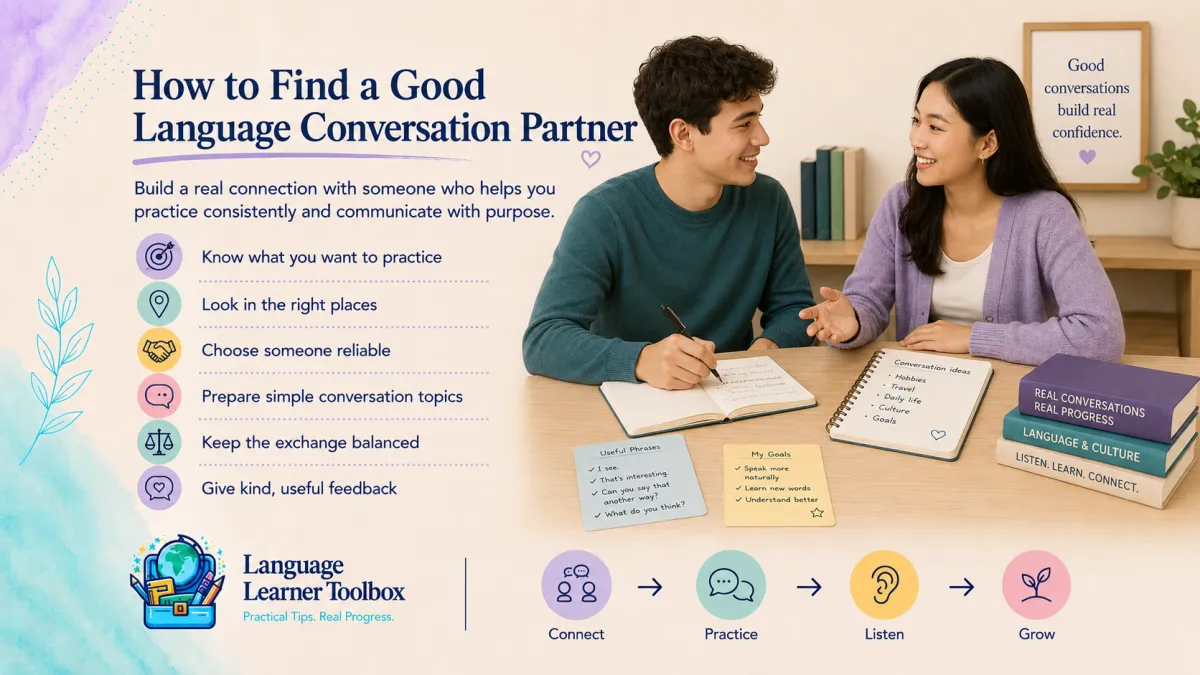
How to Find a Good Language Conversation Partner
A good conversation partner can make language practice feel more natural, useful, and motivating.
They give you a reason to speak. They help you notice what you can already communicate. They expose you to real questions, unexpected responses, and the kind of language that does not always appear in a textbook.
But not every conversation partnership works well.
Some meetings become one-sided. Some partners cancel often. Some conversations stay too simple. Others turn into long grammar lessons, awkward corrections, or casual chatting that never supports either person’s goals.
A strong language partnership is not based only on finding someone who speaks the language you want to learn.
It depends on finding someone who is:
reliable
respectful
willing to share the time fairly
interested in real communication
clear about expectations
patient with mistakes
open to giving and receiving useful feedback
The right partner does not need to be a professional teacher.
They do need to be someone with whom you can practice consistently and communicate honestly.
Begin With Your Goal
Before looking for a partner, decide what you want the partnership to help you do.
Your goal might be:
speak more confidently
improve listening
prepare for travel
practice everyday conversation
learn workplace language
build vocabulary around familiar topics
improve pronunciation
ask better questions
become more comfortable responding without preparation
maintain a language you already know
A clear goal helps you find the right kind of partner.
For example, if you want relaxed everyday conversation, you may not need someone who enjoys detailed grammar correction.
If you are preparing for a job interview, you may want a partner who is willing to role-play and give focused feedback.
If you are a beginner, you may need someone patient enough to speak slowly, repeat, and stay with simple topics.
Ask yourself:
What do I want to be able to do more comfortably after several weeks of practice?
That answer should shape the partnership.
Decide What Kind of Partnership You Want
Language conversation partners can meet in different ways.
You may prefer:
an in-person exchange
online video calls
voice messages
text-based practice
a combination of speaking and writing
short, frequent meetings
one longer weekly session
casual conversation
structured topic practice
equal exchange between two languages
practice only in the language you are learning
There is no single correct format.
The important thing is that both people understand what kind of exchange they are joining.
A partnership becomes difficult when one person expects casual friendship and the other expects organized lessons.
Clarity at the beginning prevents frustration later.
Know Where to Look
Good conversation partners can be found in many places.
Possible places include:
language exchange communities
local libraries
adult education programs
universities
cultural organizations
community centers
international groups
religious communities
neighborhood organizations
professional associations
volunteer groups
social media groups
online learning communities
friends, coworkers, or acquaintances
referrals from teachers or tutors
You do not have to begin with a stranger.
Sometimes the best partner is someone already connected to your community who has similar goals and a compatible schedule.
When looking online, pay attention to profiles that include specific goals, availability, and interests. A thoughtful profile often signals that the person is serious about practicing.
Write a Clear Introduction
When you contact a potential partner, keep your message simple and specific.
Include:
the language you are learning
your approximate level
the language you can offer
what you want to practice
how often you hope to meet
your preferred format
one or two personal interests
For example:
Hi, I am an intermediate English learner and a native Spanish speaker. I would like to practice everyday conversation and speaking more naturally. I can help with Spanish in return. I am available for a 30-minute video call once a week. I enjoy travel, cooking, family topics, and learning about different cultures.
This gives the other person enough information to decide whether the exchange may be a good fit.
Avoid sending only:
Do you want to practice?
A clear introduction makes it easier to begin well.
Look for Reliability
A strong conversation partner does not have to be available constantly.
They do need to be reasonably dependable.
Look for someone who:
responds clearly
agrees on a schedule
arrives on time
gives notice when plans change
follows through
communicates respectfully
takes the exchange seriously
One missed meeting is not a problem.
A repeated pattern of cancellations, disappearing, or last-minute changes may be a sign that the partnership will be difficult to maintain.
Consistency matters because speaking confidence grows through repeated interaction.
Look for Balanced Interest
A good exchange should support both people.
Be cautious if someone:
wants help but shows little interest in helping you
speaks almost entirely in their preferred language
turns every meeting into a lesson for only one person
dominates the conversation
expects professional teaching
avoids your language goals
pressures you to continue when the fit is poor
A healthy exchange feels balanced.
Both people should have time to practice, ask questions, make mistakes, and improve.
Balance does not always mean dividing every minute perfectly. It means both people feel respected and supported.
Choose Someone With Compatible Expectations
A partner may be kind and interesting but still be a poor match.
Before committing, discuss:
how often you want to meet
how long meetings will last
how the time will be divided
which language will be used
whether corrections are welcome
what kinds of topics you enjoy
whether you want structure
whether you will prepare in advance
what happens if someone needs to cancel
This conversation may feel formal, but it helps.
You do not need a complicated agreement.
You do need shared expectations.
Start With a Short Trial
You do not have to commit to a long-term partnership after one message.
Start with one short meeting.
Twenty or thirty minutes may be enough.
During the first conversation, notice:
Does the conversation feel respectful?
Is the other person patient?
Do they ask questions?
Do you both have time to speak?
Is the language level manageable?
Are the expectations similar?
Do you feel comfortable enough to try again?
Does the schedule seem realistic?
A trial meeting gives both people permission to evaluate the fit.
You can continue if it works.
You can politely move on if it does not.
Prepare Simple Conversation Topics
Even a good partner cannot create a useful conversation alone.
Preparation helps.
Before meeting, choose one or two topics such as:
daily routines
food
family
travel
work
hobbies
holidays
childhood memories
goals
local culture
books
movies
health habits
education
weekend plans
Write down:
five useful words
three questions
one personal story or example
one phrase you want to practice
This small amount of preparation can make the conversation much easier.
It reduces pressure and gives both partners something to build on.
Use Questions That Invite Real Answers
Closed questions often lead to short conversations.
For example:
Do you like music?
The answer may be only:
Yes.
A more useful question is:
What kind of music do you listen to when you want to relax?
That question invites detail.
Good conversation questions often begin with:
What
Why
How
Tell me about
What do you think about
What was it like when
How has that changed
What would you recommend
Ask follow-up questions when something is interesting.
For example:
Why do you enjoy that?
How did you get started?
What happened next?
Is that common where you live?
Follow-up questions turn practice into real communication.
Agree on How to Divide the Time
If both people are practicing different languages, divide the time clearly.
For a 40-minute meeting, you might use:
20 minutes in one language
20 minutes in the other
Or:
one language this week
the other language next week
Or:
one topic in each language
Choose a system that feels fair and easy to remember.
Without a plan, the stronger speaker may dominate, or the conversation may stay in the easier language.
A simple structure protects both people’s practice time.
Decide How Corrections Will Work
Correction can be helpful.
Too much correction can make speaking tense and unnatural.
Before practicing, decide what kind of feedback you want.
Possible options include:
correct only mistakes that affect meaning
save corrections until the end
correct pronunciation immediately
write down repeated mistakes
help with one or two important patterns
suggest a more natural phrase
do not interrupt unless asked
You might say:
Please let me finish my idea before correcting me.
Or:
Correct only the mistakes that make my meaning unclear.
Or:
At the end, please tell me two things I can improve.
This keeps feedback useful and manageable.
Give Feedback Kindly
If you are also helping your partner, avoid correcting every mistake.
Useful feedback is:
specific
respectful
limited
connected to meaning
easy to apply
Instead of saying:
That is wrong.
Try:
I understood you. A more natural way to say it would be...
Or:
That word works, but this phrase is more common.
Or:
Your meaning was clear. One small change would make it sound more natural.
Feedback should build confidence, not reduce it.
Be Patient With Silence
Real conversation includes pauses.
Language learners need time to:
understand the question
find vocabulary
organize an answer
correct themselves
decide what to say next
Do not rush to fill every silence.
A patient partner gives the learner enough time to respond.
You can help by:
repeating the question
simplifying it
giving a sentence starter
offering two possible words
asking a smaller follow-up question
Support the conversation without taking it over.
Keep the Difficulty Appropriate
A good partner adjusts when needed.
If the conversation is too difficult, ask for:
slower speech
shorter questions
simpler vocabulary
repetition
examples
one question at a time
more familiar topics
If it is too easy, ask for:
follow-up questions
longer answers
opinions
storytelling
more natural speed
unfamiliar topics
explanations
comparisons
The best practice is challenging enough to create growth but manageable enough to continue.
Use the Partnership for Real Communication
Conversation practice should not become only grammar correction.
Use the time to:
share opinions
explain experiences
tell stories
ask genuine questions
compare cultures
solve small problems
plan imaginary trips
describe routines
discuss goals
practice real-life situations
Meaningful interaction makes language easier to remember.
It also helps both people build a real connection.
A conversation partner is not simply a speaking machine.
They are another person.
Protect Personal Boundaries
A good partnership should feel safe and respectful.
Especially when meeting online, be cautious about sharing:
your home address
financial information
private documents
account passwords
detailed travel plans
personal identification
information about children
anything that makes you uncomfortable
Use the platform’s communication tools until trust develops.
For in-person meetings, choose public places at first.
If someone behaves inappropriately, pressures you, ignores your boundaries, or makes you uncomfortable, end the interaction.
Language practice is never more important than personal safety.
Do Not Expect a Partner to Be a Teacher
A conversation partner may speak the language fluently and still be unable to explain grammar.
Native or fluent speakers often know what sounds right without knowing why.
A partner can be excellent for:
conversation
listening
natural phrases
pronunciation models
cultural information
feedback on clarity
real interaction
They may not be the best person for:
detailed grammar instruction
exam preparation
professional editing
specialized pronunciation coaching
diagnosing complex errors
Use a teacher, tutor, or reliable reference when you need formal instruction.
Let the conversation partner help with communication.
Review After Each Meeting
Spend a few minutes reflecting.
Write down:
one thing you communicated well
one useful phrase you heard
one word you wanted but could not remember
one correction worth reviewing
one topic to revisit
one goal for the next meeting
This turns the conversation into continued learning.
You can also send a short follow-up message:
Thank you. I enjoyed talking about travel today. Next time, I would like to practice describing past experiences.
That creates continuity.
Build a Simple Meeting Structure
A clear structure makes the exchange easier to repeat.
A 30-minute meeting might look like this:
First 5 minutes: Warm up
Talk briefly about the week.
Next 10 minutes: Prepared topic
Use questions and useful vocabulary.
Next 10 minutes: Second language or partner’s goal
Switch roles if it is an exchange.
Final 5 minutes: Feedback and next step
Share one helpful correction and choose the next topic.
The structure should support the conversation, not make it rigid.
Know When the Partnership Is Working
A good partnership usually helps you:
speak more often
feel less nervous
respond more naturally
ask better questions
notice useful phrases
understand more varied speech
become more comfortable making mistakes
look forward to practicing
You should not expect every meeting to be perfect.
Look for steady usefulness over time.
Know When to Make a Change
It may be time to adjust or end the partnership when:
meetings are repeatedly canceled
the exchange is consistently one-sided
your goals are ignored
the other person is disrespectful
you feel pressured or unsafe
the language level is a poor match
feedback is discouraging or unhelpful
neither person is preparing
the meetings no longer support your goals
You can first try changing the structure.
For example:
Could we divide the time more clearly?
Could we prepare one topic before each meeting?
I would like fewer corrections while I am speaking.
If the partnership still does not work, it is acceptable to stop.
You might say:
Thank you for practicing with me. I am changing my study schedule and will not be able to continue our regular meetings. I appreciate the conversations we had.
You do not have to continue an unhelpful exchange out of guilt.
A Good Partner Is Not a Perfect Partner
Your conversation partner does not need to:
correct everything
explain every rule
share all your interests
speak exactly the variety you expected
become a close friend
make every conversation easy
They do need to be respectful, reasonably reliable, and willing to support balanced practice.
The partnership can improve over time as both people learn what works.
Try This Before Your First Meeting
Complete these sentences:
The language skill I most want to practice is:
I would like to meet:
My preferred meeting length is:
Topics I enjoy include:
I would like corrections:
I can help my partner by:
A successful first meeting would include:
Then prepare three questions and five useful words.
That is enough to begin.
The Best Conversation Partner Helps You Use the Language
A good conversation partner gives you more than correction.
They give you space to think, respond, listen, connect, and try again.
The right partnership should help both people:
practice consistently
communicate with purpose
learn from each other
feel respected
build confidence
keep growing
Start with clear goals.
Choose someone reliable.
Keep the exchange balanced.
Prepare enough to make the conversation useful.
Then let the language become what it was meant to be: a way to connect with another person.
Remember This
A good conversation partner does not need to be a perfect teacher.
They need to be reliable, respectful, curious, and willing to practice with you.
The best partnerships grow when both people feel heard, supported, and equally invested in the exchange.
Ready for Your Next Step?
The Language Learner’s Workbook: A Guide for Conversation Practice gives language partners 24 structured topics with meaningful questions, vocabulary activities, preparation support, reflection, homework, and ideas for continued practice.
Instead of beginning each meeting by wondering what to discuss, you can arrive with a clear topic and a practical plan for making the conversation count.
If you are working on making conversation practice part of your regular routine, the 21-Day Language Habit Bootcamp offers one practical step each day to help you build consistency and keep showing up.

