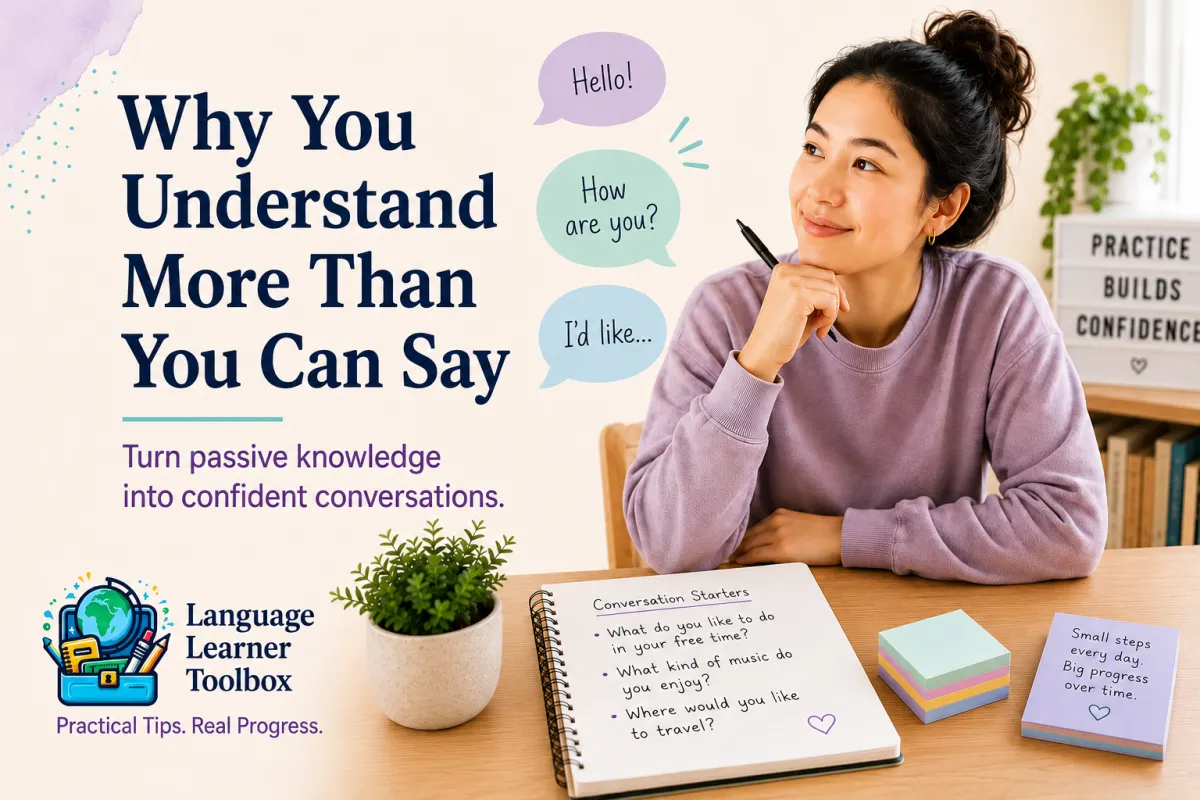
Why You Understand More Than You Can Say (and How to Close the Gap)
Many language learners understand far more than they can comfortably speak. If you've ever thought, "I know this...why can't I say it?" you're not alone. Here's why it happens, and what you can do about it.
Have you ever watched a movie in your target language and understood quite a bit...
...only to freeze when someone asked you a simple question?
Or maybe you recognize vocabulary while reading, but when it's your turn to speak, the words seem to disappear.
If that sounds familiar, you're experiencing something that almost every language learner goes through.
Understanding a language and producing it are two different skills.
The encouraging news is that this gap is completely normal, and it can be narrowed with the right kind of practice.
Why understanding develops first
Your brain usually learns to recognize language before it learns to produce it.
Every time you listen or read, your brain is collecting patterns.
You recognize words.
You notice grammar.
You begin to predict what comes next.
This is called receptive language.
Speaking, however, requires something different.
You must:
remember vocabulary quickly
choose the correct grammar
pronounce the words
organize your thoughts
respond in real time
That is a much more demanding task.
It isn't surprising that speaking feels harder.
Knowing a word isn't the same as using it
Many learners assume that if they know a word, they should be able to use it immediately.
But recognition and recall are different.
Imagine seeing someone you recognize from work.
You know you know them.
But suddenly you can't remember their name.
Language works the same way.
Sometimes the word is there, it just isn't easy to retrieve yet.
That doesn't mean you haven't learned it.
It means your brain needs more opportunities to use it.
The bridge is active practice
The fastest way to close the gap between understanding and speaking is to move information from passive recognition into active use.
Instead of only reading vocabulary...
say it aloud.
Instead of only listening...
pause and repeat.
Instead of only studying grammar...
use one new sentence in a conversation.
Every time you produce language, your brain strengthens the pathway that makes future speaking easier.
Start with language you already know
One mistake many learners make is trying to speak about topics that are too advanced.
Instead, begin with language you already understand well.
Practice talking about:
your family
your hobbies
your daily routine
your work or school
your favorite foods
You already know much of this vocabulary.
Now your goal is simply to make it easier to retrieve.
Repeat yourself on purpose
Repetition isn't boring.
It is how fluency develops.
Try saying the same sentence several different ways.
Instead of saying it once and moving on, repeat it tomorrow.
Repeat it next week.
Use it in different situations.
Confidence often grows through familiarity.
Give yourself time to think
Real conversations happen quickly.
Practice doesn't have to.
When you practice alone, slow down.
Pause.
Think.
Choose your words carefully.
As your confidence grows, your speed will naturally increase.
There is no prize for speaking fast.
There is great value in speaking clearly.
Celebrate what you already understand
Sometimes learners become discouraged because they focus only on what they cannot say.
Instead, notice how much you already understand.
Every podcast you follow...
Every page you read...
Every conversation you partially understand...
Those are signs that your language ability is growing.
Speaking is simply catching up.
The gap gets smaller with practice
The difference between understanding and speaking is not a sign that something is wrong.
It is one of the most normal stages of language learning.
Every sentence you say...
Every question you ask...
Every conversation you attempt...
helps close that gap.
Over time, the words that once felt stuck begin to come more naturally.
One conversation at a time.
Ready for your next step?
If you're ready to move from understanding a language to confidently speaking it, the Language Learner's Workbook: A Guide for Conversation Practice gives you structured conversations that help you use the language you already know.
And if you're looking for simple daily routines that build lasting confidence, the 21-Day Language Habit Bootcamp will help you create a practice habit that fits real life.

