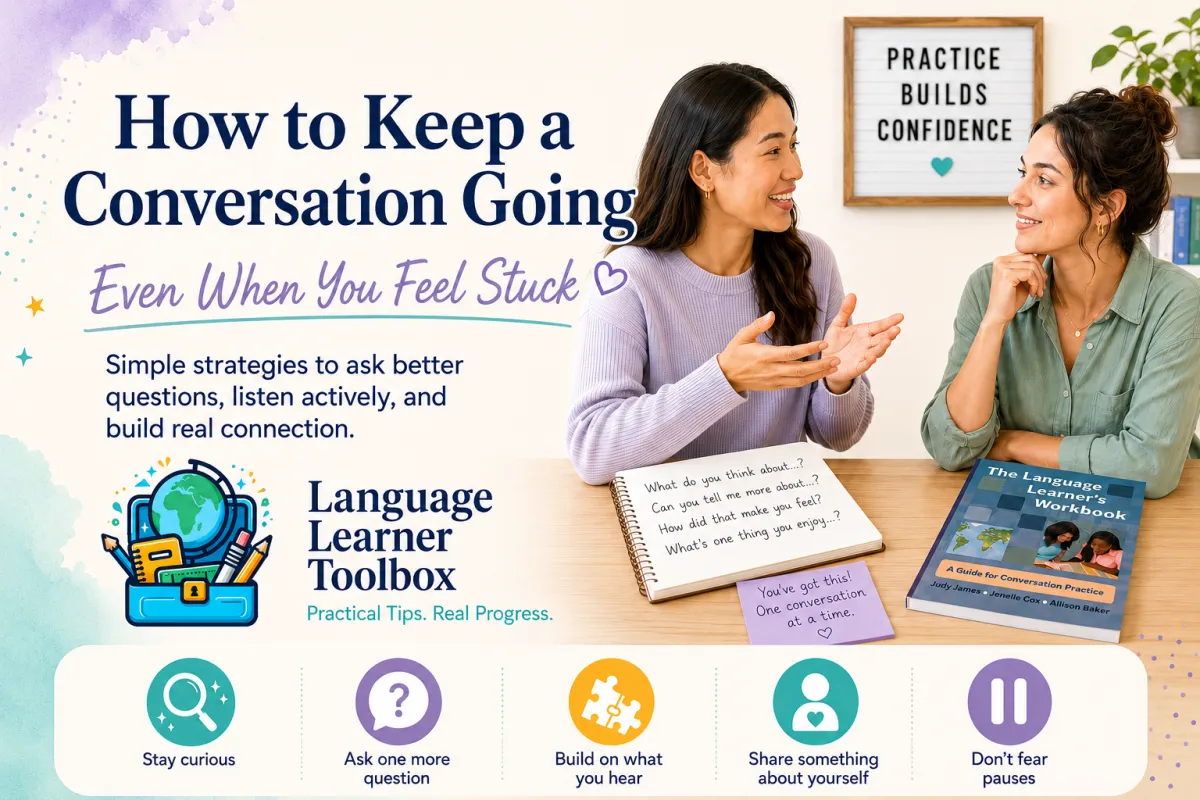
How to Keep a Conversation Going (Even When You Feel Stuck)
Conversation is a skill, not a test.
Many language learners worry about saying the right thing.
But after they ask one question or answer one question, another challenge appears.
The conversation slows down.
There is a pause.
Someone smiles politely.
And suddenly both people are wondering what to say next.
If you've experienced that moment, you're not alone.
Keeping a conversation going is a skill that every speaker develops over time—even in their first language.
The good news is that it doesn't depend on having perfect grammar or an advanced vocabulary.
Instead, it comes from learning a few simple habits that make conversations feel natural.
Stay curious
One of the easiest ways to keep a conversation moving is to become genuinely interested in the other person.
Instead of thinking,
"What should I say next?"
Try asking,
"What would I like to know?"
Curiosity creates better conversations than memorized questions ever will.
Many learners discover that speaking becomes easier when they stop worrying about perfection and simply practice having conversations.
Ask one more question
Many conversations end simply because both people answer the question and stop.
Instead of moving on immediately, ask one more follow-up question.
For example:
"What do you do?"
"I'm a nurse."
Instead of saying,
"That's nice."
Try asking:
"What made you choose nursing?"
or
"What do you enjoy most about it?"
Those small follow-up questions often lead to much richer conversations.
Build on what you hear
Good conversations are connected.
Listen for something you can build on.
If someone says,
"I love hiking."
You might ask,
"What's your favorite place you've hiked?"
or
"I've never tried hiking there. What is it like?"
Notice that you don't have to change the subject.
You simply stay with the idea a little longer.
Share something about yourself
A conversation shouldn't feel like an interview.
Even if you forget a word, you can usually describe your idea and keep the conversation moving.
After asking a question, share a small piece of your own experience.
For example:
"I enjoy cooking too."
"I've always wanted to visit there."
"That reminds me of…"
Those small connections help conversations feel more natural and balanced.
Don't fear pauses
Many learners think silence means something went wrong.
It doesn't.
Short pauses happen in every language.
People think.
They remember.
They choose their words.
A brief pause is often a sign that people are engaged, not that the conversation has failed.
Remember your goal
Your goal isn't to impress someone.
Your goal is to connect with another person.
When you focus on connection instead of performance, conversations often become easier.
People usually remember how comfortable they felt talking with you much more than whether every sentence was perfect.
Building confidence happens one conversation at a time.
Remember This
Great conversations aren't built by knowing every answer.
They're built by showing genuine curiosity, listening carefully, and helping another person feel heard.
Ready for Your Next Step?
The Language Learner's Workbook: A Guide for Conversation Practice provides structured conversation topics and guided questions that help you practice exactly these skills with a conversation partner.
If you're working to build consistent speaking confidence, the 21-Day Language Habit Bootcamp offers practical daily encouragement to help you keep progressing one conversation at a time.

