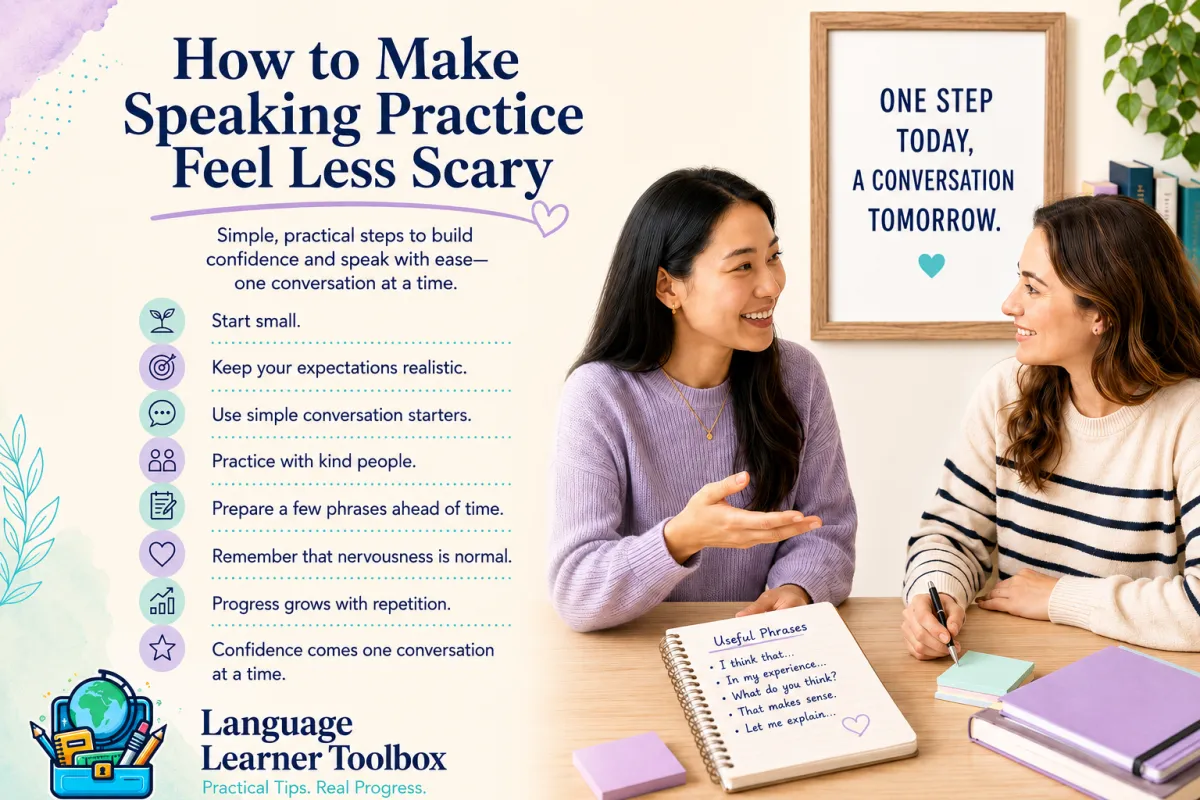
How to Make Speaking Practice Feel Less Scary
Many language learners understand far more than they feel comfortable saying.
You may recognize hundreds, or even thousands, of words. You may enjoy reading, listening to podcasts, or watching videos in your target language. You know you've been learning.
But then someone asks you a simple question...
…and suddenly your mind goes blank.
If that has happened to you, you're not alone.
Speaking often feels like the biggest hurdle in language learning because it puts everything together at once. You have to remember vocabulary, build sentences, pronounce words, listen, and respond, all in real time.
The good news is that confidence doesn't appear overnight.
It grows through repeated speaking experiences that feel manageable.
At Language Learner Toolbox, we believe that real progress comes from small, consistent steps rather than overwhelming yourself with impossible goals.
Here are several ways to make speaking practice feel less intimidating and more successful.
1. Start with smaller speaking moments
Speaking practice doesn't have to begin with a thirty-minute conversation.
In fact, for many learners, that creates unnecessary pressure.
Instead, start with moments that feel easy enough to repeat tomorrow.
For example:
Say one sentence out loud.
Read a short paragraph aloud.
Repeat after an audio recording.
Introduce yourself.
Describe one object near you.
Answer one simple question aloud.
These small victories help your mouth, ears, and brain begin working together.
Every successful speaking experience builds confidence for the next one.
2. Practice language you already know
One reason speaking feels stressful is that learners often try to produce completely new language.
Instead, begin with familiar material.
Practice:
greetings
self-introductions
everyday questions
common phrases
vocabulary you've already studied
Confidence grows faster when you build on something familiar instead of starting from scratch every time.
3. Let repetition work in your favor
Many learners worry that repeating themselves means they aren't improving.
Actually, repetition is one of the fastest paths toward confident speaking.
Repeating useful phrases helps you:
remember vocabulary more quickly
improve pronunciation
reduce hesitation
build automatic responses
Professional musicians repeat.
Athletes repeat.
Language learners should too.
The goal isn't to say something different every day.
The goal is to make speaking feel more natural.
4. Stop trying to sound perfect
Many learners believe they should wait until they can speak without mistakes.
Unfortunately, that day never comes.
Mistakes are not evidence that you're failing.
They're evidence that you're learning.
Real conversations include pauses, corrections, forgotten words, and imperfect grammar—even among native speakers.
The goal of speaking practice is not to prove that you're already fluent.
The goal is to become more comfortable using the language.
Every conversation makes the next one a little easier.
5. Practice before you practice
You don't have to jump directly into a conversation.
You can prepare first.
Try:
talking to yourself while getting ready
reading a paragraph aloud
repeating after a podcast
answering simple prompts
rehearsing what you plan to say
These low-pressure activities reduce anxiety and help you feel ready before speaking with another person.
6. Be realistic on busy days
Consistency matters more than intensity.
Some days you'll have an hour.
Other days you'll have five minutes.
Both count.
On busy days you might:
review yesterday's vocabulary
answer one question aloud
listen to a short recording
describe your day in three sentences
Language learning doesn't stop being valuable because today's practice was short.
Small practice sessions keep the habit alive.
And habits are what create long-term progress.
7. Make tomorrow easier
One of the best language-learning strategies is to leave yourself an easy starting point for tomorrow.
Before you finish today, ask yourself:
"What is one small thing I can do tomorrow?"
Maybe it's reviewing one conversation.
Maybe it's practicing five phrases.
Maybe it's reading one paragraph aloud.
Small successes create momentum.
Momentum creates consistency.
Consistency creates confidence.
Confidence grows one conversation at a time
If speaking feels intimidating today, don't assume something is wrong with you.
Almost every language learner feels nervous at some point.
The difference between learners who eventually become confident speakers and those who give up is rarely talent.
More often, it's consistency.
Instead of waiting until you feel confident before speaking...
Speak in small ways until confidence begins to grow.
That is how real progress happens.
Ready for your next step?
If you'd like help building a language-learning routine you can actually stick with, start with the free 21-Day Language Habit Bootcamp.
Inside the Bootcamp, you'll learn practical daily strategies that make consistency easier, even when life gets busy.
And when you're ready to practice real conversations,The Language Learner's Workbook: A Guide for Conversation Practice provides structured speaking activities designed to help you build confidence one conversation at a time.
Small steps.
Purposeful practice.
Real progress.

