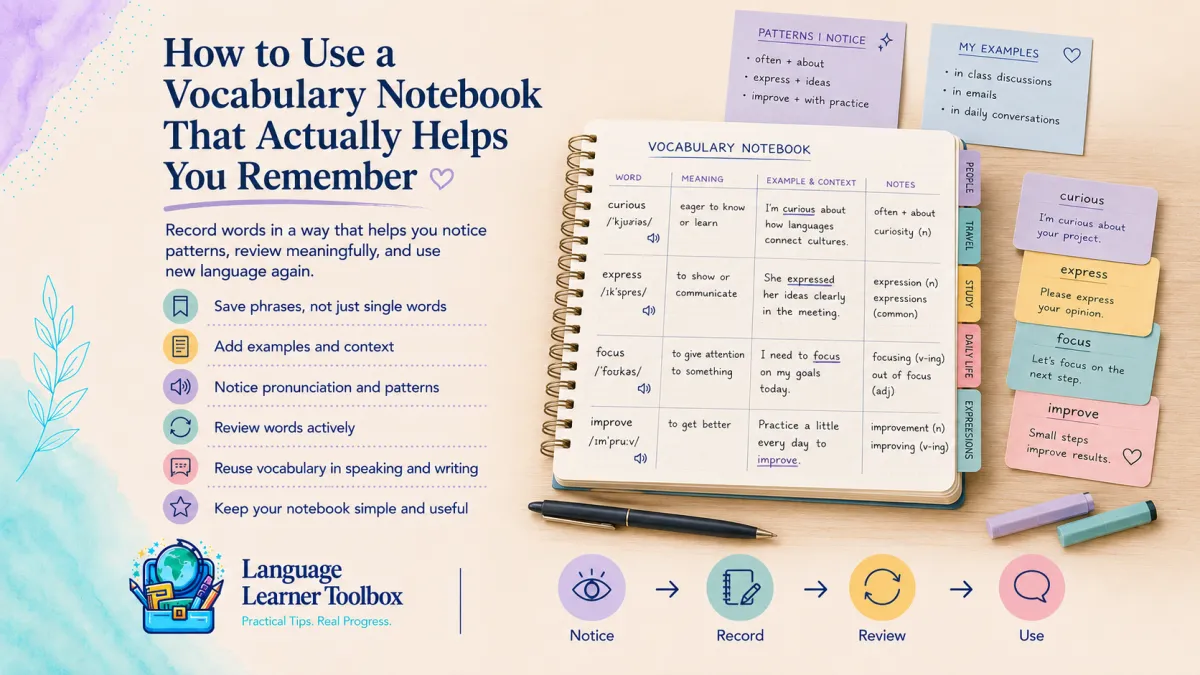
How to Use a Vocabulary Notebook That Actually Helps You Rem
A vocabulary notebook can be one of the most useful tools in language learning.
It can also become a long list of words you rarely review and never use.
Many learners carefully copy unfamiliar words, add translations, and fill page after page. The notebook looks productive, but the vocabulary does not always become available when they need it.
The problem is usually not the notebook itself.
The problem is how the words are recorded and what happens after they are written down.
A useful vocabulary notebook should help you:
understand words in context
remember useful phrases
retrieve language without looking
notice patterns
review at helpful intervals
use new vocabulary in speaking and writing
The goal is not to collect as many words as possible.
The goal is to make useful language easier to recognize, remember, and use.
Choose Vocabulary Worth Keeping
Not every unfamiliar word belongs in your notebook.
Some words are highly specialized. Others appear once and may never be useful again. Recording every unknown word can create an overwhelming list that is difficult to review.
Choose words and phrases that are:
connected to your goals
useful in your daily life
common in the situations you encounter
repeated in your reading or listening
important to understanding the main idea
words you have wanted to use but could not remember
phrases that sound natural and reusable
vocabulary related to work, travel, family, hobbies, or study
Ask yourself:
Am I likely to hear, read, say, or write this again?
If the answer is yes, it may be worth saving.
Save Phrases, Not Only Individual Words
A single word often does not give you enough information to use it correctly.
Suppose you write:
appointment
You may understand the meaning, but still not know how to use it naturally.
A more useful entry might include:
make an appointment
cancel an appointment
appointment with a doctor
I would like to make an appointment for Tuesday.
This shows how the word behaves.
Whenever possible, record:
a common phrase
a useful sentence pattern
words that often appear together
the preposition used with the word
one natural example
Language is easier to use when you learn it in meaningful pieces.
Record the Meaning in Context
Many words have more than one meaning.
Do not copy the first translation or definition without checking whether it fits the sentence where you found the word.
Record:
the meaning in that specific context
the original sentence or a shortened version
the topic or situation
a simple explanation in your own words
For example, instead of recording every possible meaning of run, record the meaning connected to the sentence you encountered:
run a business
Meaning: manage or operate a business
Context makes the entry more useful and easier to remember.
Use Simple Definitions
A vocabulary notebook should make words easier to understand.
Do not fill it with complicated dictionary definitions you would never say yourself.
Use:
a simple translation
a short explanation
a synonym you already know
a picture or symbol
a brief example
For example:
exhausted
very tired
That may be more useful than a long formal definition.
The explanation only needs to help you remember the meaning accurately.
Include Pronunciation
A word is not fully useful if you recognize it in writing but cannot understand or say it.
Add pronunciation support when needed.
You might record:
the stressed syllable
a phonetic spelling you understand
a difficult sound
a rhyme or comparison
an audio link
a note about connected speech
a regional pronunciation difference
For example:
de-CI-sion
Stress on the second syllable
You do not need to create a complex pronunciation system.
Record only what will help you say or recognize the word more accurately.
Add the Part of Speech
Knowing whether a word is a noun, verb, adjective, or adverb helps you use it correctly.
For example:
decision — noun
decide — verb
decisive — adjective
This can also help you notice word families.
You do not need to record every related form. Add the ones you are likely to use.
Notice Common Word Partners
Words often appear in predictable combinations.
These combinations are called collocations.
Examples include:
make a decision
take responsibility
heavy traffic
deeply worried
highly recommended
A learner may understand each word separately but still choose an unnatural combination.
When you record a new word, notice what commonly appears with it.
Add:
common verbs
common adjectives
common nouns
typical prepositions
useful sentence frames
This helps your language sound more natural.
Add One Example From Your Own Life
Personal examples are easier to remember than generic ones.
After recording a word or phrase, write a sentence connected to your own experience.
For example:
postpone
We had to postpone our trip because of the weather.
Or:
be responsible for
I am responsible for preparing the weekly report.
Your sentence does not need to be complicated.
It should be meaningful enough that you can imagine using it again.
Leave Space to Add More Later
Vocabulary knowledge grows over time.
You may first learn a basic meaning and later notice:
another meaning
a common phrase
a pronunciation change
a formal or informal use
a related word
a useful correction
a new example
Leave some space around important entries.
A vocabulary notebook can become a developing reference rather than a finished list.
Organize the Notebook in a Way You Will Use
There is no single correct system.
You might organize vocabulary by:
topic
date
source
situation
skill
alphabetical order
weekly lesson
work, travel, family, or daily life
words you understand versus words you can use
Choose the system that makes review easy.
By Topic
Useful for vocabulary connected to:
travel
health
work
food
education
relationships
hobbies
By Date
Simple and easy to maintain.
This works well if you review recent entries regularly.
By Source
You might have sections for:
podcasts
tutor sessions
conversation practice
reading
work
television or videos
By Use
You could separate:
words I recognize
phrases I want to use
corrections
pronunciation
questions
A simple system you maintain is better than an elaborate one you abandon.
Do Not Make the Notebook Too Beautiful to Use
A neat notebook can be enjoyable.
But perfection can become a barrier.
You do not need:
perfect handwriting
decorated pages
complex color coding
complete definitions
carefully rewritten entries
identical layouts
Your notebook should show evidence of learning.
Cross things out.
Add corrections.
Circle important phrases.
Write questions.
Return to old pages.
A useful notebook may look active and imperfect.
Limit How Many New Entries You Add
Adding too many words at once makes review difficult.
You might choose:
three useful phrases from a conversation
five words from a lesson
one expression from a podcast
two corrections from a tutor session
a small group of words connected to one topic
The ideal number depends on your time and goals.
The important question is:
Can I review and use these words again?
Ten words you practice are more valuable than fifty words you copy and forget.
Review Soon After Writing
The first review should happen while the vocabulary is still familiar.
Return to the new entry later the same day or the next day.
Try to:
recall the meaning
say the word aloud
cover the example and complete it
create another sentence
remember the phrase without looking
explain where you found it
A short early review strengthens the memory.
Retrieve Before You Reread
Rereading feels familiar, but familiarity is not the same as recall.
Before looking at the answer, try to remember it.
You can:
cover the meaning
cover the word
hide part of the phrase
look at the topic and recall the vocabulary
read the example with one word missing
say your personal sentence without looking
This effort is called retrieval.
Retrieval makes vocabulary easier to access later in real communication.
Review in Both Directions
Many learners review only from the new language to their first language.
That helps recognition.
You also need to practice moving from meaning to the new language.
For example:
Recognition
See:
postpone
Recall:
move something to a later time
Production
See:
move something to a later time
Recall:
postpone
Practice both directions.
Speaking and writing require production, not only recognition.
Use Spaced Review
Vocabulary becomes stronger when you return to it over time.
You do not need to review every word every day.
A simple schedule might be:
the same day
the next day
three days later
one week later
two weeks later
one month later
Words that are easy can be reviewed less often.
Words that are difficult can return sooner.
The schedule does not have to be exact.
The principle is to review before the word disappears completely from memory.
Mark Words by Strength
Create a simple way to show how well you know an entry.
You might use:
a star for important words
a check mark for words you can use
a question mark for confusing entries
a circle for pronunciation practice
one, two, or three dots for strength
different sections for new, developing, and ready to use
For example:
New:I recognize it with help.
Developing:I can recall it after thinking.
Ready:I can use it naturally.
This helps you focus review where it is needed.
Say the Vocabulary Aloud
Silent review does not fully prepare you for speaking.
When reviewing, say:
the word
the phrase
the example
your personal sentence
a short answer using the vocabulary
You can also record yourself and listen back.
Speaking the vocabulary helps connect meaning, pronunciation, and retrieval.
Turn the Page Into Conversation Practice
Use your notebook to create questions.
If the entry is:
make a difficult decision
Ask:
What is a difficult decision you have made?
If the entry is:
look forward to
Ask:
What are you looking forward to this month?
This turns vocabulary review into meaningful speaking.
You can use the questions:
alone
with a tutor
with a conversation partner
with AI
as journal prompts
Vocabulary becomes easier to remember when it carries an idea you want to express.
Use the Vocabulary in Writing
Choose several entries and use them in:
a short paragraph
an email
a journal entry
a story
a social media caption
a description
answers to conversation questions
Do not force every word into one sentence.
Choose vocabulary that fits naturally.
Then review whether you used it correctly.
Connect New Vocabulary to Old Vocabulary
New words are easier to remember when they connect to something you already know.
You might add:
synonyms
opposites
categories
word families
related phrases
similar sounds
shared roots
For example:
increase
opposite: decrease
noun: an increase
phrase: increase gradually
These connections create a stronger memory network.
Group Vocabulary by Situation
Instead of reviewing random words, build useful sets.
For example:
At a Doctor’s Appointment
describe symptoms
make an appointment
fill a prescription
side effects
feel dizzy
Talking About Work
meet a deadline
handle a problem
be responsible for
ask for clarification
give an update
Travel
confirm a reservation
miss a connection
carry-on luggage
ask for directions
check in
Situational groups make the vocabulary easier to use in real communication.
Record Corrections From Speaking and Writing
Some of the most valuable vocabulary comes from language you tried to use but could not.
After a conversation, tutor session, or writing task, record:
the word you needed
the phrase you used incorrectly
a more natural version
one example
the situation where it occurred
These entries are highly relevant because they fill a real communication gap.
Add Useful Sentence Starters
Fluent communication often depends on phrases that help you begin.
Examples include:
In my experience...
One reason is...
I am not completely sure, but...
What I mean is...
It depends on...
I would recommend...
The main difference is...
Something similar happened to me...
These may be more useful than isolated nouns.
A notebook should include language for organizing thoughts, not only naming things.
Learn Fewer Words More Deeply
Knowing a word includes more than recognizing its translation.
You may need to know:
meaning
pronunciation
spelling
part of speech
grammar pattern
common partners
formality
typical context
related forms
how to use it yourself
You do not need all of this information for every entry.
But deeper knowledge of useful words creates more confident communication.
Use Pictures and Symbols When Helpful
Visual support can make some words easier to remember.
You might add:
a quick sketch
a symbol
a small diagram
arrows
a timeline
an emotion face
a location map
a contrast between two words
The picture does not need to be artistic.
It only needs to help you recall the meaning.
Use Color With a Purpose
Color can support organization, but too much can become distracting.
You might use one color for:
pronunciation
corrections
examples
phrases to use
difficult words
Keep the system simple enough that you do not spend more time formatting than practicing.
Test Yourself With Blank Pages
Occasionally close the notebook and write what you remember.
Choose a topic such as travel or work.
Then list:
useful words
phrases
questions
sentence starters
Afterward, compare your list with the notebook.
This reveals what is available from memory and what still needs review.
Revisit Vocabulary During Real Activities
Before reading, listening, speaking, or writing, review vocabulary connected to the topic.
For example:
Before a conversation about travel:
review five travel phrases
choose two sentence starters
prepare one story
decide which words you want to use
After the activity:
mark what you used
add missing vocabulary
correct unnatural phrases
write one improved example
This creates a useful practice cycle.
Remove or Retire Entries
Your notebook does not need to hold every word forever.
Some vocabulary may become:
too easy
no longer relevant
duplicated
incorrect
less useful than you expected
You might move mastered words to a completed section or mark them as ready.
This keeps the active review list manageable.
Review the Notebook, Not Just the Newest Page
It is easy to keep adding new entries while older ones disappear.
Set aside regular review time.
You might:
review one old page each day
revisit one topic each week
choose five older phrases for conversation
review the previous month
create a weekly quiz
use old vocabulary in new writing
A notebook is useful only when you return to it.
Use a Weekly Vocabulary Routine
A simple weekly routine might look like this:
Collect
Choose a small number of useful words and phrases.
Clarify
Check meaning, pronunciation, context, and natural use.
Personalize
Add your own examples.
Retrieve
Practice without looking.
Use
Include the vocabulary in speaking or writing.
Review
Return to older entries.
This keeps the notebook connected to real learning.
Avoid Common Vocabulary Notebook Mistakes
Be cautious if you are:
recording every unfamiliar word
copying long definitions
writing only translations
never including phrases
reviewing only by rereading
adding words but never using them
creating a complicated system
focusing more on appearance than practice
keeping several notebooks you rarely open
waiting until you have time for a perfect review session
A simple, active notebook is enough.
Know Whether the Notebook Is Helping
A vocabulary notebook is working when you notice that you can:
recognize words more quickly
recall them without looking
use phrases in conversation
understand them in listening
choose more natural combinations
write with more variety
notice repeated vocabulary
recover words you previously forgot
connect new language to your life
Page count is not the goal.
Usable language is the goal.
Try This With One Vocabulary Entry
Choose one useful word or phrase.
Record:
The word or phrase
Its meaning in context
A common word partner
Pronunciation or stress
One original example
One question you could answer with it
The date you will review it again
Then close the notebook and say the phrase from memory.
Finally, use it in a sentence about your own life.
That sequence is more valuable than copying ten new words.
Remember This
A vocabulary notebook should not become a storage place for words.
It should become a practice space for language you want to use.
Save fewer words, record them in context, return to them over time, and use them in meaningful speaking and writing.
Ready for Your Next Step?
The Learning Tools & Resources page brings together practical guides, workbooks, and downloadable support to help you choose and use language-learning tools more effectively.
If you want to build vocabulary into a consistent learning routine, the Language Learning Habit Stack Workbook can help you attach small review and practice actions to habits already present in your day.
If your goal is to use new vocabulary more naturally in conversation,The Language Learner’s Workbook: A Guide for Conversation Practice provides structured topics, questions, vocabulary preparation, and reflection for practice with a partner.

