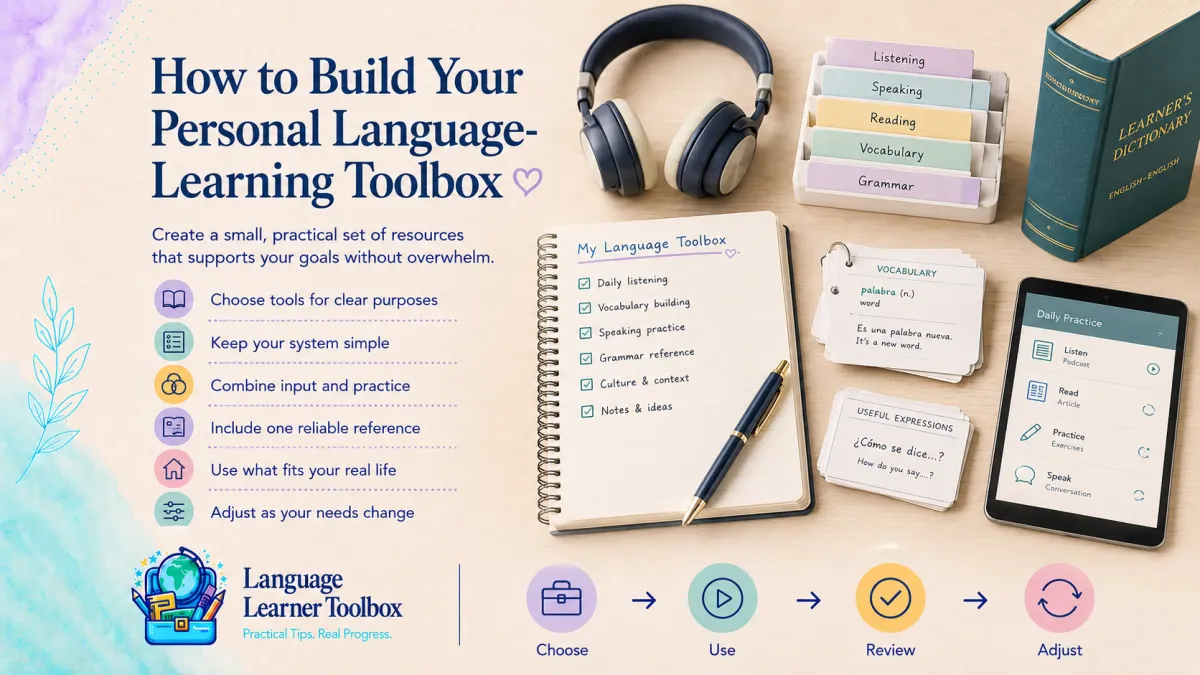
How to Build Your Personal Language-Learning Toolbox
Language learners have access to more resources than ever.
You can choose from apps, workbooks, tutors, podcasts, videos, dictionaries, AI tools, conversation partners, online courses, vocabulary systems, and free practice materials.
That variety can be helpful.
It can also make learning feel scattered.
You may use one app for a few days, begin a workbook, save several videos, download a vocabulary list, subscribe to a course, and still wonder what you should actually do next.
The solution is not always another resource.
It is often a smaller, more purposeful collection of tools.
A personal language-learning toolbox is a set of resources with clear jobs. Each tool supports a specific part of your learning, fits your schedule, and works with the other tools you have chosen.
The goal is not to build the largest toolbox.
It is to build one you can use.
Begin With Your Current Goal
Your toolbox should be built around what you want to improve now.
A broad goal such as “learn French” is too general to guide your choices.
A clearer goal might be:
speak more confidently in everyday conversations
understand natural speech more easily
build a consistent study routine
remember useful vocabulary
prepare for travel
improve workplace communication
write more clearly
prepare for a test
maintain a language you already know
practice regularly with a conversation partner
Choose one primary goal.
You may have several interests, but one priority helps you decide which tools deserve your attention.
Ask:
What would I most like to do more easily one month from now?
Your toolbox should support that answer.
Identify the Skills Your Goal Requires
Once you know your goal, break it into the skills you need.
For example, if your goal is to speak more confidently, you may need:
useful vocabulary
listening practice
sentence-building
conversation questions
pronunciation support
repeated speaking
feedback
opportunities to respond without preparation
If your goal is to understand podcasts, you may need:
level-appropriate audio
transcripts
vocabulary preparation
repeated listening
note-taking
summarizing
pronunciation awareness
The tools should match the skills.
Do not add a resource simply because it is popular or interesting.
Add it because it helps you practice something your goal requires.
Give Every Tool a Job
A useful toolbox is easier to manage when each resource has a clear role.
You should be able to complete this sentence:
I use this tool to help me ________.
For example:
I use this workbook to organize conversation practice.
I use this podcast to practice listening.
I use this notebook to review vocabulary.
I use this tutor for feedback.
I use this dictionary to check meaning and natural usage.
I use AI to prepare questions and practice responses.
I use this habit tracker to stay consistent.
If two or three tools have the same job, you may not need all of them.
If a resource has no clear job, it may be adding clutter instead of support.
Choose One Main Resource
Your toolbox should have one resource that provides the main direction.
This might be:
a workbook
a course
a textbook
a tutor’s lesson plan
a guided challenge
a structured practice program
The main resource answers:
What should I work on next?
It gives your learning a center.
Without one main resource, you may spend too much time deciding between options.
Choose something that:
fits your goal
matches your level
provides a clear sequence
can be used within your schedule
includes active practice
feels manageable
Your main resource does not need to teach everything.
It needs to give you enough direction to keep moving.
Add One Practice Tool
Your practice tool helps you use the language.
Possible practice tools include:
a conversation partner
a tutor
speaking prompts
role-play activities
writing prompts
AI conversation practice
voice recording
a conversation workbook
This tool should require you to retrieve, create, respond, explain, or communicate.
A learner can spend a great deal of time reading and recognizing language without producing much.
Your practice tool helps move language from understanding into use.
Add One Input Source
Input gives you language to hear or read.
Possible sources include:
a podcast
a video series
graded reading
short articles
an audiobook
a newsletter
interviews
real-world conversations
Choose one source you can return to regularly.
Familiarity can be helpful. When you follow the same speaker, topic, or format for several weeks, you begin to recognize repeated language and patterns.
You do not need a long list of sources.
One reliable source used consistently may be enough.
Add One Reference Tool
A reference tool helps you check meaning, pronunciation, grammar, or natural usage.
Your reference toolbox might include:
a bilingual dictionary
a learner dictionary
a translator
a pronunciation guide
a grammar reference
an example-sentence source
a collocation reference
You may use more than one reference tool because they answer different questions.
Still, each should have a purpose.
For example:
dictionary for meaning
pronunciation source for sound
example tool for natural phrasing
grammar reference for recurring patterns
Reference tools should help you return to practice, not keep you searching endlessly.
Add One Review System
Learning requires returning to important material.
Your review system might be:
a vocabulary notebook
flashcards
a weekly review page
a progress tracker
saved corrections
a workbook review section
a list of useful phrases
a recurring study session
The system should help you remember:
what you learned
what still feels difficult
what to practice again
which mistakes repeat
what progress you have made
Keep the review system simple.
If it takes longer to organize the review than to complete it, it may be too complicated.
Consider Whether You Need Feedback
Some goals require outside feedback more than others.
Feedback may be especially useful for:
pronunciation
speaking clarity
writing
repeated grammar problems
test preparation
professional communication
interviews
presentations
Possible feedback sources include:
a tutor
a teacher
a knowledgeable partner
writing correction
pronunciation tools
guided AI feedback
self-recording and comparison
You do not need correction on everything.
You need feedback that helps you identify the changes that matter most.
Include a Real-Life Connection
Your toolbox should not exist only inside study time.
Choose one way to connect the language to real life.
This might be:
talking with a conversation partner
using the language at work
writing messages
reading about a personal interest
preparing for travel
watching content you enjoy
speaking with family or community members
keeping a short journal
practicing common appointments or tasks
Real-life use gives the tools a purpose.
It also reveals what language you need next.
Keep the Toolbox Small
A useful starting toolbox may include only:
One main resource
One practice tool
One input source
One reference tool
One review system
That may be enough.
You can add something later when you identify a specific gap.
Too many tools can create:
repeated beginner practice
overlapping subscriptions
unused downloads
scattered notes
multiple progress systems
too many choices
less time for real practice
A smaller toolbox makes it easier to begin.
Separate Essential Tools From Optional Tools
Not every resource needs to be part of your regular routine.
You might organize your tools into two groups.
Essential Tools
These are used every week.
For example:
main workbook
podcast
vocabulary notebook
weekly tutor session
Optional Tools
These are used when needed.
For example:
grammar reference
translator
pronunciation guide
extra videos
specialized articles
This keeps occasional resources available without letting them compete with your main plan.
Choose Tools That Work Together
A strong toolbox creates connections between resources.
For example:
Listen to a podcast.
Record useful phrases in a notebook.
Discuss the topic with a conversation partner.
Ask a tutor about one recurring mistake.
Review the phrases later.
Each tool supports the others.
Another example:
Complete a workbook lesson.
practice the questions aloud.
Use the topic with a partner.
Write down missing vocabulary.
Repeat one answer later.
The toolbox becomes a system rather than a collection.
Avoid Building Around Features
A resource may include:
hundreds of lessons
games
points
videos
downloadable pages
community access
progress charts
AI features
Those features may be useful.
But features should not determine the choice.
Ask:
What will this help me do?
A simple tool that supports active practice may be more valuable than a feature-filled platform you rarely use.
Match the Toolbox to Your Schedule
Your toolbox should fit the time you actually have.
A learner with fifteen minutes a day may need:
a short main activity
easy access
clear stopping points
a five-minute backup option
limited setup
A learner with longer weekend sessions may use:
one structured lesson
extended listening
tutor preparation
conversation practice
weekly review
Do not build a toolbox that requires your ideal schedule.
Build one for your real week.
Create a Regular Rhythm
Decide when each tool will be used.
For example:
Monday
Workbook lesson
Tuesday
Short listening practice
Wednesday
Vocabulary review
Thursday
Speaking practice
Saturday
Tutor session and weekly reflection
The schedule does not need to be rigid.
It should reduce the need to decide from the beginning each day.
Create a Busy-Day Version
Your toolbox should still work when time is limited.
A five-minute version might be:
review three phrases
answer one question aloud
listen to a one-minute clip
complete one workbook activity
record one short response
The busy-day version keeps the system alive.
It also prevents an all-or-nothing pattern.
Store Your Tools Together
A scattered toolbox is harder to use.
Keep physical materials together:
workbook
notebook
pens
headphones
vocabulary cards
Keep digital materials organized:
one bookmark folder
one notes page
one document with useful links
one clearly labeled digital folder
Avoid saving resources in so many places that you forget what you have.
Your system should make beginning easier.
Make the Next Step Visible
At the end of each session, leave a clear next step.
You might:
bookmark the next page
write the next activity
save the next audio clip
prepare the next topic
list one question
leave the workbook open
schedule the next practice session
This prevents you from having to rebuild the plan every time.
Use Tools Long Enough to Evaluate Them
Do not replace a tool after one difficult day.
Give it a fair test.
You might test:
an app for two weeks
a workbook for one unit
a tutor for three or four sessions
a podcast for several episodes
a review system for one month
Then ask:
Did I use it consistently?
Did it support my goal?
Did it create active practice?
Did it fit my schedule?
Did it work well with my other tools?
Did I notice progress?
Should I continue, adjust, or replace it?
A fair test helps you avoid constant switching.
Remove Tools That No Longer Serve a Purpose
A toolbox should change as your needs change.
You may retire a tool when:
it is too easy
it no longer matches your goal
another tool does the same job better
you have not used it for months
it creates unnecessary complexity
the format no longer fits your schedule
you have reached the end of what it offers
Removing a tool is not failure.
It is part of maintaining a useful system.
Do Not Keep Resources Out of Guilt
You may have paid for a course, workbook, or subscription.
That does not mean it must remain in your active toolbox forever.
Ask:
Is this still useful?
Does it support my current goal?
Can I adjust how I use it?
Am I keeping it only because I paid for it?
A past purchase should not control your current learning plan.
Keep what helps.
Pause, archive, cancel, or release what does not.
Notice Whether You Are Practicing or Organizing
Organizing resources can feel productive.
But it can become a way to avoid difficult practice.
You may spend time:
creating folders
comparing apps
rewriting plans
decorating notebooks
collecting links
building trackers
Some organization is helpful.
Then you need to use the tools.
Ask:
Did I spend more time preparing the toolbox than practicing the language?
If so, choose one tool and begin.
Build Around Actions, Not Possessions
Your toolbox is not defined by what you own.
It is defined by what you do.
Instead of saying:
I have three language apps.
say:
I use one app for ten minutes of vocabulary review on weekdays.
Instead of:
I own several workbooks.
say:
I complete one conversation lesson before my weekly partner meeting.
Instead of:
I follow many podcasts.
say:
I listen to one short episode twice a week and summarize it aloud.
Actions create progress.
Create a Personal Toolbox Map
Write down each resource, the job it performs, and when you plan to use it.
For example:
Main workbook
Gives your learning structure and direction. Use it on Monday and Thursday.
Podcast
Provides focused listening practice. Use it on Tuesday.
Vocabulary notebook
Helps you review and retrieve useful words and phrases. Use it for five minutes each day.
Conversation partner
Provides real speaking and listening practice. Meet on Saturday.
Dictionary or reference tool
Helps you check meaning, pronunciation, and natural usage. Use it when needed.
Your plan does not need to follow this exact schedule. The important thing is that every tool has a clear job and a realistic place in your routine.
Check for Missing Support
After using your toolbox for several weeks, ask:
Do I have enough speaking practice?
Am I receiving useful feedback?
Do I hear or read enough real language?
Do I review what I learn?
Do I know what to do next?
Can I fit the system into my schedule?
Is one area receiving too much attention?
Is one resource doing very little?
Add or change only what addresses a clear gap.
Use the Toolbox for One Learning Cycle
A useful learning cycle might be:
Choose
Select one goal and one main resource.
Prepare
Review vocabulary or background information.
Practice
Listen, read, speak, or write actively.
Check
Use feedback or a reference tool.
Apply
Use the language in a real or realistic situation.
Reflect
Notice progress and choose the next step.
Your tools should support this cycle rather than compete for attention.
Example Toolbox for Speaking Confidence
Main resource
A guided speaking workbook
Practice tool
A conversation partner or tutor
Input source
Short interviews or everyday conversations
Reference tool
A learner dictionary and pronunciation guide
Review system
A notebook for useful phrases and repeated corrections
The tools all support the same goal.
Example Toolbox for Listening
Main resource
A structured listening course or guide
Practice source
One podcast or video channel
Reference tool
Transcript, dictionary, and pronunciation support
Active practice
Short oral summaries
Review system
A list of repeated phrases and listening difficulties
Again, each tool has a job.
Example Toolbox for Consistency
Main resource
A habit-based workbook or challenge
Practice activity
One small daily language action
Input source
A short podcast, reading, or video
Tracking tool
A simple weekly record
Accountability
A tutor, partner, or scheduled check-in
The system is designed around showing up regularly.
Try This With Your Current Resources
Gather or list the language-learning tools you already have.
Then answer:
My current goal is:
My main resource is:
My practice tool is:
My input source is:
My reference tool is:
My review system is:
The tool I use least is:
The gap in my current system is:
One tool I can remove or pause is:
My next practice action is:
Then choose one tool and use it today.
Do not wait until the entire toolbox feels perfect.
Remember This
A strong language-learning toolbox is not filled with everything that might help.
It contains a small number of tools with clear jobs.
Choose resources that support your current goal, work together, fit your schedule, and lead to active practice.
Ready for Your Next Step?
The Learning Tools & Resources page brings together practical guides, workbooks, and downloadable support to help you choose, use, and organize your resources with more purpose.
If your toolbox needs a stronger routine, the Language Learning Habit Stack Workbook can help you connect small learning actions to habits already present in your day.
If speaking is your current priority, explore the Train Your Brain Workbook: 30-Day Speaking Confidence or The Language Learner’s Workbook: A Guide for Conversation Practice for structured practice you can use independently, with a tutor, or with a conversation partner.

