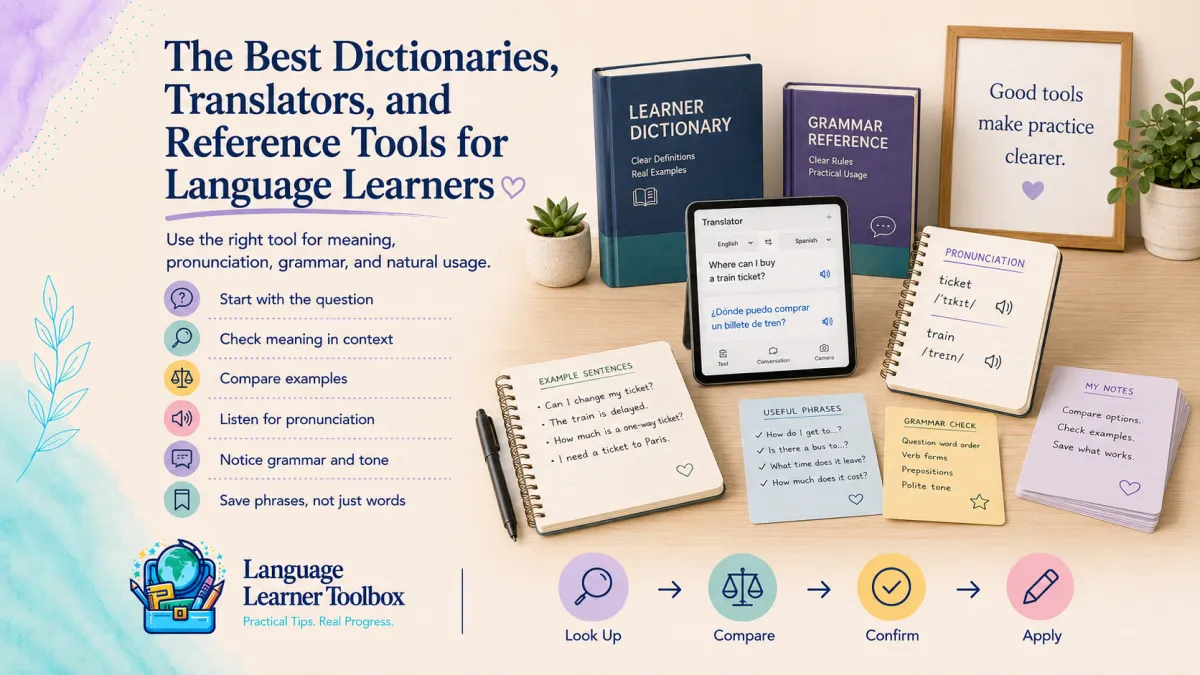
The Best Dictionaries, Translators, and Refrence Tools for Language Learners
Language learners often reach for a dictionary or translator when they meet an unfamiliar word.
That can be helpful.
It can also create confusion.
A translation may be technically correct but sound unnatural. A dictionary may list several meanings without explaining which one fits. A grammar reference may answer the question but leave you with more terminology than understanding.
The most useful reference tool is not simply the one that gives you an answer fastest.
It is the one that helps you understand:
what a word means in context
how it is pronounced
how it is normally used
what words commonly appear with it
whether the phrase sounds natural
how to use it again on your own
Different tools are designed for different jobs.
A bilingual dictionary, learner dictionary, translator, pronunciation guide, grammar reference, and example-sentence database may all be useful. They are not interchangeable.
The key is knowing which tool to use and what to check before trusting the result.
Begin With the Question You Are Trying to Answer
Before opening a reference tool, identify what you need to know.
Are you asking:
What does this word mean?
Which meaning fits this sentence?
How do I say this idea in my new language?
Is this phrase natural?
How is this word pronounced?
What words commonly appear with it?
Is this word formal or informal?
Which grammar form belongs here?
What is the difference between two similar words?
How would a real speaker express this idea?
These questions require different kinds of support.
A translator may help you understand the general meaning of a sentence.
A learner dictionary may explain how one word is used.
An example database may show whether a phrase appears naturally.
A pronunciation tool may help you hear stress, rhythm, and sound differences.
A grammar reference may explain why one form is correct.
Use the tool that matches the question.
Understand the Main Types of Reference Tools
Language learners often use the word “dictionary” to describe several different resources.
It helps to understand what each type is designed to do.
Bilingual Dictionaries
A bilingual dictionary connects a word in one language with possible words in another.
It is especially useful when you need:
a quick meaning
a starting point
help understanding a short text
possible translations
confirmation of a familiar word
support at the beginner level
For example, you may look up one word and find three possible translations.
That does not mean the words are always interchangeable.
A strong bilingual dictionary should also show:
parts of speech
example sentences
different meanings
common expressions
pronunciation
usage notes
grammatical information
The translation is the beginning of the search, not always the final answer.
Monolingual Learner Dictionaries
A learner dictionary explains words using the language you are learning.
These tools are often designed with clearer definitions and simpler examples than dictionaries written for native speakers.
They can help you:
think more directly in the language
understand small differences in meaning
see natural example sentences
notice grammar patterns
learn common phrases
avoid depending on translation
They are especially useful for intermediate and advanced learners, though beginners can also use them with support.
A learner dictionary can help you move from:
What is the translation?
to:
How is this word actually used?
General Dictionaries for Native Speakers
A standard dictionary written for native speakers may include:
precise definitions
multiple meanings
historical or uncommon uses
formal labels
detailed grammatical information
specialized vocabulary
These resources can be useful for advanced learners.
They may be difficult for beginners because the explanations often use complex language.
Use them when you need depth, but do not assume the longest definition is the most helpful one.
Translators
A translator converts words, phrases, sentences, or longer texts from one language into another.
Translators can help you:
understand the main idea of a message
check whether you understood a sentence
prepare a simple phrase
compare possible ways to express an idea
work through unfamiliar text
communicate in an urgent situation
They are convenient, but they are not always reliable teachers.
A translator may produce language that is:
grammatically correct but unnatural
too formal
too casual
different from the intended meaning
inappropriate for the situation
influenced by incomplete context
Use translation as a support, not as proof.
Example-Sentence and Usage Tools
These resources show words and phrases in real or carefully written sentences.
They are useful when you want to know:
whether a phrase sounds natural
which preposition follows a word
what verbs commonly appear with a noun
how formal a phrase is
whether speakers use one expression more than another
how meaning changes across contexts
Examples help you see patterns that a short definition may not explain.
Do not rely on one sentence alone.
Look for repeated patterns across several examples.
Pronunciation References
Pronunciation tools may include:
recorded word pronunciation
multiple speakers
slow and natural-speed audio
phonetic spelling
stress marks
syllable divisions
mouth-position explanations
regional variations
recording and playback
These tools help you answer:
Which syllable is stressed?
Is the vowel long or short?
Are sounds connected?
Is a letter silent?
Does pronunciation change in a phrase?
Are there regional differences?
Whenever possible, listen to the full word or phrase rather than studying sounds in isolation.
Pronunciation lives in rhythm and context.
Grammar References
Grammar references explain how forms and sentence patterns work.
They may include:
verb forms
tense explanations
word order
articles
prepositions
agreement
pronouns
sentence structure
punctuation
common errors
A useful grammar reference should help you connect the rule to meaning.
The goal is not to memorize terminology.
It is to understand how the grammar changes what you communicate.
Collocation References
Collocations are words that commonly appear together.
For example, a language may use the equivalent of:
make a decision
take a break
heavy rain
deeply concerned
A grammatically possible combination may still sound unusual if speakers do not normally use those words together.
Collocation tools can help you choose:
natural verbs
common adjectives
typical prepositions
frequent noun combinations
useful phrases
These tools are especially valuable for intermediate and advanced learners who want to sound more natural.
Phrase and Idiom References
Some expressions cannot be understood by translating each word separately.
Phrase references can help with:
idioms
phrasal verbs
fixed expressions
conversational phrases
greetings
polite requests
informal language
cultural expressions
Always check:
what the phrase means
who normally uses it
whether it is formal or informal
whether it is still common
what situations it fits
A memorable expression is not always an appropriate one.
Start With Context, Not an Isolated Word
A word often has more than one meaning.
The best definition depends on the sentence.
Suppose you look up a word with five possible translations.
Before choosing one, examine:
the surrounding words
the topic
the sentence structure
the speaker’s purpose
whether the word is a noun, verb, adjective, or another form
whether the situation is formal or informal
Do not ask only:
What does this word mean?
Ask:
What does this word mean here?
Context helps you avoid choosing a translation that is correct in one situation but wrong in another.
Check the Part of Speech
The same spelling may function as different parts of speech.
A word might be:
a noun
a verb
an adjective
an adverb
a preposition
an expression within a larger phrase
Before selecting a meaning, check how the word functions in the sentence.
A dictionary entry may separate meanings by part of speech.
That information can eliminate several incorrect options immediately.
Read More Than the First Definition
The first meaning listed is not always the one you need.
Dictionary entries may be ordered by:
frequency
historical development
common usage
part of speech
editorial style
Read enough of the entry to find the meaning that matches your sentence.
Also check:
example sentences
usage notes
common phrases
grammatical patterns
labels such as formal, informal, technical, or old-fashioned
The example often tells you more than the definition.
Use Example Sentences Carefully
Example sentences show how language behaves.
When reading them, notice:
what comes before the word
what comes after it
which prepositions appear
what type of subject is used
whether the sentence is formal
whether the word refers to people, objects, ideas, or actions
what other words appear repeatedly
Do not simply copy the sentence and replace one word.
Make sure the pattern still fits your meaning.
A good practice is to write your own sentence using the same structure.
Then compare it with the examples.
Check More Than One Source When the Meaning Matters
For casual reading, one quick lookup may be enough.
For important communication, check more carefully.
You may want to compare sources when:
writing an email
preparing a presentation
applying for a job
completing academic work
communicating with a doctor
signing a document
preparing for an interview
using a phrase you have never heard before
choosing between similar words
Different reference tools may reveal different information.
One may explain meaning.
Another may show natural examples.
Another may provide pronunciation.
Another may identify tone or formality.
Agreement across several sources gives you more confidence.
Use Translators to Compare, Not Simply Copy
A translator can provide a useful first version.
Do not stop there.
After translating a sentence, ask:
Does this express what I intended?
Is the tone appropriate?
Is it too formal or too direct?
Would a speaker naturally say it this way?
Are there words I do not understand?
Can I explain the sentence myself?
Could I produce a simpler version?
A good learning routine is:
Write your own sentence first.
Compare it with the translation.
Notice differences.
Check important words or phrases.
revise the sentence yourself.
Say or write it again without looking.
This keeps the thinking with you.
Translate Smaller Sections When Possible
Long passages can hide errors.
If you translate a full paragraph, the result may sound smooth even when it changes important details.
For better learning and accuracy, work with:
one sentence
one phrase
one idea
one difficult section
Then check how the parts connect.
Smaller sections make it easier to notice:
missing meaning
changed tone
incorrect pronouns
tense differences
word-choice problems
overly literal phrasing
Translate Meaning, Not Every Word
Languages organize ideas differently.
A natural sentence in one language may not follow the same word order or use the same expressions in another.
Word-for-word translation often creates language that is grammatically awkward or unclear.
Ask:
What am I trying to communicate?
Then look for the most natural way to express that meaning.
This is especially important with:
idioms
polite requests
humor
emotional language
professional communication
cultural expressions
The goal is not to preserve every individual word.
The goal is to preserve the message.
Use Back-Translation as a Check, Not a Guarantee
Back-translation means translating a sentence into the new language and then translating it back into your first language.
This can reveal major changes in meaning.
However, it does not guarantee that the original translation sounds natural.
A sentence may translate back correctly while still sounding:
stiff
overly formal
unusual
literal
inappropriate for the context
Use back-translation as one check among several.
Check Formality and Tone
Reference tools should help you understand not only meaning but also social use.
Before using a new word or phrase, ask:
Is it formal or informal?
Is it polite?
Is it direct?
Is it common in writing or speech?
Is it used with friends, strangers, or professionals?
Is it regional?
Is it old-fashioned?
Could it sound rude or humorous?
Two expressions may share a basic meaning but create very different impressions.
This matters in:
workplace communication
customer service
messages to teachers
medical situations
introductions
requests
disagreements
apologies
Look for usage labels and real examples.
Check Frequency
Some dictionary entries are correct but uncommon.
A word may be:
literary
technical
old-fashioned
regional
rare
highly formal
If you are learning everyday communication, choose words and phrases that speakers commonly use.
A simple common word is often more useful than an impressive rare one.
Frequency information can help you decide what deserves your attention.
Check Regional Differences
Many languages have regional varieties.
A word may be common in one country and unusual in another.
Pronunciation, spelling, vocabulary, and formality may differ.
When the distinction matters, check:
which region the source represents
whether alternative forms are listed
what variety your teacher or community uses
what variety you are most likely to encounter
You do not need to master every regional difference.
You do need to recognize that more than one form may be correct.
Save Phrases, Not Only Words
When you find a useful word, save enough context to use it again.
Instead of recording:
appointment
record something like:
make an appointment
cancel an appointment
I’d like to make an appointment for Tuesday.
A useful vocabulary record may include:
the word
a simple meaning
pronunciation
part of speech
one common phrase
one example sentence
your own sentence
a note about formality or usage
This turns reference work into future practice.
Keep the Lookup From Interrupting Everything
Looking up every unknown word can make reading and listening slow and frustrating.
Not every word deserves immediate attention.
Consider looking up a word when:
it is important to the main idea
it appears repeatedly
you need it for a task
it seems useful in your life
it prevents understanding
you want to use it yourself
You may skip a word when:
you can understand the main idea without it
it appears only once
it is highly specialized
the context already makes the meaning clear
stopping would interrupt useful listening or reading practice
Reference tools should support the activity, not replace it.
Use the Right Tool for Writing
When writing, you may need several kinds of support.
For Meaning
Use a bilingual or learner dictionary.
For Natural Word Choice
Use example sentences and collocation information.
For Grammar
Use a focused grammar reference.
For Tone
Look for usage labels and examples from similar situations.
For Pronunciation
Use recorded audio if you also plan to say the sentence.
For Final Checking
Use a translator or correction tool carefully, then review the changes yourself.
Do not allow one tool to rewrite everything without understanding why.
The goal is to improve your own ability to write.
Use the Right Tool for Speaking
Before a conversation, reference tools can help you prepare:
useful vocabulary
likely questions
common phrases
pronunciation
polite requests
sentence starters
During a live conversation, speed matters.
Choose simple language you already know instead of searching for the perfect word.
Afterward, look up:
words you wanted but could not remember
phrases the other person used
errors that affected meaning
more natural ways to express an important idea
Reference work is often most useful before and after speaking, not in the middle of every sentence.
Use the Right Tool for Reading
While reading:
Try to understand from context.
Mark important unfamiliar words.
Continue long enough to understand the main idea.
Look up only the words that matter most.
Return to the sentence.
Read the section again.
This keeps reading from turning into a long dictionary exercise.
Use the Right Tool for Listening
While listening, constantly stopping to look up words can make it difficult to follow the message.
Try this sequence:
Listen once for the main idea.
Listen again for details.
Check a transcript if available.
Look up a few important words or phrases.
Listen again.
repeat or summarize what you understood.
The reference tool supports the listening.
It should not become the main activity.
Evaluate the Quality of a Reference Tool
A useful reference tool should offer more than quick answers.
Look for:
clear definitions
reliable pronunciation
example sentences
multiple meanings
parts of speech
grammar information
common phrases
usage labels
regional information
source transparency
regular updates
easy navigation
limited distractions
Also notice what the tool does not provide.
A translator may not explain grammar.
A dictionary may not show conversational frequency.
A pronunciation tool may not explain meaning.
Use each tool for its strongest purpose.
Be Cautious With User-Submitted Content
Some reference tools include examples, translations, or definitions added by users.
These can be helpful, especially for informal language and regional expressions.
They may also contain:
mistakes
incomplete explanations
unusual phrasing
jokes
offensive language
highly local usage
outdated expressions
Check user-submitted material against a more reliable source before using it in important communication.
Do Not Confuse a Fluent Translation With a Correct One
Modern translators can produce smooth sentences.
Smooth language can still contain errors.
The translation may:
omit a detail
change who performed the action
confuse past and future
choose the wrong meaning
soften or strengthen the tone
misunderstand a name
alter a technical term
create a culturally inappropriate phrase
The more important the communication, the more carefully it should be checked.
For legal, medical, financial, academic, or professional matters, machine translation should not be treated as the final authority.
Build a Small Reference Toolkit
You do not need many tools.
A useful reference set may include:
One quick bilingual reference
Use it for basic meanings and fast checks.
One learner dictionary
Use it for definitions, examples, grammar patterns, and natural usage.
One pronunciation source
Use it to hear words and phrases spoken clearly.
One translation tool
Use it to compare meaning and support longer text.
One grammar reference
Use it when a recurring structure causes confusion.
One example or collocation source
Use it when you want to know what sounds natural.
Each tool should have a clear job.
Create a Consistent Lookup Routine
When you find an unfamiliar word or phrase, use a simple process.
Step 1: Guess From Context
What do you think it means?
Step 2: Check the Meaning
Use an appropriate dictionary or translator.
Step 3: Confirm the Fit
Does the meaning match the sentence?
Step 4: Check an Example
How is it used naturally?
Step 5: Listen
How is it pronounced?
Step 6: Save the Phrase
Record a useful phrase or sentence, not only the word.
Step 7: Use It
Say or write your own example.
This turns a quick lookup into active learning.
Know When to Stop Looking
Reference searching can become endless.
You may compare five definitions, twelve examples, and several translations without ever returning to the activity.
Stop when you have enough information to:
understand the sentence
choose a natural expression
complete the task
communicate clearly
continue practicing
You do not need complete mastery every time you look something up.
You need the next useful answer.
The Best Reference Tool Helps You Become Less Dependent
A strong reference tool should gradually help you:
understand meaning from context
recognize common patterns
choose more natural language
check your own work
notice differences in tone
build useful phrases
make better decisions independently
The goal is not to stop using dictionaries or translators.
Experienced language users still use reference tools.
The goal is to use them thoughtfully rather than automatically.
Try This With One New Word
Choose one word or phrase you encountered recently.
Then answer:
What does it mean in this context?
What part of speech is it?
How is it pronounced?
What words commonly appear with it?
Is it formal, informal, or neutral?
What is one natural example?
How would I use it in my own sentence?
Then say or write your sentence without looking.
That final step matters.
The best dictionary, translator, or reference tool does more than answer your question.
It helps you use the language more clearly the next time you need it.
Remember This
A quick answer is not always a complete answer.
The best reference tools help you understand how language works in context.
Use dictionaries, translators, pronunciation tools, grammar references, and example sentences for the jobs they do best. Then return to the language and use what you found.
Ready for Your Next Step?
The Learning Tools & Resources page brings together practical guides for choosing and using language-learning support more thoughtfully.
If you want to turn the words and phrases you look up into something you can remember and use, read How to Use a Vocabulary Notebook That Actually Helps You Remember.
If consistency is the bigger challenge, the 21-Day Language Habit Bootcamp offers one practical step each day to help you build a learning routine and make better use of the tools you already have.

