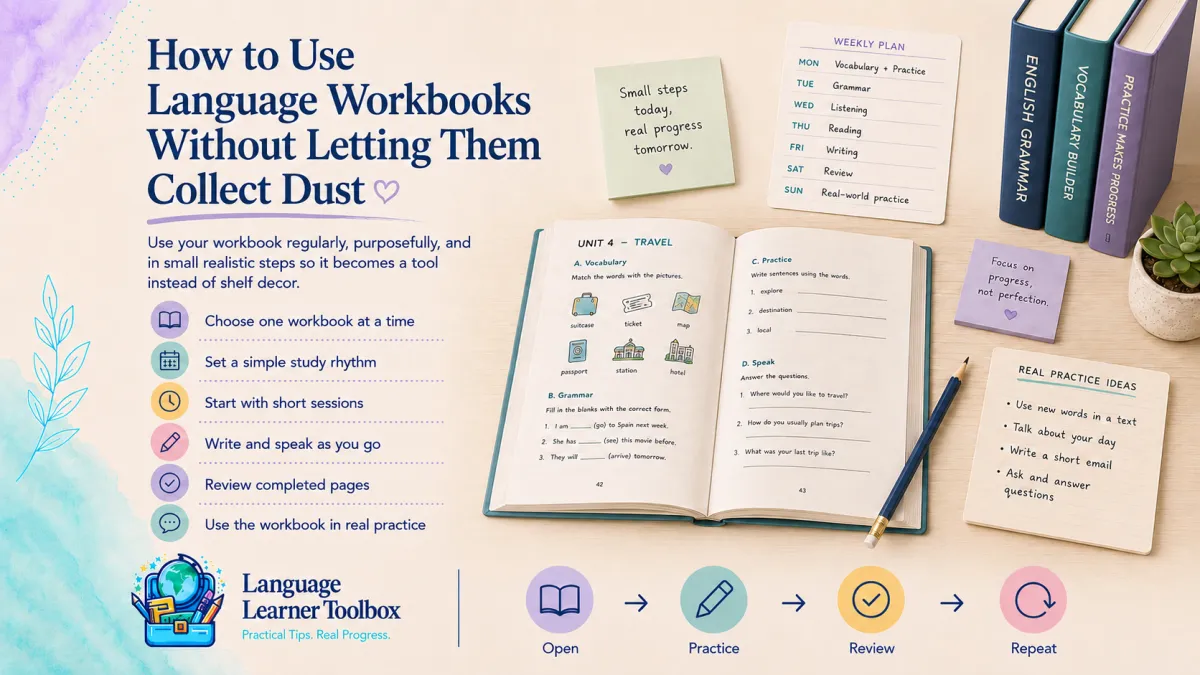
How to Use Language Workbooks Without Letting Them Collect Dust
Language workbooks can be incredibly useful.
They can provide structure, clear explanations, guided practice, review, and a place to track what you are learning.
They can also sit unopened on a shelf.
Many learners buy a workbook with good intentions, complete a few pages, and then stop. The problem is not always the workbook. Often, the workbook was never given a clear role in the learning routine.
A workbook becomes valuable when you use it regularly, connect it to real communication, and return to what you have already practiced.
The goal is not to finish every page as quickly as possible.
The goal is to turn the workbook into a tool that helps you understand, practice, and use the language more confidently.
Begin With a Clear Purpose
Before opening the workbook, decide why you are using it.
Your goal might be:
build a consistent study routine
improve speaking confidence
practice grammar
prepare for conversations
strengthen vocabulary
review a course
study independently
prepare for travel
improve writing
organize tutor or partner practice
A workbook is easier to use when it has one clear job.
Ask yourself:
What do I want this workbook to help me do?
A grammar workbook should not be expected to provide all the conversation practice you need.
A conversation workbook may not explain every grammar point.
A habit workbook may help you become more consistent without teaching large amounts of new vocabulary.
Know what the workbook is designed to do, then use it for that purpose.
Choose the Right Starting Point
You do not always need to begin on page one.
First, look through the workbook.
Notice:
the table of contents
the lesson sequence
instructions
skill level
review sections
practice activities
answer keys
reflection pages
progress trackers
recommended schedule
Then decide where to begin.
Start at the beginning when:
the lessons build on each other
you need the foundation
the workbook follows a clear sequence
you want a structured path
Start with a later section when:
the chapters are independent
you need help with one specific skill
you already know the earlier material
the workbook is designed as a reference
Do not skip randomly. Choose intentionally.
Make the First Session Small
One reason workbooks get abandoned is that learners begin with too much.
They may try to complete an entire chapter, fill every blank, learn every word, and review every mistake in one sitting.
That can make the workbook feel heavy before the routine has even begun.
For the first session, choose something small:
read one explanation
complete one activity
answer three questions
review one page
write for ten minutes
prepare one conversation topic
Finish while you still feel capable of returning.
A small completed session builds more momentum than an ambitious session that leaves you exhausted.
Put the Workbook Into Your Schedule
Do not wait until you “have time.”
Choose a realistic time and place.
For example:
ten minutes after breakfast
twenty minutes on Tuesday and Thursday evenings
one lesson every Saturday morning
one page before a tutor session
fifteen minutes during lunch
one conversation topic before meeting a partner
The schedule should fit your real life.
A workbook used for fifteen minutes three times a week may be more helpful than one used for two hours once every few months.
Try to connect the workbook to an existing routine.
For example:
After I finish dinner, I will complete one workbook activity.
Or:
Before my conversation partner meeting, I will prepare one lesson.
The clearer the cue, the easier it is to begin.
Decide What “Enough” Looks Like
Not every workbook session needs to be long.
Set a minimum that still counts.
Your minimum might be:
one page
one activity
ten minutes
five vocabulary items
one written response
one speaking prompt
one review section
This gives you a backup plan for busy days.
You can always do more when you have time.
The minimum keeps the habit alive.
Use the Instructions
Many learners skip instructions and begin filling in answers.
That can lead to confusion or shallow practice.
Before starting an activity, ask:
What skill is this practicing?
Am I supposed to speak, write, listen, or reflect?
Should I use notes or answer from memory?
Is there an example?
Should I check my work now or later?
Is this meant to be repeated?
A well-designed workbook often includes more than content. It also includes a process.
Follow the process before deciding that the activity is not useful.
Write in the Workbook
A workbook is meant to be used.
You do not need to keep every page perfect.
Underline useful phrases.
Circle recurring mistakes.
Write questions in the margins.
Add examples from your own life.
Mark pages to review.
Cross out answers and try again.
A workbook that shows evidence of learning is more valuable than one that looks untouched.
If you hesitate to write in a physical book, use sticky notes or a separate notebook. But do not let the desire to keep it clean prevent you from using it fully.
Say Answers Aloud
Many workbook activities are completed silently, even when the goal is speaking.
Whenever possible, say the answers aloud.
You can:
read your written response
answer before writing
repeat a corrected sentence
explain why you chose an answer
use vocabulary in a spoken example
summarize the lesson
record yourself
This turns a written workbook into a speaking tool.
If the workbook includes conversation questions, do not only write short answers. Practice answering aloud as though someone had asked you directly.
Answer Before Looking
Learning becomes stronger when you retrieve information from memory.
Before checking a model, answer key, vocabulary list, or example:
pause
think
try
then compare
This may feel slower, but it creates more active learning.
For example, instead of reading all the vocabulary first, cover the list and see what you remember.
Instead of copying the model sentence, create your own version.
Instead of checking the answer immediately, explain your choice.
The effort matters.
Check Answers Thoughtfully
An answer key can tell you whether an answer is correct.
It does not always tell you why.
When checking your work, notice:
what you got right
what you misunderstood
whether the mistake changed the meaning
whether the error is repeated
what rule or pattern is involved
what you should try again
Do not simply mark an answer wrong and move on.
Correct it.
Say it again.
Write a new example.
Use the pattern in another sentence.
The correction becomes useful when you apply it.
Do Not Correct Everything at Once
A page full of mistakes can feel discouraging.
Choose the corrections that matter most.
Focus on:
mistakes that affect meaning
repeated patterns
vocabulary you need often
pronunciation problems that make understanding difficult
grammar connected to your current goal
You do not need to master every detail before continuing.
Select one or two priorities.
Return to the others later.
Connect the Workbook to Real Life
The most useful workbook practice leaves the page.
After completing an activity, ask:
Where could I use this?
You might use the lesson to:
prepare for a conversation
write a message
make a phone call
speak with a tutor
describe your week
ask a question at work
understand a podcast
tell a short story
practice for travel
If the workbook teaches restaurant vocabulary, role-play ordering a meal.
If it teaches past tense, tell someone what you did last weekend.
If it includes conversation questions, ask them during your next partner meeting.
Application helps the language become usable.
Personalize the Activities
Workbooks often use general examples.
Make them your own.
Change names, places, jobs, interests, and situations.
Instead of writing about an imaginary person, write about yourself.
Instead of using the example vocabulary only once, connect it to:
your family
your work
your hobbies
your neighborhood
your travel plans
your opinions
your memories
Personal language is easier to remember because it carries meaning.
Repeat Important Activities
Completing an activity once does not mean you are finished with it.
Repeat useful tasks after a few days.
You might:
answer the questions again
cover the page and recall the vocabulary
redo a speaking activity
rewrite a paragraph
repeat a role-play
explain the grammar without looking
use the same structure with a new topic
The second attempt often feels easier and more natural.
That improvement is evidence of learning.
Use Review Pages
Review sections are easy to skip because they may feel repetitive.
Do not skip them automatically.
Review helps you:
retrieve information
notice what you forgot
connect earlier lessons
strengthen weak areas
see progress
decide what to practice next
If the workbook does not include review pages, create your own.
At the end of each week, ask:
What did I learn?
What can I use now?
What still feels difficult?
What should I repeat?
What is one useful phrase I want to remember?
Keep a Simple Progress Record
You do not need an elaborate tracking system.
You might mark:
date completed
pages used
lesson topic
one thing learned
one question
one next step
A simple record helps you see that the workbook is being used.
It also makes it easier to return after a break.
Instead of wondering where you stopped, you can see what comes next.
Stop Measuring Success by Pages Alone
Finishing pages can feel satisfying, but page count is not the only measure of progress.
A more useful question is:
What can I now understand or do?
Progress may include:
answering more easily
using a new phrase
recognizing a grammar pattern
speaking for longer
making fewer repeated mistakes
remembering vocabulary
preparing more independently
feeling less nervous
You may spend several sessions on one page and gain more than you would by rushing through ten.
Use the workbook to build ability, not just completion.
Use the Workbook With a Tutor
A tutor can help you get more from a workbook.
Before the lesson:
complete part of the activity
mark confusing sections
prepare questions
identify one difficult pattern
During the lesson:
discuss your answers
practice aloud
ask for examples
apply the lesson in conversation
receive focused feedback
After the lesson:
correct your work
repeat the activity
write a new example
review key phrases
This makes tutoring time more focused and useful.
Use the Workbook With a Conversation Partner
A conversation workbook can provide structure for partner practice.
Before meeting:
choose a topic
prepare vocabulary
answer a few questions
note phrases you want to use
During the meeting:
ask and answer questions
use follow-up questions
compare experiences
practice the target language
note useful phrases
Afterward:
reflect on what went well
review missing vocabulary
repeat one answer
choose the next topic
This prevents meetings from beginning with:
What should we talk about today?
Use the Workbook Independently
A workbook can still create active practice when you study alone.
Try:
answering aloud
recording yourself
writing extended responses
role-playing both sides of a dialogue
using AI for follow-up questions
checking examples in a dictionary
teaching the idea to an imaginary learner
summarizing what you learned
Independent study does not have to be passive.
Pair the Workbook With One Supporting Resource
You do not need many extra tools.
Choose one support that helps the workbook do its job.
For example:
workbook plus podcast
workbook plus tutor
workbook plus conversation partner
workbook plus vocabulary notebook
workbook plus pronunciation tool
workbook plus AI practice
Avoid adding so many resources that the workbook disappears into the collection.
Keep one main resource and one useful support.
Leave the Workbook Visible
A workbook that is hidden is easy to forget.
Keep it somewhere you will see it:
on your desk
beside your planner
near your study chair
in your work bag
next to your headphones
with your tutor notes
You can also leave it open to the next page.
Reduce the effort required to begin.
Prepare the Next Step Before You Stop
At the end of each session, decide what comes next.
You might:
place a bookmark
write the next page number
circle the next activity
leave a note
choose the next topic
write down one question
This makes the next session easier to start.
Do not make your future self search for the plan again.
Use a Restart Plan
Missing several days does not mean the workbook has failed.
When you return:
Review the last page you completed.
Read your notes.
Repeat one short activity.
Choose a small next step.
Continue.
Do not try to catch up by completing several lessons at once.
Restart where you are.
Know When the Workbook Is Not a Good Fit
A workbook may not be right for you if:
the level is consistently inappropriate
the instructions are unclear
the content does not match your goal
the activities are mostly passive
the examples feel outdated or irrelevant
there is no way to apply the learning
the format does not fit your schedule
you have given it a fair test and still avoid it
Before abandoning it, try changing how you use it.
Use fewer pages.
Add speaking.
Connect it to a tutor.
Choose only relevant chapters.
If those changes do not help, another resource may fit better.
Do Not Let Guilt Keep You Stuck
An unfinished workbook is not a personal failure.
You may have chosen the wrong level.
Your schedule may have changed.
Your goals may be different now.
The workbook may have served its purpose even if you did not finish it.
Ask:
Is this still useful?
Does it support my current goal?
Can I adjust how I use it?
Should I continue, pause, or stop?
Use the answer to make a clear decision.
Do not keep it in your routine only because you paid for it.
Build a Simple Workbook Routine
A practical routine might look like this:
Choose
Select one lesson or activity.
Prepare
Review the instructions and identify the goal.
Practice
Write, speak, retrieve, or apply the language.
Check
Review answers and choose one important correction.
Use
Connect the lesson to a real conversation or task.
Reflect
Write one thing you learned and one next step.
This process turns workbook pages into active learning.
Try This With Your Current Workbook
Choose one workbook you already own.
Complete these sentences:
I bought this workbook to help me:
The skill it supports best is:
I will use it on:
My minimum session will be:
I will make the activities more active by:
I will use what I learn in:
My next page or lesson is:
Then complete one small activity today.
Do not wait until you have time to make a fresh start.
Start with the next useful page.
Remember This
A workbook does not create progress by sitting on your shelf.
It becomes valuable when you open it, use it, and carry the learning beyond the page.
You do not need to rush through every lesson. Use the workbook consistently, practice actively, and return to the material that matters most.
Ready for Your Next Step?
The Learning Tools & Resources page brings together practical guides, workbooks, and downloadable support to help you choose tools that fit your goals and use them more effectively.
If you need help turning language practice into a regular routine, the Language Learning Habit Stack Workbook can help you connect small learning actions to habits already present in your day.
If your goal is more confident speaking, explore the Train Your Brain Workbook: 30-Day Speaking Confidence or The Language Learner’s Workbook: A Guide for Conversation Practice for structured practice you can use independently or with a partner.

