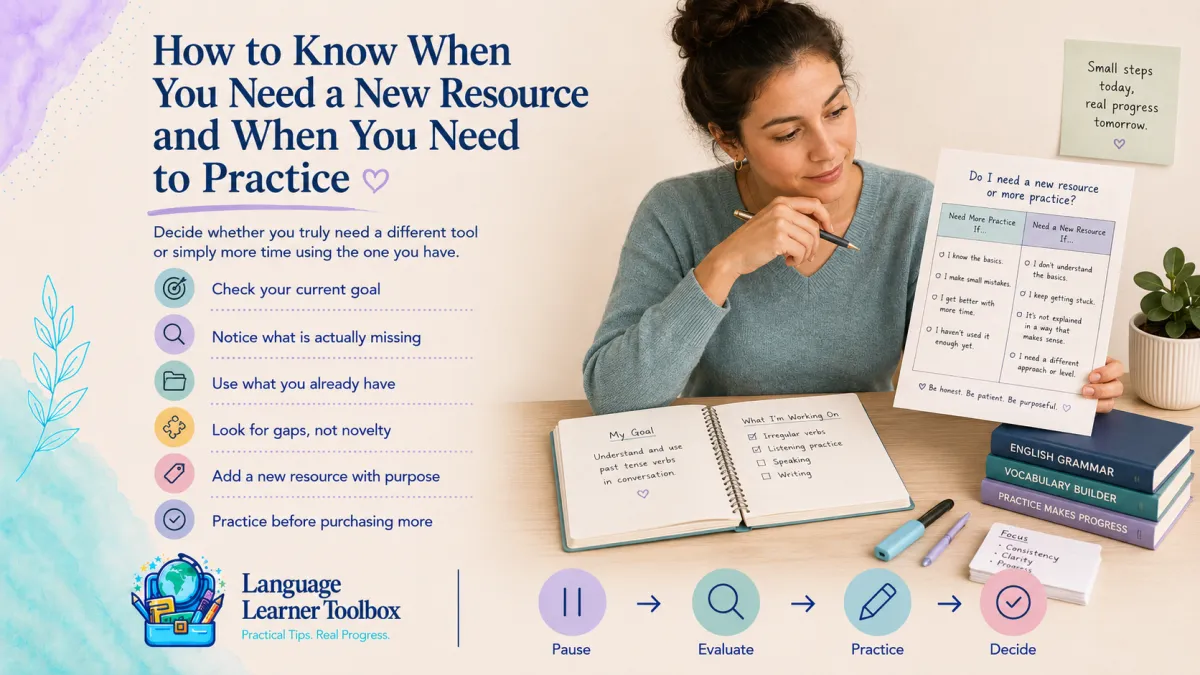
How to Know When You Need a New Resource and When You Need More Practice
Language learning can feel frustrating when progress slows.
You may begin to wonder whether your app is too basic, your workbook is ineffective, your tutor is not the right fit, or your study plan needs to change.
A new resource can feel like a fresh start.
Sometimes that is exactly what you need.
A different tool may provide clearer instruction, more appropriate practice, better feedback, or support that matches your current level and goals.
But sometimes the resource is not the problem.
You may understand what to do but need more repetition. You may have used the tool inconsistently. You may be avoiding the hardest activity. You may be improving in ways that are difficult to notice.
The challenge is knowing the difference.
Before replacing a resource, ask:
Is this tool preventing me from progressing, or am I still developing a skill that requires more practice?
A thoughtful answer can save you time, money, and another cycle of starting over.
Begin With the Result You Want
You cannot evaluate a resource clearly unless you know what you expect it to help you do.
Your goal might be:
understand everyday conversations
speak with less hesitation
remember useful vocabulary
improve pronunciation
write more accurately
prepare for travel
participate at work
build a consistent routine
practice with a conversation partner
prepare for a test
Be specific.
Instead of:
I want to improve my Spanish.
try:
I want to answer everyday questions without translating every sentence first.
Or:
I want to understand the main ideas in short podcasts about familiar topics.
A clear goal helps you decide whether the resource is supporting the right skill.
Identify What the Resource Is Designed to Do
Every resource has strengths and limits.
An app may be useful for daily vocabulary review but provide limited open-ended speaking.
A workbook may offer structure and written practice but not live feedback.
A tutor may provide personalized correction but cannot create progress without practice between lessons.
A podcast may improve listening but not teach grammar in a clear sequence.
Ask:
What is this resource designed to help me practice?
What does it do particularly well?
What does it not provide?
Am I expecting it to solve a problem outside its purpose?
A resource may be working well at its intended job even if it does not meet every language-learning need.
You may not need to replace it.
You may need to add one complementary form of practice.
Signs You May Need More Practice
Progress often requires more repetition than learners expect.
You may need more practice rather than a new resource when the following situations apply.
You Understand the Material but Cannot Use It Quickly
You may recognize vocabulary, understand a grammar point, or follow an example but struggle to produce the language during conversation.
That does not necessarily mean the resource failed.
Recognition develops before fast retrieval.
You may need to:
answer questions aloud
repeat useful phrases
practice without notes
use the language in several situations
return to the same topic
create original examples
speak under gradually increasing pressure
Understanding is an important step.
It is not the same as being able to use the language automatically.
You Have Used the Resource Inconsistently
A resource cannot show its value if you use it only occasionally.
Before replacing it, ask:
How many times have I actually used it?
Have I followed the suggested sequence?
Did I practice between sessions?
Have I returned to previous material?
Did I stop after the first difficult lesson?
Have I given it enough time to work?
A workbook used twice, an app opened sporadically, or a tutor seen once may not have received a fair test.
You may need a smaller, more consistent routine rather than another tool.
The Activities Are Still Appropriately Challenging
A useful resource should not feel easy all the time.
You may need more practice when:
you understand most instructions
the activities require concentration
you can complete them with effort
some mistakes repeat
the material is difficult but not completely confusing
you notice small improvements over time
This level of difficulty is often where learning happens.
Do not replace a resource only because it asks you to work.
You Are Making Fewer or Different Mistakes
Progress may appear as a change in your errors.
At first, you may struggle to form a complete sentence.
Later, you may form the sentence but use the wrong tense.
Later still, the grammar may be correct, but the phrase may sound slightly unnatural.
The mistakes have become more advanced.
That is progress.
Before assuming the resource is not helping, compare your current performance with where you began.
The Skill Is Improving Slowly
Some language skills require a long period of repeated exposure.
Listening at natural speed, responding spontaneously, pronunciation, and speaking confidence may improve gradually.
You may not notice the change from one day to the next.
Look for smaller signs:
you understand a little more
you ask for repetition less often
you pause for less time
you recover more easily
you can say more before becoming stuck
familiar phrases come faster
you feel slightly less anxious
Slow progress is still progress.
You Have Not Applied the Material
You may complete lessons successfully but never use the language outside the resource.
Before changing tools, try applying the material.
You might:
answer the questions aloud
discuss the topic with a partner
write a short message
use new phrases with a tutor
summarize a listening passage
repeat an activity without looking
create examples from your life
The missing step may be application, not instruction.
You Are Avoiding the Most Important Practice
Sometimes learners replace a resource because the work has become uncomfortable.
You may prefer:
vocabulary games instead of speaking
grammar explanations instead of writing
subtitles instead of listening
reading about conversation instead of having one
organizing materials instead of using them
Ask honestly:
Am I changing resources because this one is ineffective, or because it is asking me to do something difficult?
Discomfort does not always mean poor fit.
It may mean you are practicing the skill that needs to grow.
You Keep Looking for a Faster Method
A new tool often promises:
easier learning
quicker progress
better motivation
more complete instruction
less effort
The promise can be appealing when the current stage feels slow.
But no resource can eliminate the need to:
retrieve vocabulary
listen repeatedly
make mistakes
speak before you feel ready
review
practice over time
If you keep switching whenever progress becomes less exciting, you may never stay with a resource long enough to benefit from it.
Signs You May Need a New Resource
Some resources truly are a poor fit.
A different tool may be appropriate when the following problems continue even after a fair trial.
The Resource Does Not Match Your Goal
You may want to speak more naturally, but the resource requires almost no original speaking.
You may want listening practice, but most activities are written.
You may need workplace language, but the content stays focused on tourist vocabulary.
Ask:
Does this resource require me to practice the skill I want to improve?
If the answer is consistently no, choose something better aligned with your goal.
The Level Is Far Too Easy
A resource may be too easy if:
you complete activities without much attention
nearly everything is familiar
you rarely need to retrieve or create language
the material repeats skills you already control
you can predict every answer
you are not learning anything useful
Easy review can support confidence and maintenance.
But if all practice is comfortable, the resource may no longer help you grow.
The Level Is Far Too Difficult
A resource may be too difficult if:
you cannot understand the instructions
almost every word is unfamiliar
you rely on constant translation
you cannot complete basic tasks without help
the examples assume knowledge you do not have
you remain lost after repeated attempts
the material creates frustration without meaningful practice
Challenge is useful.
Confusion that prevents participation is not.
Look for a resource that provides more support or a clearer progression.
The Instructions Are Consistently Unclear
A strong resource should help you understand:
what to do
why the activity matters
how to complete it
what to check
what comes next
If you repeatedly spend more time interpreting the instructions than practicing the language, the resource may not be well designed for you.
The Resource Provides No Useful Feedback
Feedback helps you understand what to improve.
You may need another resource when:
answers are marked wrong without explanation
speaking scores do not tell you what to change
writing is rewritten without teaching you anything
corrections are overwhelming
repeated mistakes are never identified
you cannot tell whether your responses are clear
Depending on your goal, you may need a tutor, answer key, correction system, pronunciation guide, or more thoughtful feedback tool.
The Material Is Outdated or Unreliable
Language changes, and reference information can become inaccurate.
Be cautious if the resource includes:
outdated expressions
incorrect explanations
poor translations
unnatural examples
broken links
unsupported claims
cultural information that no longer applies
When accuracy matters, especially for professional, academic, legal, or medical communication, use a reliable and current source.
The Format Does Not Fit Your Life
A resource can be high quality and still be wrong for your schedule.
You may need a different format if:
lessons are much longer than your available time
the tool requires a fixed schedule you cannot maintain
you cannot use it on your device
preparation takes longer than the practice
the materials are difficult to access
the resource depends on conditions you rarely have
Choose something you can realistically use, not something that works only in an ideal week.
You Have Reached the Resource’s Limit
A resource may have served you well and still no longer be enough.
You may have:
completed the course
mastered most of the material
moved beyond the level
changed goals
developed a need for specialized support
become ready for more authentic language
reached a point where live feedback is necessary
Replacing or supplementing the resource does not mean it failed.
It may mean it did its job.
You Have Given It a Fair Test and Still Avoid It
Resistance does not always mean the resource is wrong.
But persistent avoidance can matter.
If you have:
adjusted the schedule
reduced the session length
tried relevant sections
connected the material to your goals
used it consistently
given it several weeks
and still find the format unhelpful, another resource may fit better.
Distinguish Between a Resource Problem and a Routine Problem
Sometimes the material is useful, but the routine around it is not.
For example:
The workbook is good, but you never schedule it.
The podcast fits your level, but you listen only in the background.
The tutor is helpful, but you do not prepare or review.
The app supports vocabulary, but you rush to protect a streak.
The conversation guide is useful, but you do not have a partner.
Before replacing the resource, try changing the way you use it.
You might:
shorten the sessions
choose a regular time
prepare the next step in advance
add speaking aloud
review after practice
use the material with a tutor or partner
reduce competing tools
A better routine can make an existing resource far more useful.
Look for Evidence Before Deciding
Do not evaluate only by how motivated you feel.
Motivation changes.
Look for evidence.
Ask:
What could I do before that I can do more easily now?
What has become more familiar?
Which mistakes have decreased?
What still feels difficult?
Have I used the resource as intended?
Does it match my goal?
Am I practicing actively?
Can I fit it into my life?
What would another resource provide that this one does not?
This helps separate temporary frustration from a genuine mismatch.
Repeat One Activity and Compare
Choose an activity you completed earlier.
Try it again without reviewing your old answer first.
You might:
answer the same speaking question
repeat a listening clip
rewrite a paragraph
complete the same vocabulary review
retell the same story
redo part of a lesson
Then compare.
Notice whether you:
answer more quickly
understand more
use better vocabulary
make fewer mistakes
speak for longer
need less support
feel more confident
Repetition can reveal progress that moving constantly into new material hides.
Ask for an Outside Perspective
A tutor, teacher, conversation partner, or knowledgeable friend may see progress you do not notice.
Ask:
What has improved?
Which difficulty appears repeatedly?
Do I need more repetition or a different kind of practice?
Is my current resource appropriate for my level?
What one change would help most?
You do not need to follow every recommendation.
An outside perspective can help you make a more informed decision.
Change One Thing at a Time
If you replace your app, workbook, tutor, podcast, schedule, and vocabulary system all at once, you will not know what helped.
Change one part.
For example:
keep the workbook but add speaking
keep the tutor but prepare better
keep the podcast but use shorter sections
keep the vocabulary notebook but review through retrieval
replace only the app that no longer matches your goal
One change is easier to evaluate.
Add Support Before Replacing the Main Resource
A resource may have one clear gap without needing to be discarded.
You might keep:
the course for structure and add a conversation partner
the workbook for practice and add a tutor for feedback
the podcast for listening and add a transcript
the app for vocabulary and add real speaking
the tutor for guidance and add independent practice
Complementary tools can work together.
Do not expect every resource to do everything.
Avoid Creating a Large Replacement System
When one resource feels disappointing, it can be tempting to collect several alternatives.
You may download multiple apps, purchase new workbooks, save courses, and follow more teachers.
That creates a larger decision problem.
Choose one possible replacement that fills the specific gap you identified.
Test it before adding more.
Give the New Resource a Clear Job
Before adding something, complete this sentence:
I need this resource because my current system does not provide enough ________.
For example:
live speaking
listening at my level
clear feedback
structured review
workplace vocabulary
accountability
pronunciation support
Then define the job:
I will use this resource twice a week for focused listening practice.
A resource with a clear job is easier to use and evaluate.
Set a Fair Test Period
Choose a review date before beginning.
You might test:
an app for two weeks
a workbook for one complete lesson or unit
a tutor for three or four sessions
a podcast for five episodes
a conversation routine for one month
a vocabulary system for two weeks
During the test, use it as intended.
Then ask:
Did I use it consistently?
Did it match my goal?
Did it create active practice?
Was the level appropriate?
Did the feedback help?
Did it fit my schedule?
Did I notice progress?
Should I continue, adjust, or stop?
Know When to Stay
Stay with the current resource when:
it matches your goal
the level is appropriate
it requires useful practice
you have not used it consistently yet
you can see small signs of progress
the difficulty is normal and manageable
you still have meaningful material to work through
the main problem is follow-through
In this situation, simplify the routine and practice more.
Know When to Adjust
Adjust how you use the resource when:
the content is useful but sessions are too long
you need more speaking or writing
review is missing
you need to personalize the examples
you need a clearer schedule
one section is useful and another is not
you need limited outside feedback
You may not need to keep every part of the original system.
Use the parts that support your goal.
Know When to Supplement
Add another tool when:
the main resource provides structure but not feedback
it teaches vocabulary but not conversation
it provides listening but not comprehension support
it gives explanations but little active practice
it supports independent work but not accountability
Choose one support that fills the gap.
Know When to Replace
Replace the resource when:
it does not match your goal
the level is consistently inappropriate
the information is unreliable
the format does not fit your life
the activities do not create meaningful practice
you have given it a fair trial
reasonable adjustments have not helped
a better option clearly addresses the problem
Replacing thoughtfully is different from switching impulsively.
Use a Simple Decision Process
Step 1: Name the goal
What do you want to improve?
Step 2: Name the problem
What is preventing progress?
Step 3: Review your use
Have you used the resource consistently and as intended?
Step 4: Look for evidence
What has improved? What has not?
Step 5: Identify the gap
What support is missing?
Step 6: Choose the smallest useful change
Practice more, adjust, supplement, or replace.
Step 7: Set a review date
Evaluate the change after a fair test.
This process prevents frustration from making the decision for you.
Try This With One Current Resource
Choose one resource you are considering replacing.
Then complete these sentences:
My current goal is:
This resource is designed to help me:
I have used it:
The part that works well is:
The part that is missing is:
I may need more practice because:
I may need a new resource because:
The smallest useful change I can make is:
I will test that change for:
I will know it helped when:
Then choose one action:
continue
adjust
supplement
replace
Do not add several new tools while you are deciding.
Remember This
Not every struggle means you need a new resource.
Sometimes the next breakthrough comes from using the right tool a little longer and a little more purposefully.
A new resource should fill a clear gap. More practice should strengthen a skill that your current resource already supports.
Ready for Your Next Step?
The Learning Tools & Resources page brings together practical guides, workbooks, and downloadable support to help you choose resources thoughtfully and use them with more purpose.
If you decide that your current tools are useful but consistency is the problem, the 21-Day Language Habit Bootcamp offers one practical step each day to help you keep showing up.
The Language Learning Habit Stack Workbook can also help you build a repeatable routine around the resources you already have, while How to Choose Your Next Language-Learning Resource can guide you when a genuine gap remains.

