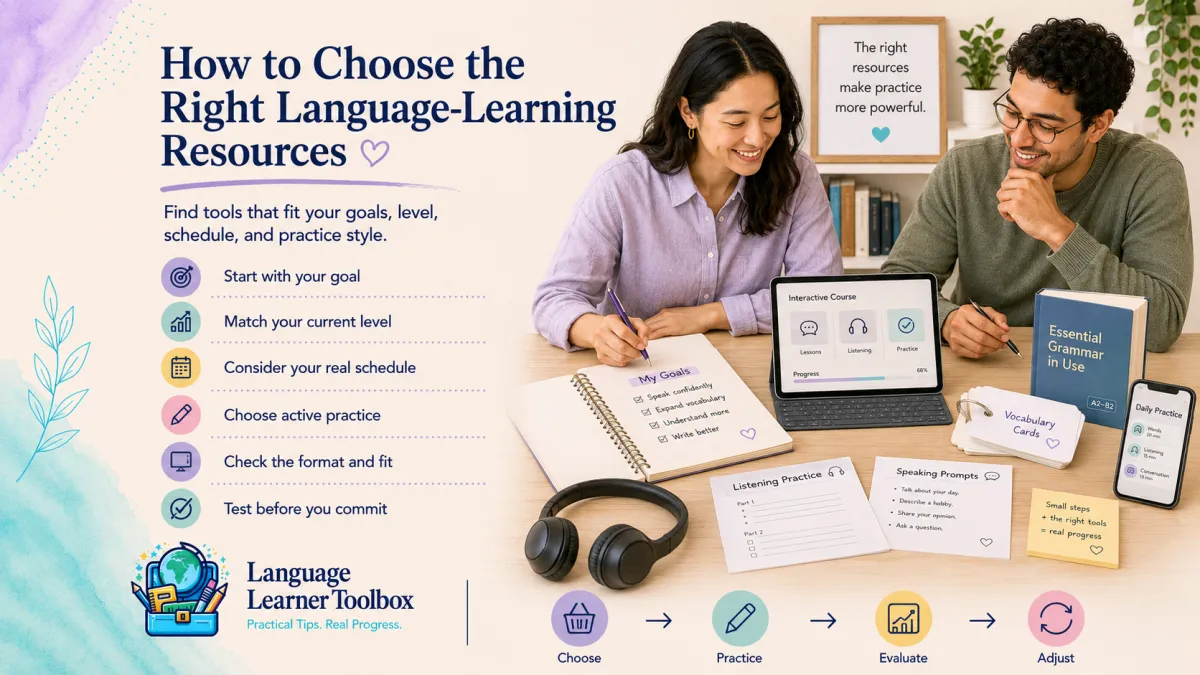
How to Choose the Right Language-Learning Resources
The right resource can make language learning feel clearer, more focused, and easier to continue.
The wrong resource can create the opposite effect.
You may download an app that everyone recommends, buy a workbook that looks useful, save several videos, subscribe to a course, and still wonder what you should actually do each day.
The problem is not always a lack of resources. Often, it is a lack of fit.
A resource is useful when it matches:
what you want to improve
your current language level
the time you realistically have
the way you prefer to practice
the kind of support you need right now
You do not need the most popular resource or the most expensive one. You need a resource that helps you take the next meaningful step.
Start With Your Goal
Before choosing a resource, decide what you want it to help you do.
A broad goal such as “learn Spanish” or “improve my English” is difficult to match with a specific tool. A clearer goal makes the decision easier.
For example:
I want to understand everyday conversations more easily.
I want to speak without translating every sentence.
I want to remember vocabulary I can use at work.
I want to prepare for a trip.
I want to practice regularly instead of studying occasionally.
I want more structure for conversations with my language partner.
I want help writing clearer emails.
I want to understand grammar explanations without feeling overwhelmed.
Each goal points toward a different kind of support.
If you want to improve listening, a conversation workbook may not be your first choice. If you need a consistent routine, collecting more vocabulary lists may not solve the real problem. If speaking is your priority, a resource that only asks you to recognize correct answers will not give you enough speaking practice.
Ask yourself:
What do I want to be able to do more confidently?
Your answer should guide the choice.
Match the Resource to Your Current Level
A resource should challenge you enough to help you grow without making every activity feel confusing.
If it is too easy, you may complete the work without learning much.
If it is too difficult, you may spend most of your time translating instructions, guessing, or feeling discouraged.
The goal is not to find something that feels effortless. The goal is to find something you can use successfully with a reasonable amount of concentration.
A useful resource for your level should let you:
understand most of the instructions
complete at least part of the activity without constant help
notice some unfamiliar language
learn from mistakes without feeling completely lost
see how the practice connects to what you already know
A beginner may need short explanations, clear examples, and limited vocabulary.
An intermediate learner may benefit from more open-ended speaking, authentic listening, and activities that require creating original language.
An advanced learner may need resources that develop nuance, precision, speed, and flexibility.
Do not choose a resource only because it is labeled beginner, intermediate, or advanced. Look at the actual activities. Level labels are not always used consistently.
Be Honest About Your Schedule
A resource is only helpful if it fits into your real life.
A detailed course may be excellent, but it will not help much if it requires five hours a week and you currently have fifteen minutes a day.
Before committing, ask:
How much time does this resource expect?
How often will I need to use it?
Can I complete meaningful practice in a short session?
Does it allow me to pause and return easily?
Will I need extra preparation before I begin?
Can I use it on busy days?
A good resource does not have to be short. It does need to be realistic.
You may have time for a longer lesson on Saturdays and only ten minutes on weekdays. In that case, choose something flexible enough to support both.
Look for resources that let you divide the work into manageable pieces.
A workbook with clear sections may be easier to use than a long course module. A podcast with short episodes may fit better than a one-hour video. A guided prompt may be more practical than an open-ended activity that requires planning first.
The best resource is not the one with the most content. It is the one you can use consistently.
Choose the Type of Practice You Actually Need
Language resources often focus on different kinds of learning.
Some help you recognize language. Others help you produce it. Some explain. Others give you opportunities to practice.
Think about which type you need most.
Listening resources
These may include:
podcasts
videos
audiobooks
short dialogues
listening exercises
interviews
television clips
Choose these when your goal is to understand spoken language, recognize pronunciation patterns, or become more comfortable with natural speed.
Speaking resources
These may include:
conversation prompts
tutor sessions
language exchanges
role-play activities
speaking challenges
AI conversation practice
guided speaking workbooks
Choose these when you need to retrieve language, form answers, describe ideas, ask questions, or build confidence using your voice.
Reading resources
These may include:
graded readers
short articles
stories
newsletters
dual-language books
reading apps
Choose these when you want to build vocabulary in context, improve comprehension, or become more comfortable with sentence patterns.
Writing resources
These may include:
journals
writing prompts
correction tools
email practice
sentence-building exercises
feedback from a tutor or AI tool
Choose these when you want to organize your thoughts, improve accuracy, or express yourself more clearly.
Vocabulary resources
These may include:
flashcards
vocabulary notebooks
word lists
spaced-repetition systems
topic-based phrase guides
sentence-building activities
Choose these when you need useful words and phrases, but make sure the resource also shows you how to use them in context.
Grammar resources
These may include:
reference books
short lessons
practice exercises
videos
comparison charts
guided explanations
Choose these when a grammar pattern is preventing you from understanding or communicating clearly.
You do not need to practice every skill equally every day. Choose the area most connected to your current goal.
Consider How You Prefer to Learn
Two resources can teach the same skill in very different ways.
One learner may enjoy a structured workbook with written instructions and checklists. Another may prefer audio lessons and speaking aloud. Someone else may learn best through live interaction.
Think about the conditions that help you stay engaged.
Do you prefer:
clear steps or open exploration?
independent study or interaction?
written explanations or video demonstrations?
repetition or variety?
printed materials or digital tools?
short daily activities or longer weekly sessions?
immediate correction or time to reflect first?
Your preferences do not have to control every choice, but they matter.
A resource that constantly works against the way you like to learn may be difficult to continue, even if the content is good.
At the same time, be careful not to choose only what feels comfortable. If you want to improve speaking, you will eventually need to speak. Reading more grammar explanations cannot replace that practice.
Choose a resource that supports your preferences while still asking you to do the skill you want to improve.
Look for Active Practice
Many resources feel productive because they keep you busy.
That does not always mean they are helping you use the language.
Active practice asks you to retrieve, create, respond, notice, or reflect.
For example:
Less active:
rereading a vocabulary list
watching a video without pausing
reviewing completed exercises
tapping through answers you already recognize
More active:
recalling a word before checking
answering a question aloud
summarizing what you heard
writing an original sentence
using new vocabulary in a conversation
correcting your own mistake
repeating an activity and improving it
When evaluating a resource, ask:
What will this require me to do?
A strong resource should help you move beyond recognizing the language and toward using it.
Check Whether the Resource Gives You a Clear Next Step
A useful resource should make it easier to begin.
It should not leave you wondering:
Where do I start?
What should I do first?
How much should I complete?
What should I practice after this?
How will I know when to move on?
Look for:
clear instructions
realistic practice goals
examples
progress markers
review opportunities
reflection questions
suggestions for continued practice
This is especially important if you tend to collect materials but struggle to use them.
The more planning a resource requires before you can begin, the more likely it is to sit untouched.
Decide Whether Free or Paid Support Makes Sense
Free resources can be excellent.
You can find helpful videos, podcasts, articles, practice activities, dictionaries, and conversation opportunities without paying.
A paid resource may be worth considering when it gives you something free materials do not provide easily.
You may be paying for:
a clear sequence
thoughtful organization
guided practice
feedback
convenience
accountability
specialized instruction
printable tools
time saved
a complete system
Do not ask only:
Can I find similar information for free?
You probably can.
Instead ask:
Will this resource help me practice more clearly, consistently, or effectively?
A paid workbook may be worthwhile if it saves you from planning every session. A tutor may be worthwhile if you need feedback and live interaction. A course may be worthwhile if you need a complete path.
Paying does not guarantee progress, but the right structure may make progress easier.
Avoid Choosing Based on Excitement Alone
A new resource often feels motivating because it creates a fresh start.
That feeling can be useful, but it can also lead to repeated buying without repeated practice.
Before adding something new, ask:
Have I used the resources I already have?
Is my current resource truly missing something?
Am I avoiding a difficult type of practice?
Do I need a new tool, or do I need more time with the current one?
What will I stop using if I add this?
A new app will not automatically fix inconsistency.
A new workbook will not help if you never schedule time to open it.
A new course will not replace speaking practice if speaking is the skill you want to build.
Sometimes you need a better resource.
Sometimes you need to use the one you already have.
Test Before You Fully Commit
When possible, try a small portion first.
You might:
complete a sample lesson
listen to two episodes
use the app for several days
attend one tutor session
read a few pages
try one worksheet
complete one week of the program
Then evaluate the experience.
Ask yourself:
Did I understand what to do?
Did the activity match my goal?
Was the difficulty appropriate?
Did I practice actively?
Could I fit this into my schedule?
Did I want to return to it?
Did I learn something I could use?
Do not judge a resource only by whether it was entertaining. Also consider whether it created useful effort.
Use a Simple Resource Check
Before choosing your next language-learning resource, review these five areas.
Goal
Does this support the skill or outcome I care about most?
Level
Is it challenging but still usable?
Schedule
Can I use it within the time I realistically have?
Practice
Does it require me to actively use the language?
Fit
Does the format make it likely that I will continue?
A resource does not have to be perfect in every category. It should be strong enough in the areas that matter most to you.
Choose One Main Resource
Using too many resources at once can make language learning feel scattered.
Consider choosing:
one main resource
one supporting resource
one real-life practice opportunity
For example:
Main resource:a structured workbook
Supporting resource:a short podcast
Real-life practice:a weekly conversation partner meeting
Or:
Main resource:a language course
Supporting resource:a vocabulary notebook
Real-life practice:short daily speaking practice with AI or a tutor
This gives you variety without losing direction.
You can always add something later when you know what is missing.
The Right Resource Helps You Practice
A useful language-learning resource should not simply give you more information.
It should help you:
begin more easily
practice more purposefully
understand what you are working on
notice progress
keep going
You do not need to build the perfect collection of apps, books, courses, and materials.
Choose one resource that fits your current goal. Use it long enough to learn what it can do. Notice what improves. Then decide what you need next.
The best resource is not the one everyone else is using.
It is the one that helps you show up, practice, reflect, and repeat.
Try This Today
Choose one resource you currently use or are considering.
Write down:
My current language goal is:
This resource helps me practice:
I can realistically use it:
The main action it asks me to take is:
I will test it for:
At the end of your test period, decide whether to continue, adjust, or choose something else.
That one decision can bring more clarity than adding five new resources.
Remember This
The right resource is not the one with the most features.
It is the one that fits your goal and helps you practice consistently.
Choose tools based on your level, schedule, preferred type of practice, and the specific skill you want to improve.
Ready for Your Next Step?
The Learning Tools & Resources page brings together practical guides, workbooks, and downloadable support to help you choose, use, and organize your language-learning resources more thoughtfully.
If you are deciding what kind of support you need next, read How to Choose Your Next Language-Learning Resource.
If consistency is the bigger challenge, the 21-Day Language Habit Bootcamp offers one practical step each day to help you build a routine and make better use of the tools you already have.

