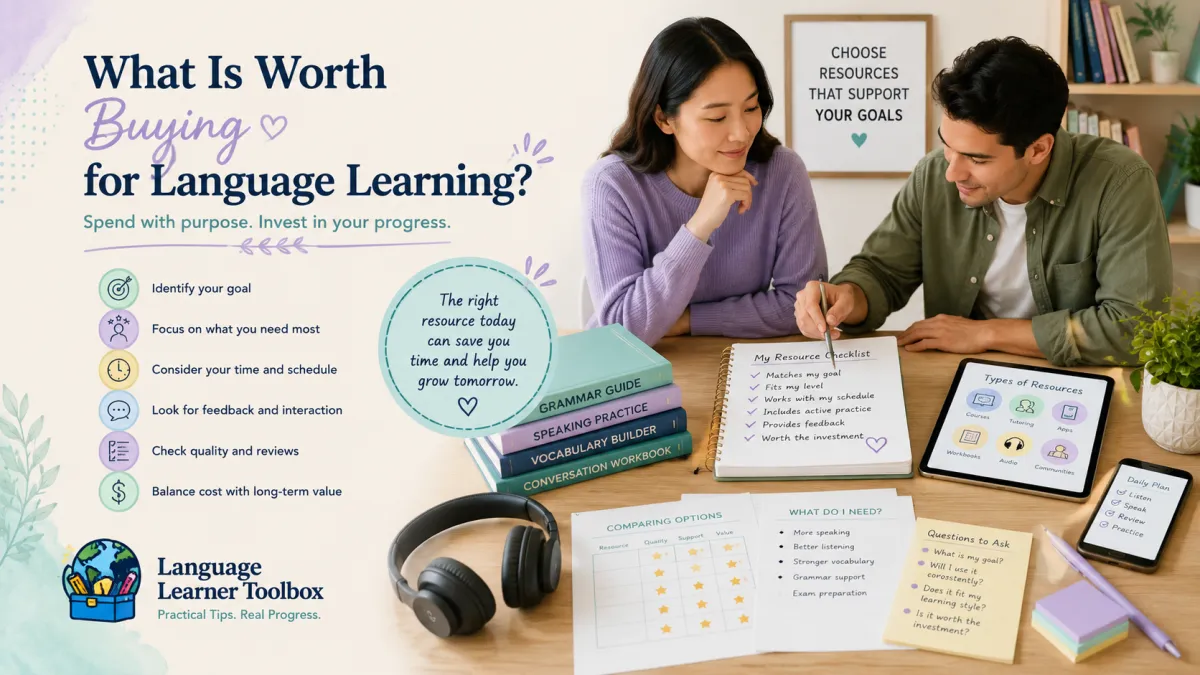
What Is Worth Buying for Language Learning?
Language learners have more choices than ever.
There are apps, courses, tutors, workbooks, subscriptions, AI tools, podcasts, memberships, vocabulary systems, and premium programs promising faster progress.
Some of these resources can be genuinely helpful.
Others may look impressive but add very little to your actual practice.
The question is not whether paid resources are good or free resources are enough. The better question is:
What kind of support would help me make better progress right now?
A paid resource may be worth buying when it gives you structure, feedback, accountability, convenience, or practice you cannot easily create on your own.
Free resources may be enough when you already know what to do and simply need to practice consistently.
The goal is not to spend as little as possible or to buy every promising tool. The goal is to use your time and money where they will make the greatest difference.
Start With the Problem You Are Trying to Solve
Before buying anything, identify the specific problem you want the resource to address.
For example:
I do not know what to practice.
I struggle to study consistently.
I understand more than I can say.
I need correction and feedback.
I want help preparing for real conversations.
I need more listening practice.
I forget vocabulary quickly.
I feel overwhelmed by scattered materials.
I need accountability.
I want a clear learning sequence.
A clear problem makes it easier to decide whether a purchase is likely to help.
A vague goal such as “I want to get better at French” can lead to buying resources that sound exciting but do not address your real needs.
Ask yourself:
What is currently keeping me from making progress?
Your answer is more important than the sales page.
When Free Resources May Be Enough
Free resources can provide excellent language practice.
You can often find:
podcasts
videos
articles
dictionaries
online exercises
language exchanges
public library materials
AI practice
pronunciation examples
grammar explanations
free newsletters
community groups
sample lessons
Free support may be enough when you already have a clear goal and know how to turn available materials into practice.
For example, free resources may work well when:
You need more exposure
If your goal is to hear more of the language, free podcasts, videos, interviews, and audio lessons may provide plenty of useful input.
You want extra practice in one area
A few free grammar exercises, vocabulary reviews, or pronunciation videos may be enough to strengthen a specific skill.
You already have a reliable learning system
If you know what to practice, when to practice, and how to review your progress, you may not need another paid program.
You enjoy creating your own study plan
Some learners like choosing articles, making vocabulary lists, finding listening material, and designing their own activities.
You are exploring before committing
Free trials, sample lessons, and public resources can help you understand what kind of support works best for you.
Free does not mean low quality.
It does, however, often require more decision-making.
You may need to find the material, judge its quality, organize it, decide what to do, and create your own sequence.
For some learners, that freedom is useful.
For others, it becomes another form of overwhelm.
What You Are Really Paying For
Most paid language resources do not contain information that is completely unavailable elsewhere.
You are usually paying for one or more of the following:
Structure
A well-designed resource tells you where to begin, what to do next, and how the pieces fit together.
This can be valuable when you feel scattered or unsure.
Organization
Instead of searching through dozens of videos, articles, and worksheets, you receive a focused collection created for a specific purpose.
Guided practice
A strong paid resource does not simply explain a skill. It helps you practice it.
Feedback
Tutors, teachers, correction services, and some interactive platforms can help you notice mistakes and understand what to improve.
Accountability
A scheduled lesson, group program, challenge, or coaching relationship can make it easier to follow through.
Convenience
A useful tool can save you time by providing prepared activities, prompts, examples, checklists, or review systems.
Personalization
Some paid resources adjust to your level, goals, interests, or recurring difficulties.
Access
You may be paying for live conversation, expert instruction, a learning community, or specialized materials that are difficult to create alone.
These benefits can be worth paying for when they solve a real problem.
The important question is not:
Could I find some of this for free?
You probably could.
Ask instead:
Will this help me practice more clearly, consistently, or effectively?
When a Paid Resource Is More Likely to Help
A paid resource may be a good investment when one or more of these situations apply.
You Need a Clear Path
If you regularly wonder what to study next, a structured course, workbook, or program may reduce confusion.
A clear sequence can help you stop jumping between resources and begin building on what you have already practiced.
Look for resources that include:
a logical order
specific learning goals
manageable lessons
review opportunities
active practice
clear next steps
A large amount of content is not the same as a clear path.
You Need Feedback
It is difficult to notice every problem in your own speaking or writing.
A tutor, teacher, coach, or feedback-based program may be worth paying for when you need help with:
pronunciation
grammar patterns
natural phrasing
writing clarity
repeated mistakes
speaking confidence
preparation for an exam or professional task
Feedback is especially valuable when it is specific and focused.
You do not need every error corrected. You need help identifying the changes that will improve your communication most.
You Need Real Conversation Practice
Free language exchanges can work very well, but they may be inconsistent.
A paid tutor or conversation coach may be helpful when you want:
reliable scheduling
focused conversation practice
structured correction
preparation for a specific situation
someone who understands your level
a partner who keeps the session centered on your goals
You are not only paying for conversation. You are paying for consistency, attention, and guidance.
You Need Accountability
Some learners know exactly what to do but struggle to follow through.
A paid class, tutoring appointment, guided challenge, or membership can create an external commitment.
This can be useful when:
you study only when someone expects you
you frequently restart
you lose direction without deadlines
you benefit from encouragement
you need regular check-ins
Accountability should support your independence, not make you dependent on constant pressure.
You Need Specialized Help
General resources may not be enough when your goal is highly specific.
You may benefit from paid support for:
test preparation
academic writing
workplace communication
medical language
pronunciation coaching
immigration interviews
business presentations
professional certification
advanced grammar
heritage language learning
Specialized guidance can save time because it focuses directly on the language and situations you need.
You Want to Save Planning Time
Creating your own practice can be effective, but it takes time.
A thoughtful workbook, toolkit, or course may be worth buying when it provides:
ready-to-use exercises
conversation prompts
vocabulary activities
reflection pages
review plans
printable materials
practice sequences
level adjustments
You are paying for thoughtful preparation that has already been done for you.
That can be valuable when your available study time is limited.
What Is Often Not Worth Buying
A resource may not be worth purchasing simply because it is popular, attractive, or heavily promoted.
Be cautious when the resource relies on one or more of these promises.
“Fluent in a few weeks”
Language growth can become visible quickly, but fluency usually requires repeated exposure and use over time.
A good resource may accelerate progress. It cannot remove the need for practice.
“Learn without effort”
Effective language learning can be enjoyable, but it still requires attention, retrieval, repetition, and communication.
“One method works for everyone”
Learners have different goals, levels, schedules, and strengths.
A strong method should be adaptable.
“This is the only tool you will ever need”
Most resources are stronger in some areas than others.
An app may help with vocabulary but provide limited real conversation. A workbook may offer structure but not live feedback.
“More content means more value”
Hundreds of lessons are not useful if you do not know where to begin or cannot fit them into your schedule.
“Buy now so you finally become motivated”
A purchase can create temporary excitement, but motivation often fades.
The resource should still be useful after the excitement is gone.
Watch for Duplicate Support
Before buying a new resource, compare it with what you already own.
Ask:
Do I already have something that teaches this?
Have I used the resource I already purchased?
Is the new option meaningfully different?
Am I replacing a poor fit or simply seeking novelty?
What specific gap will this fill?
What will I stop using if I add this?
You may discover that you do not need another resource.
You may need a plan for using the one you already have.
Consider the Total Cost
The purchase price is not the only cost.
A language resource also requires:
time
attention
energy
practice
setup
possible subscription renewals
space in your learning routine
A low-cost resource can still be expensive if it distracts you from more important practice.
A higher-priced resource can be worthwhile if it gives you strong feedback, a clear system, or reliable support.
Think in terms of total value rather than price alone.
Ask:
How much will this cost me to buy, learn, organize, and use?
Then ask:
What meaningful result could it help me produce?
Be Careful With Subscriptions
Subscriptions can be useful when you actively use the service.
They can also quietly continue long after the resource stops helping.
Before subscribing, check:
Is monthly payment required?
Can I cancel easily?
Will I lose access to completed materials?
How often do I expect to use it?
Does the program add new value each month?
Would a one-time purchase meet the same need?
Set a review date when you subscribe.
At the end of thirty or sixty days, ask whether the resource has become part of your actual learning routine.
Do not keep paying because you hope you might use it later.
Try Before You Buy
When possible, test the resource first.
Look for:
free trials
sample lessons
preview pages
demonstration videos
library copies
short introductory sessions
return policies
learner reviews
course outlines
During the trial, do not only explore the features.
Complete a real activity.
Ask:
Did I know what to do?
Was the difficulty appropriate?
Did I actively use the language?
Did the resource fit my goal?
Could I use it within my schedule?
Did it provide something I do not already have?
Would I realistically return to it?
A resource may look impressive and still be a poor fit.
Decide What Result Would Make the Purchase Worthwhile
Before buying, define what success would look like.
For example:
I will complete three speaking activities each week.
I will prepare for my tutor sessions more effectively.
I will build a consistent fifteen-minute routine.
I will finish one guided lesson each week.
I will use the vocabulary in real conversations.
I will receive feedback on my writing twice a month.
I will practice listening with a clear purpose.
This helps you evaluate the purchase later.
Without a specific result, it is easy to confuse owning the resource with benefiting from it.
Give the Resource a Fair Test
Do not expect one lesson or one week to prove whether a resource works.
Choose a reasonable test period.
That might be:
two weeks for an app
four sessions with a tutor
one completed unit in a course
seven days with a workbook
one month of a subscription
several conversations using a prompt guide
During that time, use it as intended.
Then review:
Did I use it consistently?
Did it support my goal?
Did I notice any progress?
Was it easy enough to continue?
Did it create useful practice?
What would I adjust?
A resource cannot help if it is never used.
At the same time, you do not need to continue indefinitely simply because you paid for it.
A Simple Buying Check
Before purchasing a language-learning resource, ask these seven questions.
1. What exact problem will this solve?
Be specific.
2. Does it match my current goal?
A good resource for someone else may not be right for you.
3. Does it fit my level?
Look beyond the label and examine the activities.
4. Can I fit it into my actual schedule?
Use your real schedule, not your ideal one.
5. What will it help me do?
Look for active practice, not only information.
6. Do I already own something similar?
Use what you have before adding unnecessary duplicates.
7. How will I know it was worth buying?
Choose a result you can observe.
If you cannot answer these questions clearly, wait before purchasing.
Build a Small, Useful Resource Set
You do not need a large collection.
A simple resource set might include:
One main learning resource
This provides structure and direction.
Examples:
a workbook
a course
a textbook
a guided program
One practice resource
This helps you use the language.
Examples:
a tutor
a conversation partner
AI conversation practice
speaking prompts
writing activities
One input resource
This gives you meaningful language to hear or read.
Examples:
a podcast
graded reader
video series
newsletter
audiobook
One reference tool
This helps you check meaning, pronunciation, grammar, or natural usage.
Examples:
a dictionary
translator
grammar guide
phrase reference
That may be enough.
A small system you use consistently is more valuable than a large collection you rarely open.
Free and Paid Resources Can Work Together
You do not have to choose one or the other.
A practical learning system may combine:
a paid workbook for structure
free podcasts for listening
a tutor twice a month for feedback
a free dictionary for reference
AI practice for preparation
a conversation partner for real communication
The paid resource does not have to do everything.
It should fill a meaningful gap.
Free resources can then extend and support the practice.
Spend Where It Matters Most
Different learners benefit from spending money in different places.
You may decide that your best investment is:
feedback from a tutor
a structured workbook
a reliable course
a pronunciation program
a guided speaking toolkit
an exam-preparation resource
a high-quality dictionary
a conversation membership
Another learner may need none of those right now.
Spend where the support is difficult for you to create alone.
If you already find excellent listening material easily, you may not need a paid listening subscription.
If you struggle to organize practice, a structured workbook may be more valuable.
If you need correction, feedback may be worth more than another self-study app.
The Best Purchase Is the One You Use
A resource is not valuable because it is expensive, popular, beautiful, or comprehensive.
It becomes valuable when it helps you take useful action.
The right purchase should help you:
begin more easily
practice more consistently
receive useful feedback
reduce confusion
save planning time
work toward a specific goal
notice progress
Before buying, pause long enough to identify what you need.
Then choose one resource that fills that need.
Use it.
Evaluate it.
Adjust when necessary.
That approach will help you spend less impulsively and gain more from the resources you choose.
Try This Before You Buy
Consider one resource you are thinking about purchasing.
Complete these sentences:
The problem I want this resource to solve is:
My current language goal is:
This resource will help me practice:
I can realistically use it:
I already own:
This resource is different because:
I will know it was worthwhile when:
If your answers are clear, the resource may be a good fit.
If they are vague, wait.
Sometimes the best next step is buying a useful tool.
Sometimes it is returning to the practice already in front of you.
Remember This
A paid resource is worth buying when it solves a real problem.
It is not valuable simply because it is new, popular, or full of content.
Free resources may be enough when you already know what to practice. Paid support can be worthwhile when it gives you structure, feedback, accountability, convenience, or a clearer path forward.
Ready for Your Next Step?
The Learning Tools & Resources page brings together practical guides, workbooks, and downloadable support to help you choose tools that fit your goals without adding unnecessary clutter.
If you are deciding what kind of support would help most, read How to Choose Your Next Language-Learning Resource.
If consistency is the real challenge, the 21-Day Language Habit Bootcamp offers one practical step each day to help you use the resources you already have more consistently.

