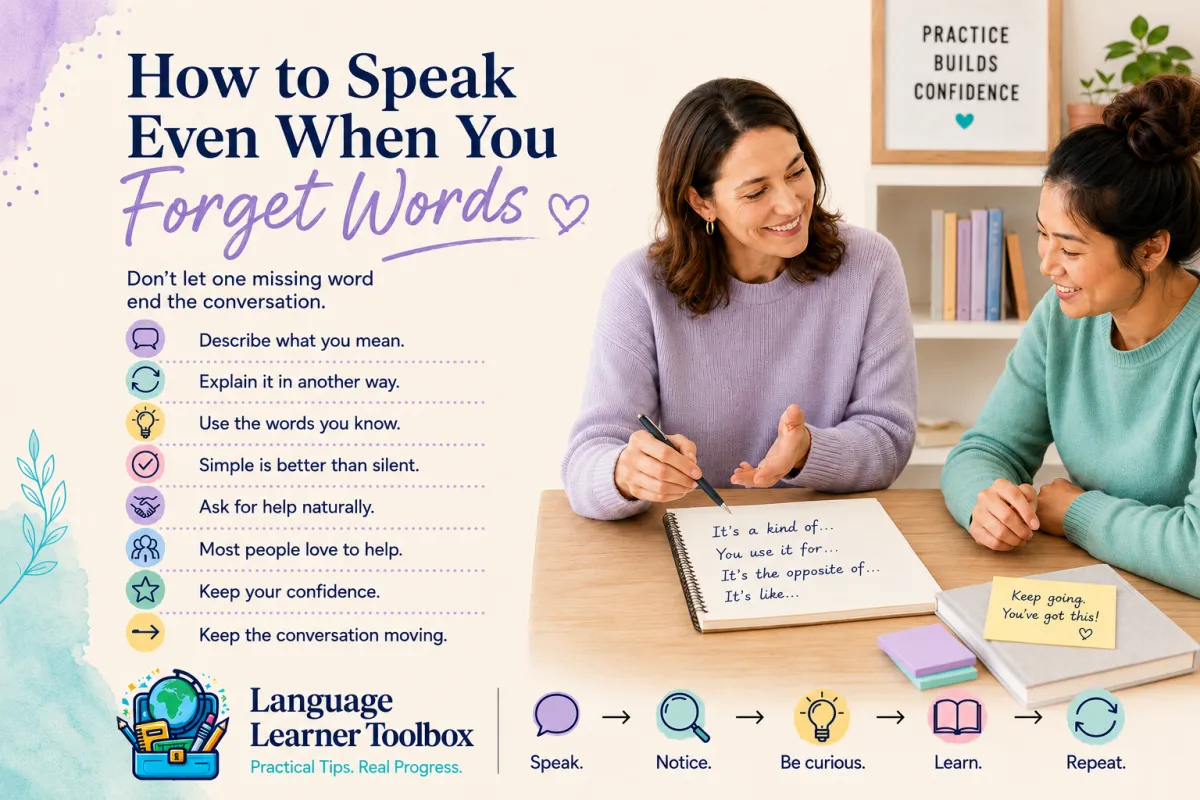
How to Speak Even When You Forget Words
Don't let one missing word end the conversation.
Every language learner knows this feeling.
You're speaking confidently.
The conversation is going well.
Then suddenly...
One important word disappears.
You know you know it.
You can almost see it.
But it won't come.
Many learners stop talking right there.
They apologize.
They switch to their first language.
Or they give up on the idea they wanted to share.
The good news is that forgetting words is completely normal.
Just like making mistakes, forgetting words is a natural part of learning a language.
In fact, it happens to native speakers too.
The difference is that experienced communicators have learned how to keep the conversation moving.
And that's a skill you can practice.
Forgetting a word doesn't mean you don't know the language
Our brains don't store vocabulary like a dictionary.
Words are connected through experiences, emotions, sounds, situations, and repeated use.
Sometimes the word you need simply isn't easy to retrieve in that moment.
If you've ever felt your mind suddenly go blank during a conversation, you're not alone.
That isn't failure.
It's part of how memory works.
The important question isn't,
"Will I ever forget words?"
It's,
"What will I do when it happens?"
Describe what you mean
One of the best communication skills you can develop is learning to explain an idea even when you don't know the exact word.
Instead of stopping, try describing it.
For example:
"I don't remember the word, but it's something you use for..."
"It's similar to..."
"It's the place where..."
"It's the opposite of..."
Many conversations continue perfectly well because someone describes an idea instead of searching for one perfect word.
Communication is more flexible than many learners realize.
Use the words you already know
Sometimes learners think they need the most advanced vocabulary to sound intelligent.
Often, a simple explanation is even better.
Instead of waiting for the perfect word, choose words you already know.
Clear communication is usually more important than impressive vocabulary.
The more you focus on communicating ideas instead of translating every sentence perfectly, the more naturally conversations begin to flow.
Ask for help naturally
Native speakers help each other all the time.
You can say:
"What's the word for...?"
"How do you say...?"
"I'm looking for the word..."
Most people are happy to help.
And because you're using the conversation itself to learn, you're much more likely to remember the word later.
Practice communication, not perfection
One of the goals of language learning is becoming resourceful.
Strong communicators don't always know every word, but they know how to keep the conversation moving. They ask questions, describe ideas in different ways, and use the language they already know to express themselves.
That flexibility is a skill in itself—and every conversation helps you strengthen it.
Keep your confidence
One forgotten word doesn't erase everything you know.
In fact, continuing the conversation despite missing a word often leaves a stronger impression than stopping every time something isn't perfect.
Confident communicators don't always know every word.
They know how to keep communicating.
Build your toolbox
Every time you successfully explain an idea, ask for help, or find another way to express yourself, you're adding another communication strategy to your toolbox.
Those strategies become just as valuable as vocabulary itself.
Over time, you'll notice something surprising.
Instead of worrying about forgetting words...
You'll trust yourself to find another way.
That's confidence.
Remember This
Communication isn't about knowing every word.
It's about helping another person understand your ideas.
When one word disappears, don't stop communicating.
Find another way forward.
Ready for your next step?
The best way to become comfortable handling these moments is to experience real conversations.
The Language Learner's Workbook: A Guide for Conversation Practice gives you opportunities to ask questions, explain ideas, and practice keeping conversations moving—even when you don't know every word.
If you're building confidence one small step at a time, the 21-Day Language Habit Bootcamp will help you create consistent speaking habits that make these moments feel less intimidating.

