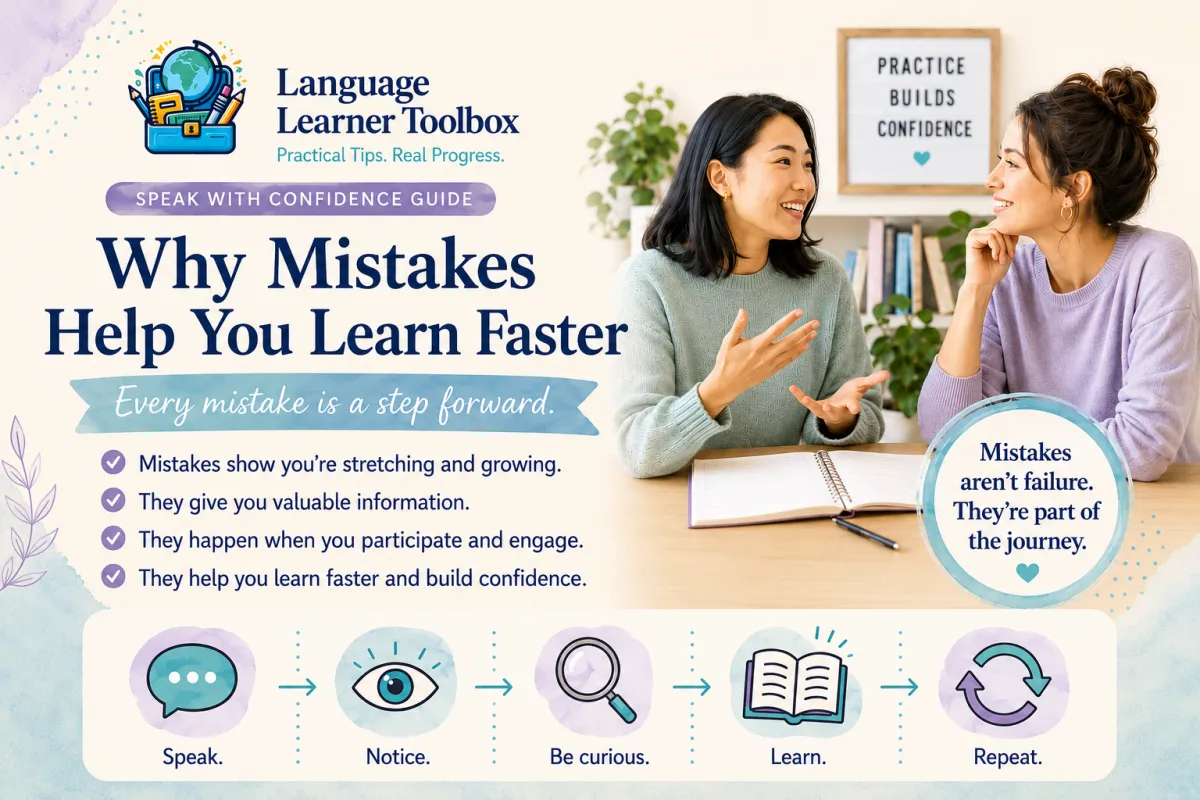
Why Mistakes Help You Learn Faster
If your goal is to communicate, mistakes aren't the enemy, they're part of the journey.
Most language learners don't enjoy making mistakes.
In fact, many try very hard to avoid them.
They wait until they're certain.
They rehearse sentences silently before speaking.
They choose easier words instead of taking a chance.
It's understandable.
No one enjoys feeling embarrassed.
But after years of teaching adult language learners, I've noticed something surprising.
The students who make the fastest progress are often the ones who make the most mistakes.
Not because mistakes are the goal.
Because communication is the goal.
And if you're communicating, mistakes are simply part of learning.
First, remember your goal
People learn languages for many different reasons.
Some want to read literature.
Some want to understand music or movies.
Some enjoy discovering the history of words.
Some simply love learning.
Others want to communicate confidently with the people around them.
None of those goals is better than another.
Your goal should shape how you practice.
If your goal is reading, you'll spend a great deal of time reading.
If your goal is conversation, then conversation has to become part of your learning.
And conversations come with mistakes.
That's perfectly normal.
Mistakes show you're stretching
Imagine lifting weights at the gym.
If every weight feels easy, your muscles don't change very much.
Growth happens when you challenge yourself just beyond what feels comfortable.
Language works in much the same way.
If you only use language you already know perfectly, you'll probably make very few mistakes.
You'll also make slower progress.
The learners who improve most quickly are usually willing to stretch beyond what they already know.
That's where mistakes appear.
And that's where growth happens.
Mistakes are valuable information
One of my favorite moments in class is when I hear a mistake.
Not because someone was wrong.
Because now I know exactly where learning is happening.
A mistake tells us something useful.
It says,
"Here's something we haven't mastered yet."
That's wonderful information.
Instead of thinking,
"I failed."
Try thinking,
"Interesting...why did I say it that way?"
That small shift changes everything.
Curiosity turns mistakes into opportunities.
Who wants to make a mistake?
Sometimes, after hearing a mistake in class, I'll smile and ask,
"Who else wants to make a mistake?"
At first, students laugh.
Then they realize I'm serious.
Making a mistake means you're participating.
You're thinking.
You're experimenting.
You're trying to communicate.
Those are exactly the things that help people learn a language.
If I never hear mistakes, I actually become a little concerned.
It often means students are staying safely inside language they already know, or they aren't speaking very much at all.
Neither leads to confident communication.
Engagement matters
One of the biggest differences I notice between learners who progress quickly and those who struggle isn't intelligence.
It's engagement.
The learners who improve the fastest are usually paying attention.
They ask questions.
They notice patterns.
They take guesses.
They laugh when something sounds funny.
They become curious about why language works the way it does.
They participate.
That active engagement keeps their minds involved in learning.
Learning isn't something happening to them.
It's something they're actively part of.
You don't have to be fearless
Taking risks doesn't mean speaking all the time.
Some learners naturally observe first.
Others jump into conversations immediately.
Both approaches have value.
But if your goal is to become comfortable speaking, there comes a point when observation alone isn't enough.
Communication develops through communicating.
You don't need to know everything before you begin.
You simply need to be willing to keep participating.
Progress is built one conversation at a time
Many learners wait until they believe they're "ready."
The challenge is that confidence usually doesn't come first.
Confidence grows because you've spoken.
Because you've tried.
Because you've noticed mistakes.
Because you've improved.
Every conversation gives your brain another opportunity to build stronger connections.
Every mistake becomes one more stepping stone toward fluency.
Remember This
Mistakes aren't evidence that you're failing.
They're evidence that you're learning something new.
Stay curious.
Keep participating.
Let every mistake teach you something.
That's how confident communicators are built.
Ready for your next step?
If your goal is to become more comfortable speaking, don't wait until everything feels perfect.
Start having conversations.
The 21-Day Language Habit Bootcamp will help you build consistent speaking habits that fit into everyday life.
When you're ready for structured conversation practice,The Language Learner's Workbook: A Guide for Conversation Practice provides guided speaking activities that encourage you to participate, reflect, and grow—one conversation at a time.
Continue Reading
Why Your English Disappears When Someone Asks You a Question
Why You Understand More Than You Can Say (and How to Close the Gap)

