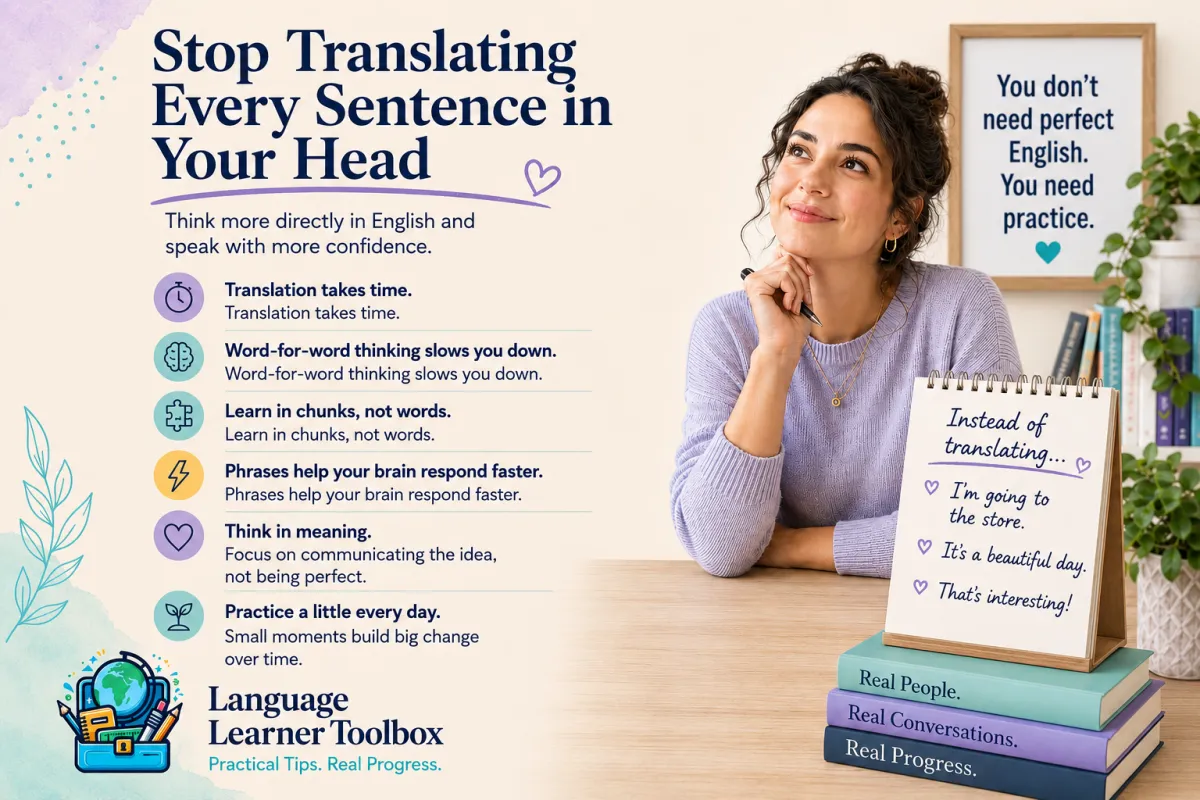
Stop Translating Every Sentence in Your Head
Why thinking word-for-word slows you down—and what to do instead.
One of the most common frustrations language learners describe is this:
"I know what I want to say...but first I have to translate it."
By the time they've finished translating, the conversation has already moved on.
If that sounds familiar, you're not alone.
Nearly every language learner translates at some point. In fact, translation is often a natural part of learning a new language. It helps you make sense of unfamiliar words and connect new ideas to what you already know.
The challenge comes when translation becomes your only way of speaking.
Real conversations move quickly. If your brain tries to translate every word before you speak, it simply can't keep up.
The good news is that this habit can change.
Why your brain wants to translate
Your first language is the strongest language your brain knows.
When you begin learning another language, your brain naturally uses it as a bridge.
Instead of thinking:
English → meaning
you often think:
English → native language → meaning → native language → English
That extra step takes time.
It also places a heavy load on your working memory, making conversation feel much harder than it really is.
Translation is not a sign that you are learning incorrectly.
It is simply one stage in the learning process.
Fluent speakers don't translate every word
When you hear someone speak fluently, it can seem as though they are processing language effortlessly.
In many cases, they are.
Rather than translating word by word, they recognize familiar phrases, expressions, and patterns as complete ideas.
For example, when you hear:
"How's it going?"
you probably don't translate each individual word anymore.
You recognize the entire expression.
That is how fluency gradually develops.
Instead of building every sentence one word at a time, your brain begins recognizing larger chunks of language.
Learn language in phrases, not single words
One of the best ways to reduce translation is to study useful expressions instead of isolated vocabulary.
Instead of memorizing:
go
store
later
learn the complete phrase:
"I'm going to the store later."
Instead of memorizing:
think
maybe
learn:
"I think..."
"Maybe we could..."
"I'm not sure."
These ready-made language chunks become tools your brain can retrieve quickly during conversation.
Focus on meaning instead of perfection
Many learners pause because they are searching for the perfect sentence.
Instead, ask yourself:
"Can I communicate the idea?"
Simple language is often better than perfect language.
Instead of trying to produce an advanced sentence, start with the language you already know.
Communication comes first.
Refinement comes later.
Describe instead of translating
Sometimes you won't know the exact word.
That is completely normal.
Rather than stopping the conversation, practice describing what you mean.
For example:
Instead of searching for one difficult word, you might say:
"It's something you use for..."
"It's similar to..."
"It's the place where..."
Native speakers do this all the time.
Strong communicators know how to explain ideas, even when they don't have the perfect word.
Give your brain more direct exposure
The more your brain experiences English connected directly to meaning, the less it depends on translation.
That means spending time with:
conversations
podcasts
videos
stories
pictures
real-life situations
Notice the goal.
You aren't translating.
You're understanding.
Every time that happens, your brain strengthens the connection between English and meaning.
Practice thinking in simple English
You don't have to wait until you're fluent to begin thinking in English.
Start with very small moments.
While walking through your home, try thinking:
"I'm making breakfast."
"It's raining today."
"I need my keys."
"I'm going to work."
Keep the language simple.
The goal isn't complexity.
The goal is building a direct pathway between English and your thoughts.
Be patient with yourself
Translation is not something you simply decide to stop doing.
It fades gradually.
The more familiar your language becomes, the less your brain needs that extra bridge.
One day you'll notice something surprising.
Someone asks you a question...
...and you answer before you even realize you were thinking in English.
That's a wonderful milestone.
It doesn't happen because you forced yourself to stop translating.
It happens because your brain has built stronger, more direct connections through consistent practice.
Remember this
Translation is part of learning.
But it isn't the destination.
Every conversation, every familiar phrase, every small speaking experience helps your brain rely a little less on translation and a little more on direct understanding.
That is how confidence grows.
One conversation at a time.
Ready for your next step?
If you'd like to practice using familiar language in real conversations,The Language Learner's Workbook: A Guide for Conversation Practice provides structured speaking activities designed to help you move beyond translation and communicate with greater confidence.
If you're building a consistent study routine, the 21-Day Language Habit Bootcamp will help you develop small daily habits that make speaking feel more natural over time.
Continue Reading
You might also enjoy:
Why You Understand More Than You Can Say (and How to Close the Gap)
Why Your English Disappears When Someone Asks You a Question
How to Make Speaking Practice Feel Less Scary

