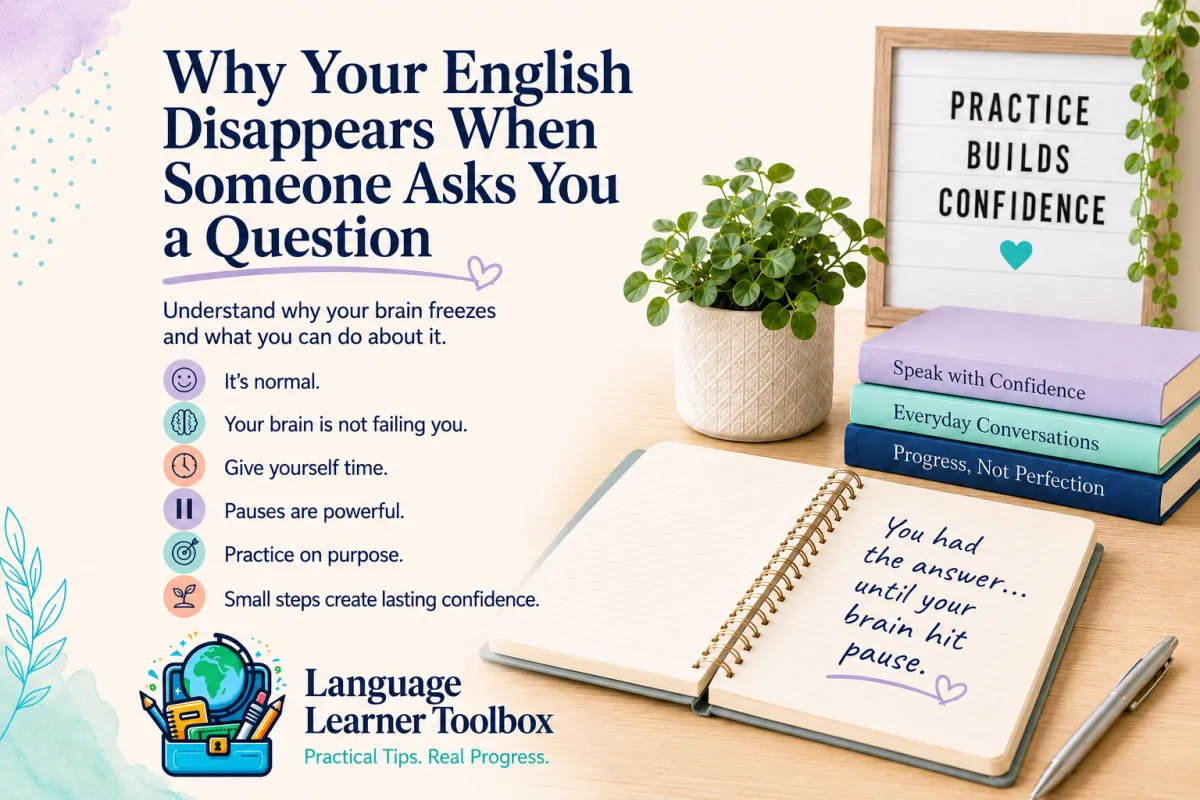
Why Your English Disappears When Someone Asks You a Question
You knew the answer five seconds ago. So where did it go?
If you've ever been asked a simple question in English and suddenly felt like your brain stopped working, you're not alone.
You may understand movies, podcasts, or your teacher. You may have practiced vocabulary and grammar for months. Then someone smiles, asks, "How was your weekend?"—and suddenly every word seems to disappear.
Many learners assume this means they don't know enough English.
In reality, something else is happening.
The good news is that this experience is completely normal, and there are practical ways to become more confident when conversations happen unexpectedly.
Why your brain freezes
Understanding language and producing language are two different skills.
When you listen, your brain recognizes familiar words and patterns.
When you speak, your brain has to work much harder. It must:
understand the question
decide what you want to say
choose the right vocabulary
organize the grammar
pronounce the words
monitor whether it sounds correct
All of that happens in just a few seconds.
It isn't surprising that your brain sometimes feels overloaded.
Freezing doesn't mean you don't know the language.
It often means your brain simply needs a little more time.
Speaking in real time is different from studying
When you study at home, there is no pressure.
You can pause.
Look up a word.
Think for a minute.
Start over if necessary.
Conversation feels different because another person is waiting for your response.
Even if they are patient and kind, many learners feel pressure to answer immediately.
That pressure alone can make speaking feel much harder than it actually is.
Your brain is protecting you, not failing you
Many people experience a stress response when speaking a new language.
Your brain begins paying attention to questions like:
What if I make a mistake?
What if they don't understand me?
What if I sound foolish?
The more attention your brain gives those worries, the fewer mental resources remain for producing language.
The result is a familiar feeling:
"I know this...why can't I say it?"
This isn't a lack of intelligence.
It's simply how the brain responds under pressure.
Give yourself permission to pause
One of the simplest ways to reduce that pressure is to stop believing you must answer immediately.
Native speakers pause all the time.
You can too.
Try using simple phrases like:
"Let me think for a second."
"That's a good question."
"I'm not sure how to explain it."
These small expressions buy your brain a few extra seconds.
Those few seconds often make a surprising difference.
Practice answering common questions
Confidence grows through familiarity.
Instead of trying to prepare for every possible conversation, start with questions people ask most often.
Practice answering questions like:
Where are you from?
What do you do?
What did you do this weekend?
What do you enjoy doing?
What are you studying?
Why are you learning English?
The more often you answer these questions, the less mental effort they require.
Eventually, they become automatic.
That frees your brain to focus on the rest of the conversation.
Build automatic language, not perfect language
Many learners try to create every sentence from scratch.
That takes a tremendous amount of mental energy.
Instead, learn useful language chunks you can use repeatedly.
For example:
"I usually..."
"It depends..."
"One reason is..."
"I haven't decided yet."
"That's interesting because..."
These ready-made phrases reduce the amount of thinking required during conversation.
Over time, they become building blocks for more natural speaking.
Practice under gentle pressure
The goal isn't to eliminate nervousness.
The goal is to become comfortable speaking even when you feel a little nervous.
Try practicing by:
answering questions aloud with a timer
recording yourself
speaking with a conversation partner
joining an online speaking group
responding to random question prompts
Each experience teaches your brain that speaking is safe.
Little by little, the feeling of panic begins to fade.
Confidence comes from repeated success
Many learners believe confidence comes before speaking.
Usually, the opposite is true.
Confidence grows after many small speaking experiences.
One successful answer.
One short conversation.
One question you answered a little more easily than last time.
Those moments add up.
They teach your brain that speaking is something you can do.
Remember this
If your English seems to disappear when someone asks you a question, it doesn't mean your learning has disappeared.
Your knowledge is still there.
You simply need more opportunities to retrieve it under real conversational conditions.
That skill improves with practice.
Every conversation strengthens the connection between what you understand and what you can say.
Ready for your next step?
If you'd like to become more comfortable answering questions in real conversations, the 21-Day Language Habit Bootcamp will help you build small, consistent speaking habits that fit into everyday life.
And if you're ready for structured conversation practice,The Language Learner's Workbook: A Guide for Conversation Practice provides guided speaking activities designed to help you move from understanding to confident communication.

