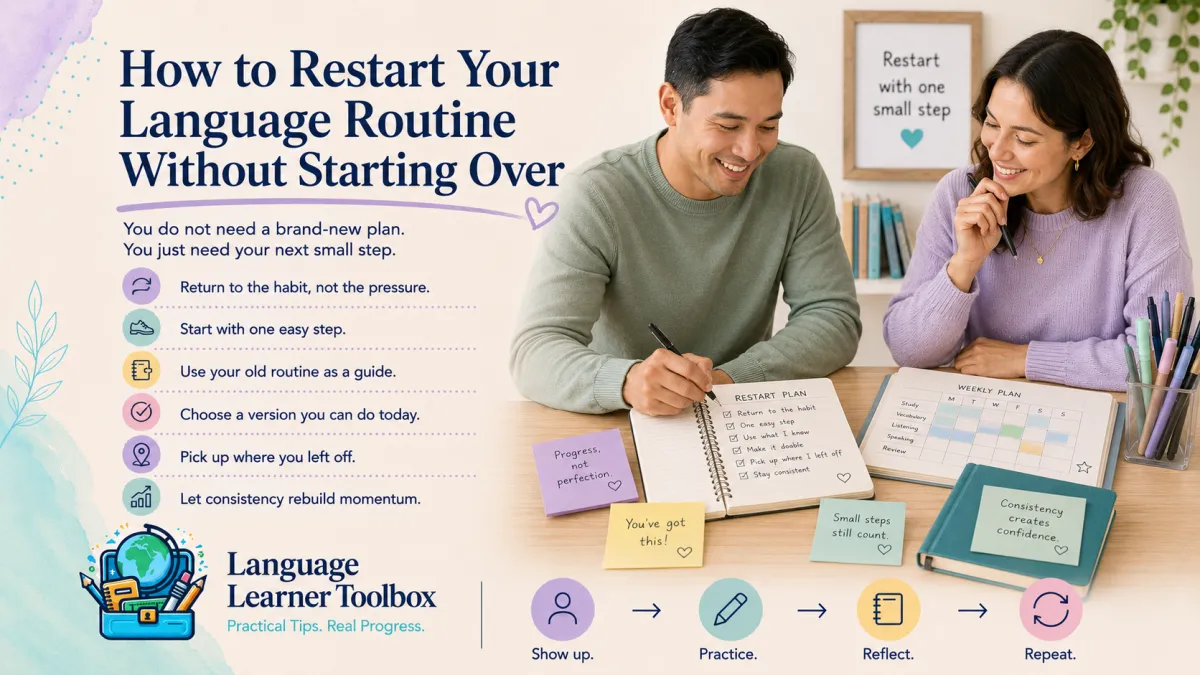
How to Restart Your Language Routine Without Starting Over
You do not need a brand-new plan. You just need your next small step.
Maybe it has been a few weeks.
Maybe several months.
The notebook is still on the shelf.
The app has not been opened.
The podcast stopped playing.
The routine that once felt familiar has quietly disappeared.
Now you want to begin again.
But instead of feeling excited, you feel behind.
You think about everything you forgot.
All the practice you missed.
The goals you did not finish.
And suddenly restarting feels like going back to the beginning.
But you are not at the beginning.
You still have experience.
You still recognize words.
You still know which activities helped.
You still understand more than you did the first time you started.
Your language routine may have paused.
Your learning did not disappear.
You do not need to rebuild everything at once.
You need one clear place to return.
1. Remember What You Already Built
Before making a new plan, look at what is still there.
You may remember more than you expect.
Open an old notebook.
Review a familiar vocabulary list.
Listen to something you studied before.
Answer a conversation question you once practiced.
You may notice:
familiar words return quickly
old notes make sense
phrases begin coming back
listening feels easier than expected
you still remember how to begin
Some knowledge may feel rusty.
That is different from being gone.
Your earlier practice created connections that can become stronger again.
Do not measure yourself only by what you forgot.
Notice what remains.
Learning how to recognize progress before you feel fluent can help you see that earlier effort still matters, even after a break.
2. Return to Something Familiar
Restarting is easier when the first activity feels recognizable.
You do not need a new app.
A new textbook.
A new study system.
A new list of goals.
Begin with something you already know how to use.
Try:
rereading an old lesson
reviewing familiar vocabulary
listening to a favorite podcast episode
answering a conversation question you have seen before
returning to a workbook page you enjoyed
Familiar material reduces the pressure to perform.
It also reminds you that you are not beginning from zero.
You have already done some of this work.
Let the first few practice sessions help you reconnect.
There will be time for new material later.
First, make returning feel possible.
3. Restart With a Smaller Version
Many learners try to restart by doing too much.
They create a detailed schedule.
Plan long study sessions.
Choose several new goals.
Promise themselves they will never miss again.
The plan feels productive.
But it can also make the first step feel heavy.
Restart smaller.
If you used to study for thirty minutes, begin with ten.
If you completed full lessons, review one section.
If you practiced every day, begin with three realistic days this week.
Try:
five minutes of listening
five vocabulary words
one short paragraph
three sentences aloud
one conversation question
The goal is not to make up for lost time.
The goal is to rebuild the pattern of returning.
If you recently missed only a day or two, what to do when you miss a day of language practice can help you return before a short interruption becomes a longer break.
4. Use Your Old Routine as a Guide
Your earlier routine may still contain useful information.
Ask:
What worked before?
When did practice fit naturally?
Which activities did I enjoy?
What made starting easy?
What became difficult?
Maybe listening during your walk worked well.
Maybe evening practice became hard because you were tired.
Maybe keeping your notebook on the table helped you remember.
Maybe the routine included too many activities.
Keep what worked.
Change what did not.
Your old plan is a guide, not a rule.
You may need a shorter routine now.
A different time.
Fewer resources.
A new focus.
Adjusting the routine does not erase the progress you made.
It helps you build a language routine that fits your life as it is now.
5. Choose One Clear Next Step
A long break can make every skill feel urgent.
You may think you need to review grammar, rebuild vocabulary, improve listening, and begin speaking again.
Trying to fix everything at once usually creates more confusion.
Choose one focus.
Ask:
What would help me feel connected to the language again?
Maybe the answer is listening.
Maybe it is conversation.
Maybe you want to review useful vocabulary.
Maybe you need a simple routine before choosing a larger goal.
Pick one next step.
For example:
This week, I will listen for ten minutes on Monday, Wednesday, and Friday.
Or:
After breakfast, I will review five familiar phrases.
Or:
I will answer one conversation question aloud each evening.
A clear plan is easier to follow than a long list of intentions.
If choosing feels difficult, how to choose what to practice each day can help you focus without trying to do everything at once.
6. Let Consistency Rebuild Momentum
The first few practice sessions may feel slow.
You may need more time to remember words.
Listening may feel difficult.
Speaking may feel less comfortable than it once did.
Keep going.
Familiarity returns through use.
Confidence returns through experience.
Momentum returns through repetition.
Do not wait until you feel fully motivated.
Let the small actions come first.
One practice session.
Then another.
A few minutes today.
Another few minutes later in the week.
Soon, the routine begins to feel familiar again.
You can track language progress without losing motivation by noticing simple evidence:
I returned twice this week.
I remembered more than I expected.
I finished a short activity.
I used a phrase I had forgotten.
I am practicing again.
Those wins matter.
They show that the routine is becoming active again.
You Are Continuing, Not Beginning Again
A break does not erase everything that came before it.
You still have knowledge.
Experience.
Useful tools.
Previous progress.
You may need time to reconnect.
You may need a smaller plan.
You may need to adjust your routine.
But you do not need to become a beginner again.
Use what you already built.
Choose one small step.
Then take the next one.
Progress does not require a dramatic comeback.
It grows when you return.
Try This
Open one familiar language resource you used before.
Choose one activity you can complete in ten minutes or less.
Schedule your next two practice times before adding anything else.
Remember This
A break does not erase your previous learning.
Begin with familiar material instead of rebuilding everything.
Restart smaller than you think you need to.
Keep what worked in your old routine and adjust what did not.
Momentum returns when you begin practicing again.
Continue Reading
What to Do When You Miss a Day of Language Practice
How to Build a Language Routine That Fits Your Life
How to Keep a Language Habit Going Long Term
Ready for Your Next Step?
Join the 21-Day Language Habit Bootcamp for simple daily guidance, or use the Language Learning Habit Stack Workbook to rebuild a practical routine without starting from scratch.

