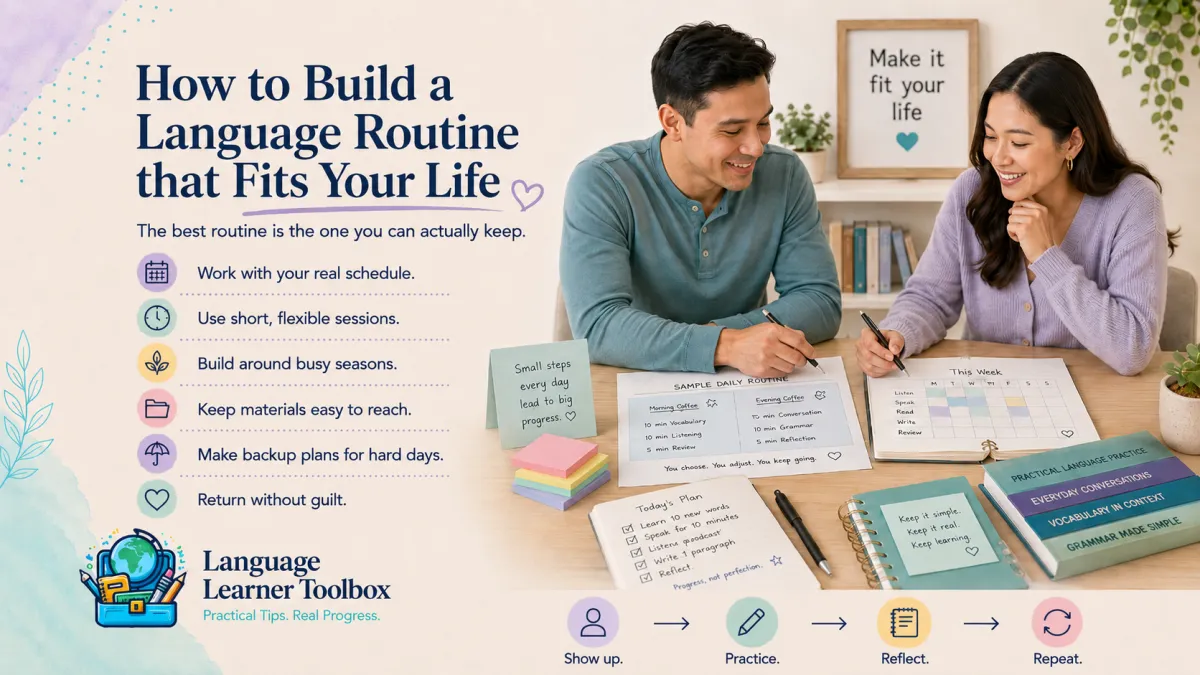
How to Build a Language Routine That Fits Your Life
The best routine is the one you can actually keep.
Many language learners build routines for the life they wish they had.
An uninterrupted hour every morning.
A quiet study session every evening.
Plenty of energy.
No unexpected responsibilities.
Then real life shows up.
Work runs late.
Family needs attention.
The week becomes crowded.
The routine starts slipping, and the learner assumes the problem is a lack of discipline.
Usually, the problem is simpler.
The routine asked too much.
A useful language routine should work with your life, not compete against it.
It should give practice a dependable place while leaving room for busy days, changing schedules, and different levels of energy.
The goal is not to build the most impressive routine.
The goal is to build one you can return to.
1. Start With the Life You Already Have
Before choosing a study schedule, look at your real week.
When do you usually have a few available minutes?
When is your mind most alert?
Which parts of your day are predictable?
You may have time:
before work
during a commute
on a lunch break
while waiting for an appointment
after dinner
during an evening walk
before bed
Do not begin by asking:
When should an ideal language learner study?
Ask:
Where could language practice fit naturally into my life?
For one learner, fifteen quiet minutes before breakfast may work well.
Another learner may practice during lunch.
Someone else may listen while driving and review vocabulary before bed.
There is no perfect study time.
There is only the time you are most likely to use.
If you are unsure where to begin, habit stacking for language learners can help you connect practice to a routine that already happens.
2. Decide What a Realistic Week Looks Like
You do not need to practice every skill every day.
Trying to include vocabulary, grammar, listening, reading, writing, and speaking in every session can make a routine feel complicated before it even begins.
Instead, create a simple rhythm.
For example:
Monday: listening
Tuesday: vocabulary
Wednesday: speaking
Thursday: reading
Friday: review
Your week may look completely different.
You might practice speaking three times because conversation is your main goal.
You may combine vocabulary with reading.
You may prefer shorter daily practice instead of longer sessions a few times a week.
The purpose of a routine is not to create more rules.
It is to make the next step easier to see.
Knowing how to choose what to practice each day can help you focus without feeling responsible for everything at once.
Keep the plan simple enough that you can remember it.
A routine you understand is easier to follow than a detailed schedule you rarely use.
3. Make Practice Easy to Begin
Often, the hardest part is not the practice.
It is getting started.
You sit down but cannot find your notes.
You spend ten minutes choosing a podcast.
You open several apps and are not sure what to do first.
Small barriers make practice easier to postpone.
Prepare before you need the routine.
Keep your notebook where you usually study.
Save a short listening playlist.
Mark the next page in your book.
Keep conversation questions ready.
Place vocabulary cards somewhere visible.
You might also create a short list called: When I have ten minutes
Your list could include:
review five phrases
listen to one short clip
answer one speaking question
read one paragraph
write three sentences
You do not need more resources.
You need a few useful tools that are ready when you are.
The easier it is to begin, the more likely you are to follow through.
4. Create a Busy-Day Version
A routine should not disappear every time life becomes difficult.
Plan for busy days before they happen.
Ask: What is the smallest version of my routine that would still keep me connected to the language?
Maybe it is:
two minutes of listening
three vocabulary words
one sentence aloud
one paragraph
one conversation question
This is your minimum practice.
It is not the amount you must stop at.
It is the amount you can return to when time or energy is limited.
Some days, five minutes may become twenty.
Other days, five minutes may be enough.
Both days count.
A smaller version helps you learn how to stay consistent even on busy days without expecting every practice session to look the same.
The goal is not perfect performance.
The goal is to keep the routine available.
5. Let the Routine Change With Your Life
A routine that works now may not work forever.
Schedules change.
Work becomes busier.
Families grow.
Travel happens.
Energy changes.
Your language goals may change too.
That does not mean the routine failed.
It may simply need to be adjusted.
Ask yourself:
What is working?
What feels difficult?
What do I keep skipping?
What would make practice easier?
You may need to shorten a session.
Move practice to a different time.
Change the activity.
Use fewer tools.
Choose a new weekly rhythm.
A flexible routine is not an inconsistent routine.
It is a routine that can adapt without disappearing.
When life changes, adjust the plan instead of abandoning the goal.
And when you miss a day, remember that you do not need to rebuild everything. Learning what to do when you miss a day of language practice can help you return without turning one missed day into a lost month.
A Good Routine Makes Returning Easier
Language learning does not need to take over your schedule.
It needs a place in it.
A few minutes in the morning.
Listening during a walk.
Vocabulary during lunch.
A short speaking question after dinner.
Small moments become meaningful when they happen often enough to build familiarity.
The routine does not have to look impressive.
It needs to help you keep going.
Build around the life you have.
Start with what is realistic.
Make practice easy to begin.
Create a smaller version for difficult days.
Then adjust when life changes.
That is how a routine becomes sustainable.
Not because every day goes according to plan.
Because you know how to return.
Try This
Choose two or three realistic times for language practice this week.
Decide what your minimum practice will be on a busy day.
Put one useful resource where it will be easy to begin.
Remember This
A useful routine should fit your real schedule.
You do not need to practice every skill every day.
Make the next activity easy to find and easy to begin.
Plan a smaller version for busy days.
Adjusting your routine is not the same as starting over.
Continue Reading
Habit Stacking for Language Learners
How to Stay Consistent Even on Busy Days
What to Do When You Miss a Day of Language Practice
Ready for Your Next Step?
Join the 21-Day Language Habit Bootcamp for simple daily guidance, or use the Language Learning Habit Stack Workbook to create and track a routine that works in real life.

