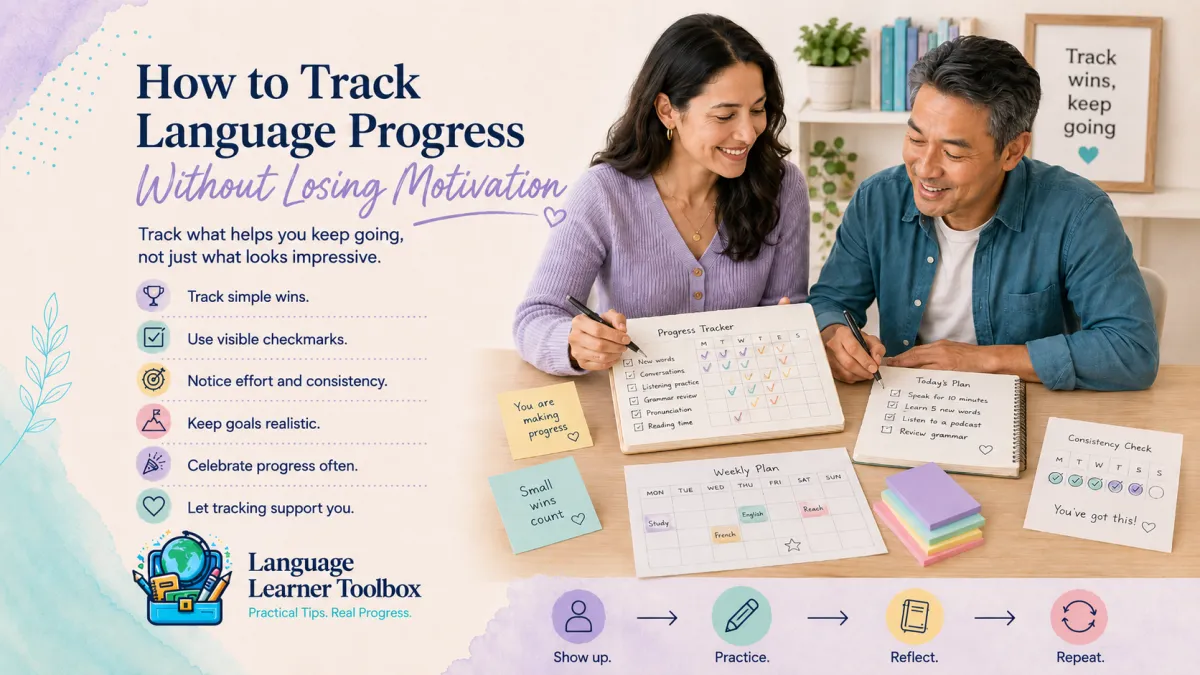
How to Track Language Progress Without Losing Motivation
Track what helps you keep going, not just what looks impressive.
Many language learners want proof that their effort is working.
They look for big signs.
A long conversation.
A higher test score.
A difficult book they can finally understand.
A moment when speaking suddenly feels easy.
Those milestones matter.
But they do not happen every day.
When learners only count large achievements, weeks of real progress can become almost invisible.
They may be listening more often.
Remembering words more quickly.
Speaking with less hesitation.
Returning to practice after busy days.
But because they do not feel fluent yet, they assume they are not improving.
The problem is not always a lack of progress.
Sometimes, it is the way progress is being measured.
A useful tracking system should help you notice growth, make better decisions, and stay encouraged.
It should not become another source of pressure.
1. Track Actions You Can Control
You cannot always control how quickly a language skill develops.
You can control whether you practice.
Start by tracking actions such as:
listened for ten minutes
reviewed vocabulary
answered a speaking question
read one page
wrote three sentences
practiced with a conversation partner
A simple check mark can be enough.
The purpose is not to prove that every session was excellent.
It is to show that you returned.
Over time, those check marks create a visible record of consistency.
That matters because progress is often built before it can be felt.
Tracking practice can help you recognize progress before you feel fluent.
2. Keep the System Simple
A complicated tracker can become harder to maintain than the habit itself.
You do not need:
detailed charts
long daily reports
several tracking apps
perfect records
a score for every activity
Choose something you will actually use.
It might be:
a check mark on a calendar
a small habit tracker
one line in a notebook
a weekly practice list
a colored dot for each study day
You could write:
Monday: listened for ten minutes
Tuesday: reviewed five phrases
Wednesday: practiced speaking
Thursday: read one short article
The best tracking system is not the most detailed one.
It is the one that helps you notice what is happening without creating more work.
3. Notice More Than Time
Minutes are easy to count.
They are not the only sign of progress.
A thirty-minute session is not automatically more useful than ten focused minutes.
Along with time, notice changes such as:
I understood more of the recording.
I remembered a word without looking it up.
I answered more quickly.
I used a phrase I had practiced.
I felt less nervous speaking.
I returned after missing a day.
These observations show how your ability is changing.
You may also begin noticing that more things count as language practice than you think.
A short conversation matters.
Recognizing a phrase matters.
Using one new word matters.
Progress is not only measured by how long you studied.
It is also reflected in what is becoming easier.
4. Compare Yourself With Your Earlier Self
It is easy to compare your language skills with someone who has studied longer.
Or someone who speaks more confidently.
Or someone who seems to learn faster.
Those comparisons rarely show the full story.
A better question is:
What can I do now that was more difficult before?
Look back at:
an old writing sample
a previous vocabulary list
an early voice recording
notes from a past lesson
a conversation topic you once avoided
You may notice that your sentences are longer.
Your ideas are clearer.
Your listening is faster.
You need less time to find familiar words.
The changes may be small.
Small does not mean unimportant.
Language growth usually happens gradually.
A record of earlier work can help you see progress that memory alone may miss.
5. Celebrate Small Wins Without Adding Pressure
A small win is evidence that learning is happening.
It might be:
I understood the main idea.
I practiced three days this week.
I asked a question without rehearsing it first.
I remembered the phrase when I needed it.
I returned after a difficult week.
Take a moment to notice those wins.
Write them down.
Add a star to your tracker.
Tell a friend.
Use a simple note:
This week, I am proud that I __________.
Celebrating progress does not mean pretending everything is easy.
It means giving effort and growth the attention they deserve.
Motivation is easier to protect when you can see that your work is leading somewhere.
6. Use Tracking to Guide Your Next Step
Tracking is most useful when it helps you make decisions.
At the end of the week, look for patterns.
Ask:
What did I practice most?
What kept getting skipped?
What felt easier?
What still needs attention?
What helped me stay consistent?
Maybe you practiced vocabulary often but avoided speaking.
Maybe short listening sessions worked better than long ones.
Maybe evening practice kept getting interrupted.
Those observations can help you decide what to practice each day and adjust your routine before frustration builds.
Tracking is not only a record of the past.
It can help shape a better plan for the future.
A simple weekly language-learning reflection can make that process even more useful.
Your Tracker Should Support You
Tracking should make progress easier to see.
It should not make you feel behind.
Missed a day?
Leave the space blank and return.
Had a short session?
Count it.
Changed your routine?
Update the plan.
A tracker is a tool.
It is not a test.
The goal is not a perfect row of check marks.
The goal is to understand your learning well enough to keep moving forward.
Try This
Choose one simple way to record your practice this week.
Add one sentence about something that felt easier.
At the end of the week, write down one win and one next step.
Remember This
Track actions you can control.
Keep the system simple enough to continue.
Notice progress in confidence, understanding, recall, and consistency, not only time.
Compare yourself with your earlier self.
Use your tracker to encourage better decisions, not to create pressure.
Continue Reading
How to Recognize Progress Before You Feel Fluent
A Simple Weekly Language-Learning Reflection
How to Choose What to Practice Each Day
Ready for Your Next Step?
Join the 21-Day Language Habit Bootcamp for simple daily guidance, or use the Language Learning Habit Stack Workbook to plan, track, and reflect on a routine that works in real life.

