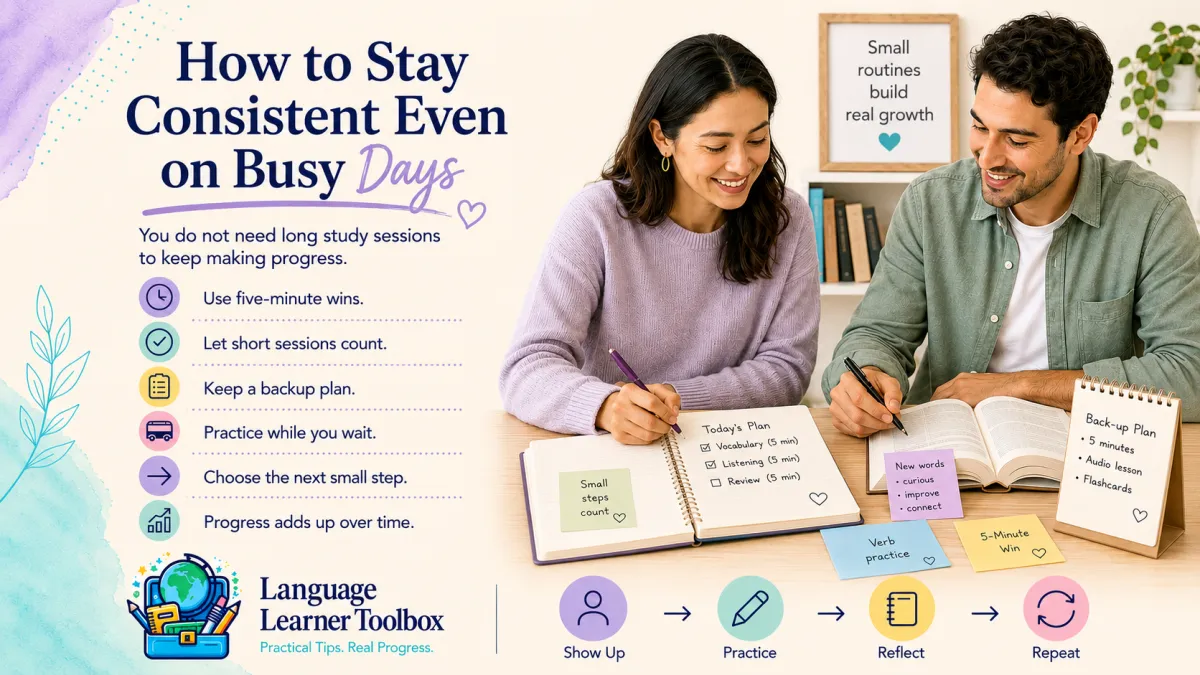
How to Stay Consistent With Language Learning on Busy Days
One of the biggest myths about language learning is that you need long study sessions to make real progress.
You don't.
Most successful language learners aren't the ones with the most free time, they're the ones who keep showing up, even when life gets busy.
Work gets hectic. Family needs your attention. Travel happens. Some days you're simply tired.
If your language learning routine only works on perfect days, it won't last very long.
The learners who eventually become confident speakers usually aren't perfect. They're consistent.
The good news is that consistency doesn't require hours every day. It grows through small, repeatable actions that fit into real life.
Here are seven ways to keep making progress, even on your busiest days.
1. Decide what your "minimum practice" looks like
Busy days are not the time to rely on motivation.
Instead, decide ahead of time what counts as success when life gets full.
Your minimum practice might be:
reviewing three vocabulary words
listening to two minutes of audio
reading one short paragraph
answering one question out loud
practicing one conversation starter
The goal isn't to accomplish everything.
The goal is to keep your language alive today so it feels easier to continue tomorrow.
2. Use the time you already have
Many learners wait for an uninterrupted hour that never comes.
Instead, look for moments that already exist.
Practice during:
breakfast
your commute
a walk
lunch
while waiting for an appointment
the last five minutes before bed
Five minutes may not feel impressive.
But five minutes repeated hundreds of times changes a learner.
3. Keep speaking within reach
If speaking is your goal, make speaking easy to begin.
Keep your practice materials where you'll actually use them.
You might:
save a favorite listening clip
keep conversation questions on your phone
leave your workbook open on your desk
bookmark a speaking activity
record yourself answering one simple question each day
The easier it is to begin, the more likely you'll keep going.
4. Let different days look different
Not every day has to be your best day.
Some days you'll have thirty minutes.
Other days you'll have three.
Both count.
Instead of asking,
"Did I study enough today?"
try asking,
"Did I stay connected to my goal of becoming a confident speaker?"
That question builds momentum instead of guilt.
5. Remember that confidence grows from repetition
Many learners think confidence appears after they've learned enough.
Usually, the opposite is true.
Confidence grows because you've practiced enough.
Every short conversation...
Every sentence you say out loud...
Every listening activity...
Every review...
is another vote for becoming someone who uses the language naturally.
Small efforts repeated often create lasting confidence.
6. Give yourself permission to practice imperfectly
Language learning isn't about performing perfectly.
It's about communicating a little better than yesterday.
Some days your practice will feel smooth.
Some days you'll forget words, hesitate, or make mistakes.
Those days still count.
Progress doesn't come from perfection.
It comes from continuing.
7. Make tomorrow easier than today
One of the smartest things you can do on a busy day is leave yourself an easy starting point for tomorrow.
Before you finish today:
choose tomorrow's listening activity
leave your workbook open
write one conversation question
save the next video you'll watch
A habit becomes easier when tomorrow's first step is already waiting for you.
Small Steps Build Fluent Speakers
Busy days don't erase your progress.
Missing perfection isn't the same as losing momentum.
The learners who eventually become confident speakers aren't usually the ones who studied the hardest on one Saturday.
They're the ones who found ways to keep going on ordinary Tuesdays.
A few minutes still count.
One conversation still counts.
One sentence spoken out loud still counts.
Keep showing up.
Your future confidence is built one small practice session at a time.
Ready for your next step?
If you'd like help building a language learning routine that fits real life, join the 21-Day Language Habit Bootcamp for practical daily encouragement and simple actions you can actually stick with.
And when you're ready to build speaking confidence through structured conversation practice, explore the resources available at Language Learner Toolbox.

