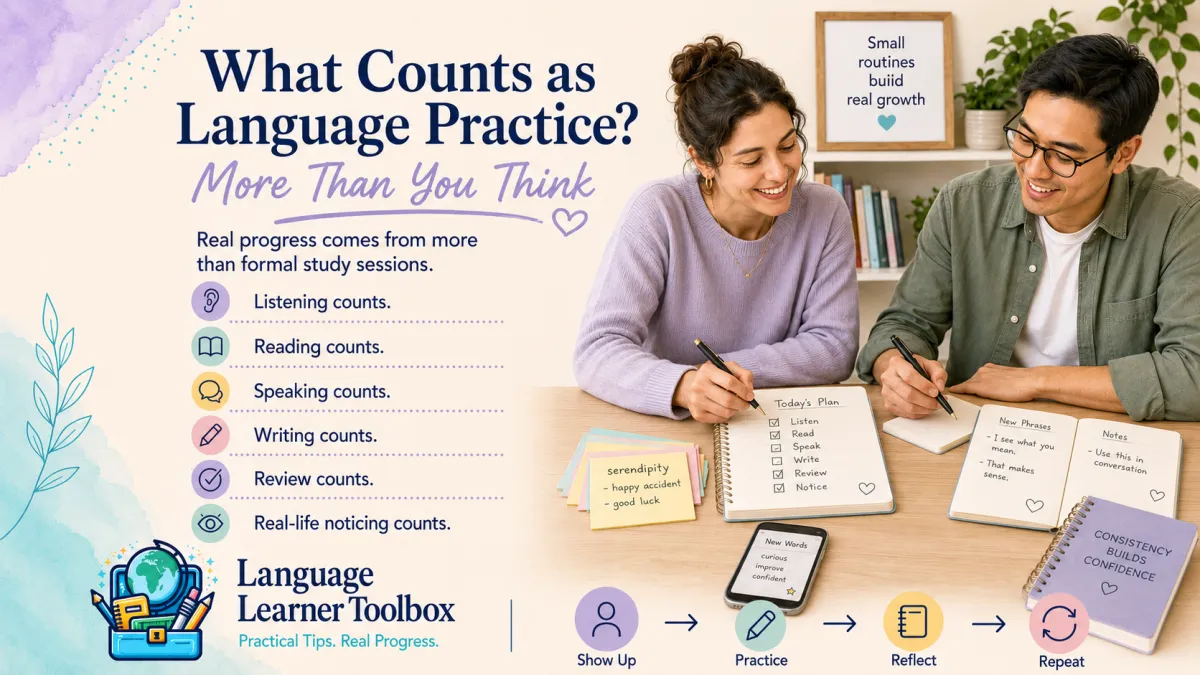
What Counts as Language Practice? More Than You Think
Real progress comes from more than formal study sessions.
Many language learners assume practice only counts if it looks serious.
A full lesson.
A grammar workbook.
An hour at a desk.
A long vocabulary list.
Those things have value.
But if that is the only kind of practice you count, it is easy to feel like you are falling behind.
The truth is that language learning happens in many small moments throughout the day.
You listen.
You read.
You notice a familiar word.
You try to remember a phrase.
You say something aloud.
You write a short message.
Those moments may not feel like formal study, but they are helping you become more familiar with the language and more prepared to use it.
Once you begin recognizing them, language learning feels less overwhelming and much easier to continue.
1. Listening Is Real Practice
Every time you listen to your target language, your brain is learning.
You become more familiar with:
pronunciation
rhythm
sentence patterns
common expressions
the way words connect in natural speech
You do not have to understand every word.
Listening while driving, walking, exercising, or preparing dinner still gives your brain useful experience with the language.
Try listening for something specific.
Can you hear a familiar word?
Can you recognize the topic?
Can you notice how a phrase is pronounced?
The goal is not perfect understanding.
The goal is becoming more comfortable hearing the language.
A few minutes of listening can be especially helpful when you are learning how to stay consistent even on busy days.
2. Reading Builds Familiarity
Reading practice does not have to mean finishing a chapter in a textbook.
It might be:
a short article
a restaurant menu
captions on social media
a simple news headline
a familiar story
instructions on a website
Each reading experience helps you recognize vocabulary more quickly and notice how words are used together.
You may understand only part of what you read.
That is okay.
Look for what you know before focusing on what you do not know.
Recognizing one phrase today may help you understand a full sentence later.
Small reading experiences prepare you to understand and eventually use the language yourself.
3. Speaking to Yourself Still Counts
Many learners believe speaking practice only happens during a conversation.
But speaking begins before another person enters the room.
You can practice by:
saying a useful phrase aloud
introducing yourself
describing what you see
reading a paragraph aloud
answering a simple question
talking through part of your day
These moments give you time to find words without the pressure of responding quickly.
They also help your mouth, ears, and brain become more comfortable working together.
You might say:
I am making dinner.
Today was busy, but I finished my work.
This weekend, I want to visit my family.
The sentences do not need to be complicated.
The goal is to practice turning thoughts into language.
That preparation can make real conversations feel more familiar when the opportunity comes.
4. Writing Helps You Use What You Know
Writing does not have to mean completing a long assignment.
One sentence counts.
A short message counts.
A grocery list counts.
You might write:
one sentence about your day
three new words in sentences
a reply to a conversation question
a short text to a friend
a simple plan for tomorrow
Writing gives you a little more time to choose words and organize your ideas.
It can also show you what you already know and where you still need help.
If you are unsure what to practice each day, a short writing activity can reveal useful next steps.
Maybe you need a word you cannot remember.
Maybe you notice the same grammar question more than once.
Maybe you realize you can express much more than you expected.
Writing makes learning visible.
5. Review Is Not Starting Over
Review may feel less exciting than learning something new.
But review is where familiarity becomes confidence.
Each time you return to old vocabulary, reread your notes, or practice a familiar phrase, you strengthen your ability to remember it when you need it.
Review might include:
looking through vocabulary cards
rereading a previous lesson
listening to the same short recording
practicing a phrase again
returning to an old conversation question
Fluent speakers do not only keep learning new language.
They become faster and more comfortable using language they already know.
Review is not proof that you failed to remember.
It is part of how remembering develops.
6. Real-Life Noticing Counts
Language practice does not always require a notebook.
Sometimes practice begins with paying attention.
You may notice:
a familiar word in a song
a phrase on a sign
a sentence you understand in a video
a word you recognize in a conversation
a new way to express an idea
You might also think in your target language.
Name objects around you.
Plan what you would say in a conversation.
Remember a useful phrase while shopping.
Ask yourself how you would describe what you are doing.
These quiet moments help the language become part of everyday thinking.
They also make progress easier to see.
You may understand more than you did a month ago.
You may recognize words more quickly.
You may find that a sentence comes to mind without translating every word.
Learning how to recognize progress before you feel fluent can help you notice growth that might otherwise be overlooked.
Practice Happens in More Places Than You Think
Language learning is not about collecting study hours.
It is about becoming more able to understand and communicate.
Some days, you may study for an hour.
Other days, you may listen for five minutes, read a short paragraph, or say one sentence aloud.
Both kinds of practice have value.
One sentence counts.
One conversation counts.
One podcast counts.
One page counts.
The goal is not to make every practice session look impressive.
The goal is to stay connected to the language and keep using what you are learning.
Try This
Notice three ways you already interact with your target language.
Add one small form of practice you usually overlook.
Count the practice instead of dismissing it because it was short.
Remember This
Language practice does not have to look like formal study.
Listening, reading, speaking, writing, reviewing, and noticing all support growth.
Short practice still matters.
The goal is to become more comfortable understanding and using the language.
Continue Reading
How to Stay Consistent Even on Busy Days
How to Choose What to Practice Each Day
How to Recognize Progress Before You Feel Fluent
Ready for Your Next Step?
Join the 21-Day Language Habit Bootcamp for simple daily support.
When you are ready to turn everyday practice into more confident conversations,The Language Learner’s Workbook: A Guide for Conversation Practice provides structured topics and activities you can use with a conversation partner.

